Your hotel cybersecurity score is quickly becoming one of the most important trust signals in the hospitality industry. Many hotel owners in Des Moines believe that their size or local brand makes them an unlikely target for sophisticated cybercriminals. This assumption is where business owners get it wrong. The reality is that the hospitality industry is currently facing a surge in attacks that target the very foundation of guest trust. In a world where your property is often judged by its digital convenience as much as its physical comfort, a single data breach can erase years of reputation building in hours.
The Reality of Hospitality Risk in the World Cup Era
The 2026 World Cup has brought an unprecedented wave of international and domestic travelers to the Midwest. While Kansas City serves as a primary host city, Des Moines has become a vital hub for overflow bookings, team base camps, and regional fan festivals. This surge in occupancy is a win for revenue but it also places a massive target on your property management systems.
Cybercriminals follow the money and the data. When your occupancy rates hit 100 percent, your staff is stretched thin and your systems are processing thousands of credit cards and personal identifiers every day. This high volume creates the perfect environment for attackers to slip through the cracks. Most hospitality leaders view cybersecurity as a background IT issue, but it is actually a core operational risk that requires executive oversight.
The 82 Percent Problem: Why Hotels are Targets
Recent data from 2026 indicates that 82 percent of surveyed hotels reported at least one successful cyber breach within the last 12 months. Perhaps more concerning is that 44 percent of those properties experienced more than 12 hours of total system downtime. In the hospitality world, 12 hours of downtime means no check-ins, no room keys, no billing, and a lobby full of frustrated guests.
Hotels are targeted because they sit on a goldmine of Personal Identifiable Information (PII). A typical guest profile contains a name, home address, phone number, email, and credit card details. For a sophisticated attacker, this is a complete identity theft kit. Unlike a retail store where a transaction is a one-time event, a hotel stay creates a long-term data trail that is highly valuable on the dark web.
Why Guest Wi-Fi and Legacy PMS are Open Doors
The two most common entry points for these attacks in Des Moines hotels are guest Wi-Fi networks and legacy Property Management Systems (PMS). Many properties still operate on “flat” networks where the Wi-Fi used by a guest in room 402 is not properly isolated from the back-office network that handles payroll and guest reservations.
Legacy PMS platforms are another significant vulnerability. Many of these systems were built decades ago and have been patched together with modern cloud integrations. These integrations often lack the robust security protocols required in 2026. If your PMS is not being monitored by a professional managed IT services partner, it is likely that you have unpatched vulnerabilities that an automated bot can find in seconds.
How a Hotel Cybersecurity Score Shifts the Narrative
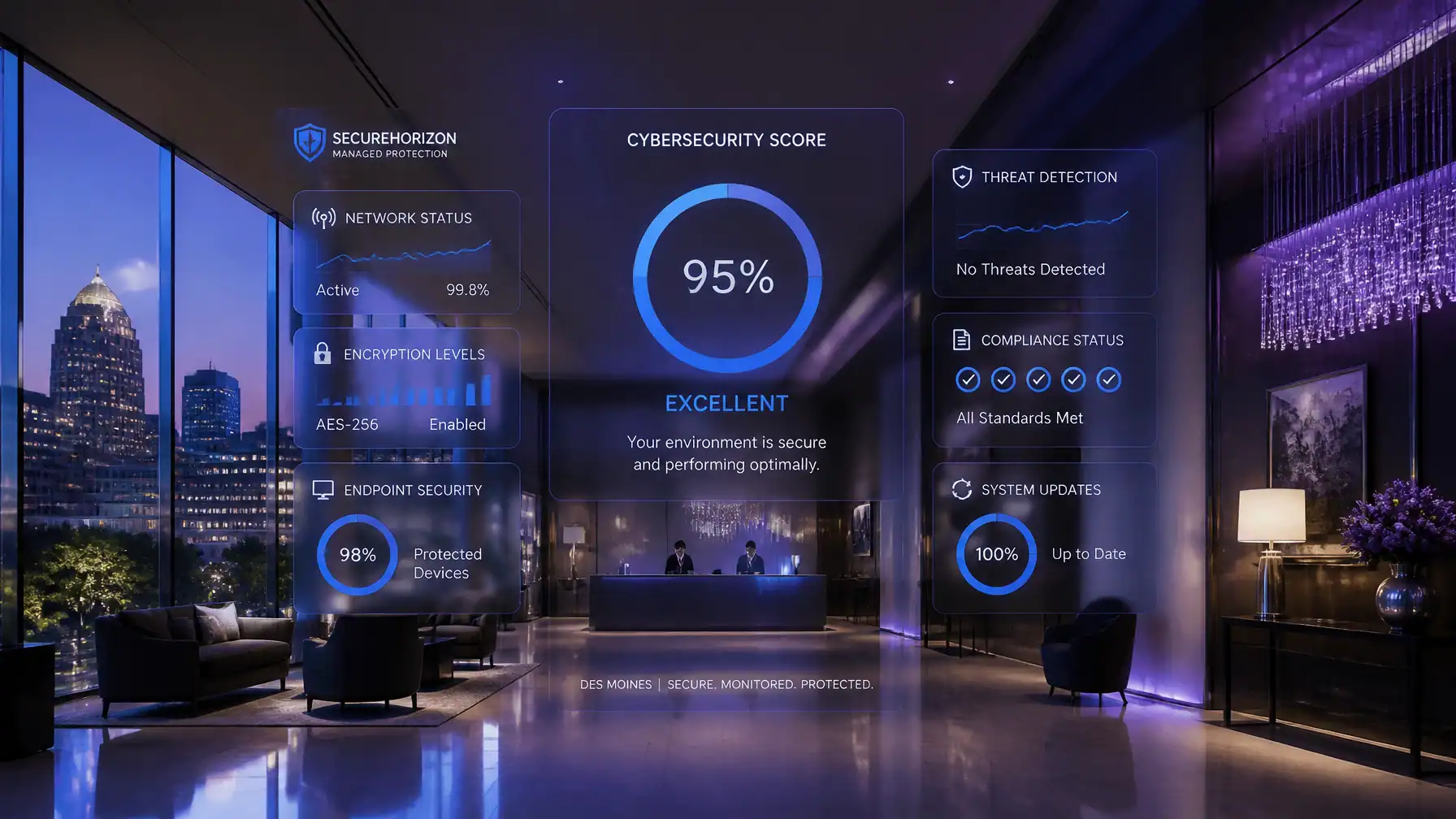
For a hotel owner or General Manager, the technical details of a firewall or an endpoint detection system are less important than the overall health of the business. This is why we use a “Cybersecurity Score.” This score translates complex technical data into a single, understandable metric that reflects your property’s risk level.
A high Cybersecurity Score tells you that your guest data is encrypted, your employees are trained to spot phishing, and your network is segmented to prevent a guest’s laptop from “talking” to your server. It provides visibility and control without requiring you to become a technology expert. It allows you to move from a reactive posture (waiting for something to break) to a proactive governance model.
Quantifying Your Risk Profile
Understanding your risk profile is the first step toward securing your property. Most leaders in the Des Moines hospitality sector are surprised to find out how many third-party vendors have access to their systems. From the elevator maintenance company to the laundry service and the online travel agencies, every connection is a potential doorway for an attacker.
We often see “credential abuse” as a primary attack vector. If a staff member uses the same password for their personal social media as they do for the hotel’s reservation system, an attacker who breaches the social media site now has the keys to your entire guest list. This is why governance and strict access controls are no longer optional.
Practical Guidance for Des Moines Hotel Owners
Managing a hotel is a complex task and cybersecurity should not add to your “tech headaches.” Instead, it should be treated as a standard operating consideration, much like fire safety or health inspections.
Leaders should consider the following steps to protect their properties:
- Request a comprehensive cybersecurity assessment to establish your current Cybersecurity Score.
- Ensure that your guest Wi-Fi is physically and logically segmented from your corporate and PMS networks.
- Audit all third-party vendor access and implement “least privilege” protocols, ensuring vendors only see what they absolutely need.
- Replace or wrap legacy PMS systems with modern security layers that include multi-factor authentication (MFA).
- Implement mandatory, ongoing security awareness training for all front-desk and back-office staff to prevent credential theft.
- Establish a formal incident response plan so that your team knows exactly what to do if a breach is detected, minimizing downtime.
By following these steps, hotel owners can expect tangible outcomes:
- Reduced risk of reputation-damaging data breaches.
- Improved visibility into network health and vendor access.
- Clearer accountability for IT and security tasks.
- Faster recovery times in the event of an attempted attack.
- Enhanced compliance with cyber insurance requirements.
Position Your Property as a Trusted Destination
In the competitive Des Moines market, trust is a differentiator. Guests are becoming more aware of digital risks and they prefer to stay at properties that take their privacy seriously. Working with a partner like CMIT Solutions allows you to focus on guest experience while we handle the invisible digital shield that keeps your operations running.
We provide the oversight and governance that small and mid-sized hotel groups often lack. By acting as your virtual Chief Information Security Officer (vCISO), we ensure that your technology accelerates your business without increasing your exposure. This is especially critical as we navigate the final weeks of the World Cup season and look toward the future of Iowa’s hospitality industry.
Addressing these risks before they become urgent is the mark of a well-run organization. If you want to understand your property’s Cybersecurity Score and identify where your gaps might be, let’s start a conversation.
Contact Edgar Ortiz:
CEO, CMIT Solutions of Des Moines and Overland Park
Email: eortiz@cmitsolutions.com