

Most business owners in Iowa think that "compliance" is a project with a start and an end date. They believe that once they have a binder on the shelf labeled "FTC Safeguards Rule," the risk is managed. This is where leaders in the automotive and lending industries get it wrong. In 2026, compliance is no longer a static snapshot; it is a high-stakes, continuous operational requirement.
If you are a motor vehicle dealer or a non-bank lender in Des Moines or Overland Park, the "check-the-box" mentality is currently your greatest liability. The Federal Trade Commission (FTC) has shifted its focus from setting rules to enforcing them, and the financial consequences for negligence have never been more precise: or more expensive.
The Reality of Regulatory Enforcement in 2026
The misconception that the FTC Safeguards Rule is only for "big banks" has led many local dealerships and independent lenders into a trap. Under the Gramm-Leach-Bliley Act (GLBA), any institution "significantly engaged" in financial activities: including those that arrange financing or lease vehicles: is a financial institution.
In Iowa, where many dealerships operate with lean administrative teams, the burden of these requirements often falls on a controller or an office manager who is already overstretched. By the time an audit occurs or a breach is detected, the gap between what the law requires and what the business is actually doing has become a chasm.
The Financial and Operational Risk of Non-Compliance
The risk of ignoring these safeguards is not a vague possibility of a "fine." It is a daily, compounding financial threat. In 2026, the FTC civil penalties have reached $50,120 per violation per day. For a dealership in Des Moines, a single incident involving 500 or more consumers now triggers a mandatory 30-day notification window.
-
Mandatory Reporting Timelines
The 2024 amendment to the Safeguards Rule removed the "risk-of-harm" analysis. If unencrypted data of 500 or more consumers is acquired without authorization, you must report it to the FTC within 30 days. There is no longer a debate about whether the data was "sensitive" enough to matter; the mere unauthorized acquisition triggers the clock. -
The 50k Daily Penalty
Regulatory fines are no longer calculated based on the size of the business. They are based on the nature of the violation. If your MFA (Multi-Factor Authentication) was not implemented properly across all systems, every day that system was active counts as a violation. -
Reputational Erasure
For local businesses in Overland Park and Des Moines, trust is the primary currency. A public listing on the FTC’s breach database is a permanent stain on a dealership's reputation, making it significantly harder to secure floor plan financing or maintain customer loyalty.

Modern Threats: Why 2023 Solutions Fail in 2026
The threats facing Iowa lenders have evolved far faster than most security programs. In 2026, attackers are using AI-automated tools to scan for "low-hanging fruit" in local business networks.
-
Credential Abuse and Brute-Force Attacks
AI-enabled tools can now cycle through millions of stolen credentials in seconds. If your dealership relies on simple passwords or outdated VPNs without robust MFA, you are essentially leaving the keys in the ignition of every car on the lot. -
Vendor and Third-Party Risk
Most Iowa dealerships rely on a web of third-party platforms for CRM, DMS, and financing. The FTC Safeguards Rule explicitly holds the business owner accountable for the security practices of these vendors. If your IT vendor is not performing regular audits of these connections, you are flying blind. -
Unencrypted Data in Transit
With the increase in remote work and mobile sales tools, customer data is often transmitted over unsecured networks. The 2024 rule focus on "unencrypted information" means that even a minor leak of unencrypted emails could trigger a massive reporting event.
Practical Guidance for Business Leadership
To move from "checking the box" to active governance, leadership must move beyond technical tasks and focus on oversight. The following steps represent the baseline for compliance in the current environment.
-
Appoint a Qualified Individual (QI)
The rule requires a single person to be responsible for the program. This person must provide a written report at least annually to the board or senior management. If your QI is a staff member with no technical background, they lack the "qualified" status required by the FTC. -
Execute a Written Risk Assessment
This is not a one-page memo. It must be a documented evaluation of internal and external risks to customer information. It must outline how those risks will be mitigated and how the effectiveness of the safeguards will be measured. -
Implement Multi-Factor Authentication (MFA)
MFA must be implemented for anyone accessing any system that contains customer information. In 2026, the FTC considers "password only" access to be a willful violation of the rule. -
Continuous Monitoring and Vulnerability Scanning
The rule requires regular testing. This means penetration testing at least once a year and vulnerability scans at least every six months. In a high-risk environment, automated, continuous monitoring is the only way to catch threats before they become breach notifications. -
Formalize Vendor Oversight
Review your contracts with your DMS and IT providers. You must have reasonable evidence that they are maintaining safeguards that are at least as stringent as your own. -
Develop a 30-Day Incident Response Plan
Your plan must include specific procedures for detecting, investigating, and reporting "notification events" to the FTC. If your team does not know how to file an FTC web form report within 30 days, your incident response plan is incomplete.
Why Businesses Partner with CMIT Solutions
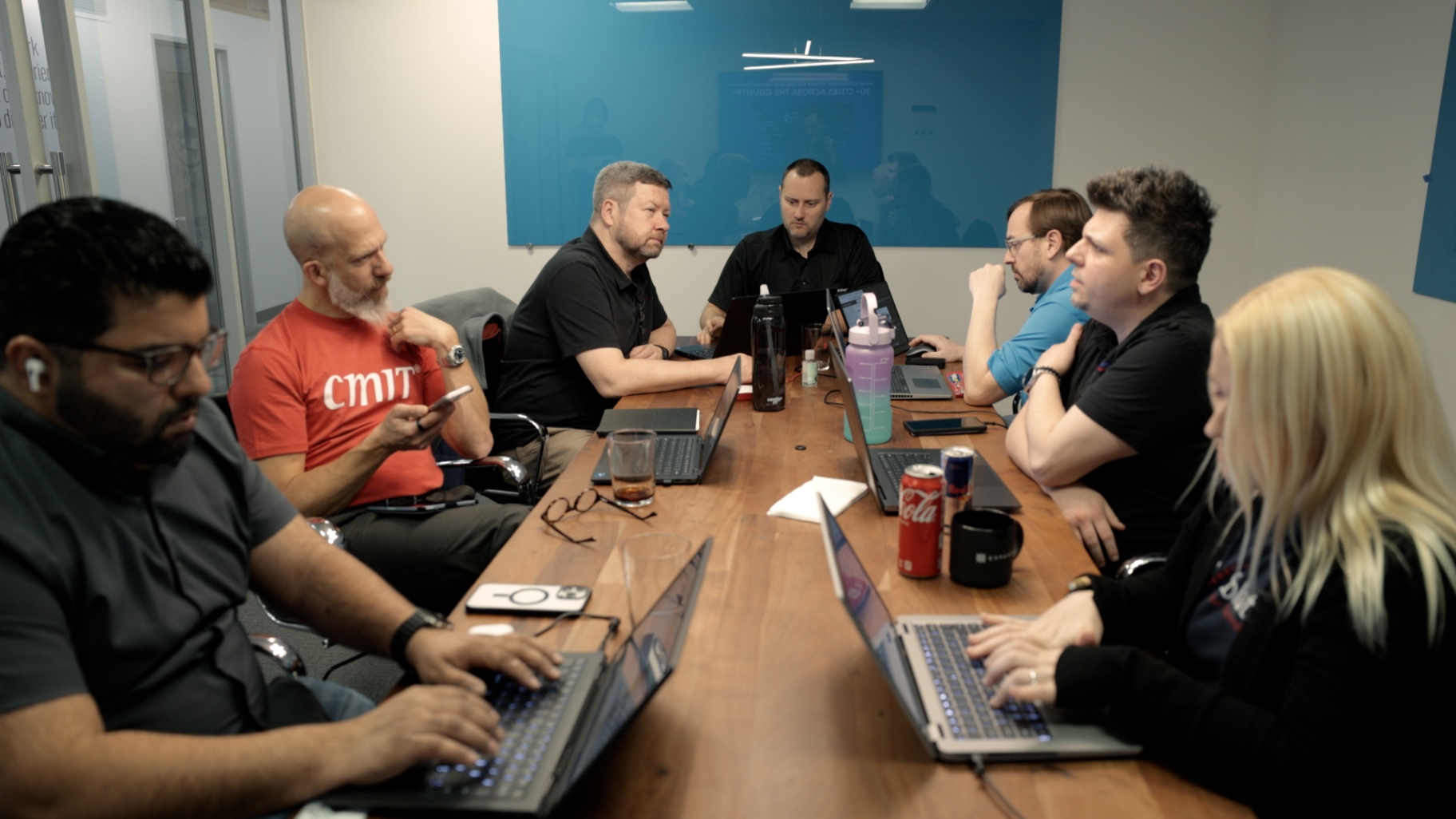
Compliance is not an IT problem; it is a governance problem. This is why businesses in Des Moines and Overland Park work with partners like CMIT Solutions. We do not just provide "support"; we provide the oversight framework that the FTC demands.
A vCISO in Des Moines (Virtual Chief Information Security Officer) provides the expert leadership required to serve as your "Qualified Individual." This role bridges the gap between technical implementation and executive responsibility. We help leadership teams understand their risk posture without getting lost in the technical weeds.
By implementing automated monitoring and structured governance, we turn compliance from a liability into a standard operating procedure. This allows leadership to focus on growth while we ensure the guardrails are in place.

Measurable Outcomes of Active Governance
When a business moves away from "checking the box" and toward active oversight, the results are tangible:
- Reduced Manual Effort: Automated monitoring replaces manual audits, freeing up internal staff.
- Improved Visibility: Real-time dashboards show exactly where your data is and who is accessing it.
- Faster Detection: Threats are identified in minutes, not months, preventing small incidents from becoming 500-person breaches.
- Fewer Unknowns: Regular pen testing and vulnerability scanning eliminate the blind spots that regulators target.
- Clear Accountability: The vCISO provides the necessary reporting to ensure ownership and compliance are documented and defensible.
The Next Generation of Security
The 2026 landscape does not reward those who wait. The cost of a breach is high, but the cost of non-compliance: even without a breach: is becoming even higher. Whether you are managing a construction fleet's financing or a high-volume automotive dealership, the requirements are the same: you must secure the data, and you must prove that you are doing so.

If you want to understand how the FTC Safeguards Rule applies to your specific operation in Iowa or Kansas, the time to address it is before an event occurs. This is worth a conversation to ensure your business is not just compliant on paper, but secure in practice.
Contact Edgar Ortiz, CEO of CMIT Solutions of Des Moines and Overland Park, to discuss your risk management and vCISO requirements.
Meta Description: Explore the 2026 risks of the FTC Safeguards Rule for Iowa dealerships and lenders. Learn why vCISO oversight in Des Moines is essential for compliance.
URL Slug: ftc-safeguards-rule-iowa-dealership-lender-compliance-2026
{“@type”:”BlogPosting”,”image”:”https://cdn.marblism.com/45a9UEEH05F.webp”,”author”:{“name”:”Edgar Ortiz”,”@type”:”Person”,”jobTitle”:”CEO”,”affiliation”:{“name”:”CMIT Solutions of Des Moines and Overland Park”,”@type”:”Organization”}},”@context”:”https://schema.org”,”headline”:”The FTC Safeguards Trap: Why Iowa Lenders and Dealerships Are Still Flying Blind in 2026″,”keywords”:[“FTC Safeguards Rule Iowa”,”vCISO Des Moines”,”Dealership Cybersecurity”,”Lender Compliance GLBA”],”publisher”:{“logo”:{“url”:”https://cdn.marblism.com/6iqmTLCK9xJ.png”,”@type”:”ImageObject”},”name”:”CMIT Solutions of Des Moines and Overland Park”,”@type”:”Organization”},”description”:”An authoritative guide for Iowa dealerships and lenders on navigating the 2026 FTC Safeguards Rule requirements, avoiding daily penalties, and implementing vCISO oversight.”,”datePublished”:”2026-06-05″,”articleSection”:”Cybersecurity and Compliance”}