The $920 Mistake That Cost $140 Million
How One Employee’s Credentials Became the Gateway to Brazil’s Largest Digital Banking Heist

In July 2025, the financial world witnessed one of the most devastating insider threat incidents in banking history. What started with a simple conversation outside a bar in São Paulo ended with $140 million stolen from six major financial institutions, all because one employee sold his corporate credentials for $920.
For Las Vegas businesses—particularly those in hospitality, gaming, legal, and financial services—this case study serves as a stark reminder: your employees hold the keys to your kingdom, and cybercriminals know it.
($920 bribe → $140 million stolen)
The Anatomy of a $140 Million Insider Threat
João Nazareno Roque, a 48-year-old junior back-end developer at C&M Software, had recently transitioned into his role at the company. C&M Software provides critical financial connectivity solutions, bridging financial institutions to Brazil’s Central Bank infrastructure through payment systems like Pix.
Roque’s credentials weren’t just passwords to a single application—they were master keys to a system that processed interbank settlements worth hundreds of millions of dollars.
Timeline of the Breach
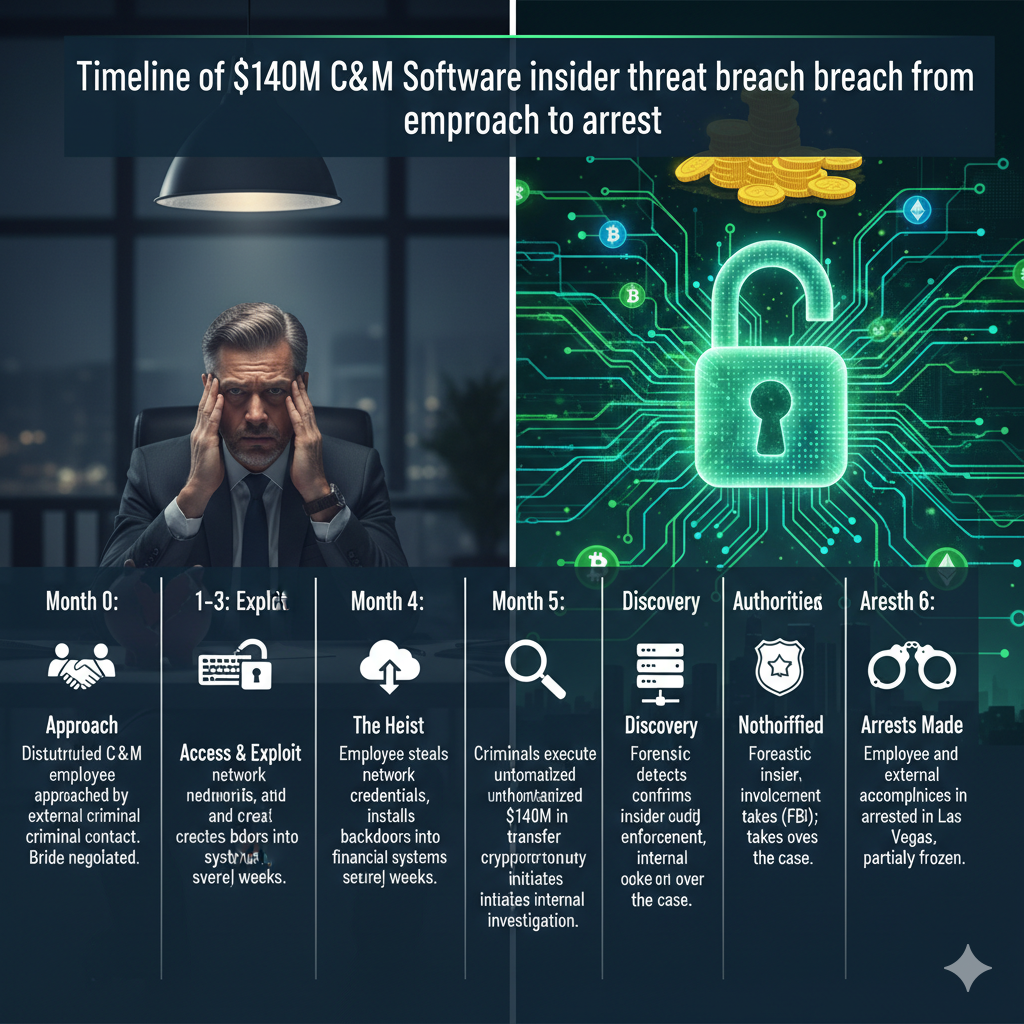
Threat actors approached Roque as he was leaving a bar in São Paulo. They identified him as a C&M Software employee with system access and made their proposition.
Roque sold his corporate login credentials for approximately 5,000 Brazilian reais ($920 USD), granting hackers access to C&M’s confidential systems connected to Brazil’s Central Bank.
Using the Notion collaboration platform, hackers instructed Roque to execute specific commands within C&M systems. He received an additional 10,000 reais ($1,850) for this work—bringing his total compensation to $2,770.
With authenticated access, threat actors executed unauthorized transfers from the reserve accounts of six financial institutions to shell companies. The entire operation occurred within hours.
C&M Software publicly confirmed the breach and reported that operations had resumed with Central Bank authorization. The full scope of the $140 million theft became clear.
São Paulo’s Cybercrime Police Division arrested Roque in the City Jaraguá neighborhood. Despite changing mobile phones every 15 days to avoid detection, investigators traced his activities.
The Digital Trail: How $140 Million Vanished
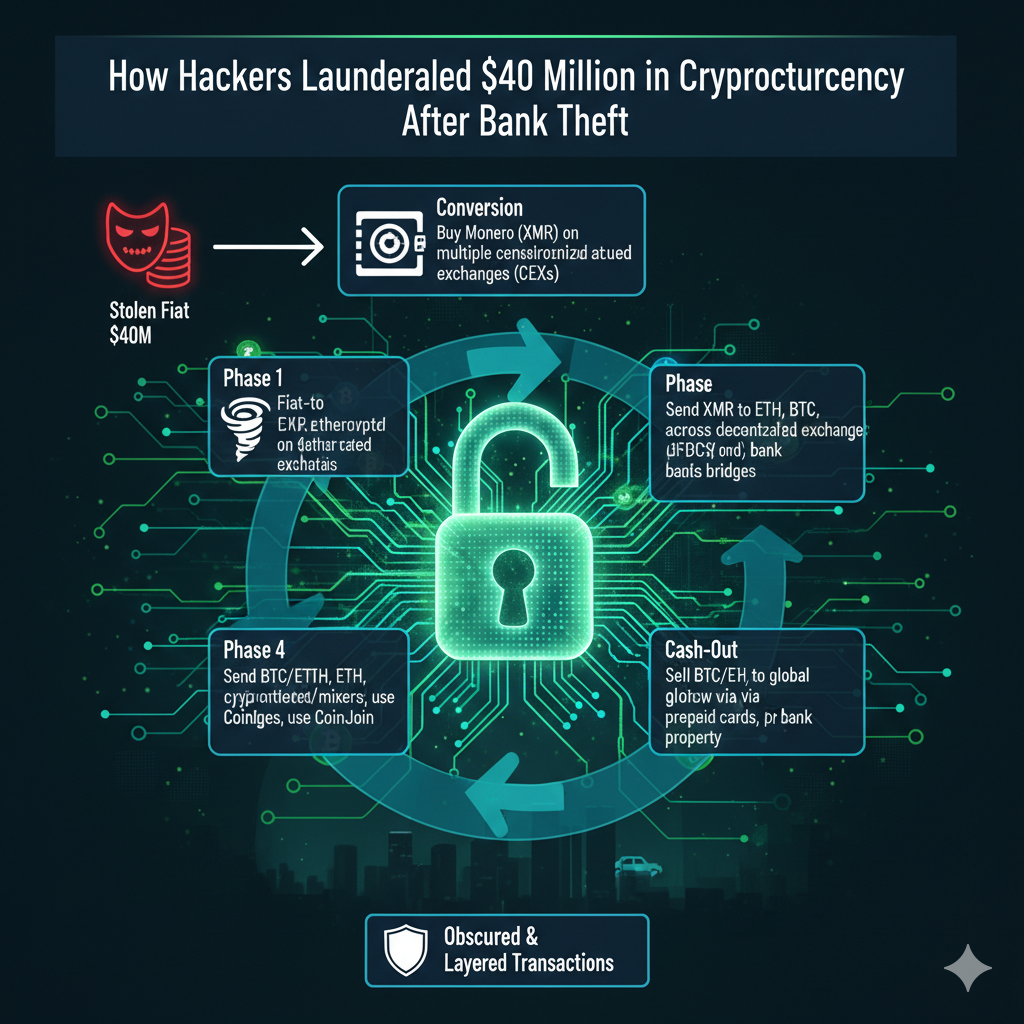
Once the funds were stolen, the criminals didn’t simply transfer money to offshore accounts. They leveraged cryptocurrency’s speed and pseudo-anonymity to launder the proceeds:
Blockchain investigator ZachXBT reported that between $30-40 million of the stolen funds were immediately converted into Bitcoin (BTC), Ethereum (ETH), and Tether (USDT). The conversion happened through over-the-counter (OTC) exchanges and regional crypto platforms across Brazil, Argentina, and Paraguay.
This multi-jurisdictional laundering approach complicated asset recovery efforts. As of January 2026, Brazilian authorities have frozen approximately $50 million, but a significant portion remains at large in the global cryptocurrency ecosystem.
🔍 The Insider Threat Reality for Las Vegas Businesses
Casino & Hospitality: Your gaming systems, payment processors, and customer databases are managed by employees with privileged access.
Legal Firms: Paralegals and IT staff have access to case management systems containing sensitive client information worth millions.
Financial Services: Junior analysts and operations staff often have broader system access than organizations realize.
Healthcare Providers: Medical records administrators can access patient data across your entire organization.
Why Traditional Security Measures Failed
C&M Software wasn’t operating without security protocols. Kamal Zogheib, the company’s commercial director, confirmed that the breach stemmed from misused credentials, not a software vulnerability or system flaw. In other words, their perimeter security was intact—the threat came from within.
This incident highlights a fundamental truth about modern cybersecurity: You can secure every system, patch every vulnerability, and deploy enterprise-grade firewalls, but for $2,770, a trusted employee can bypass it all.
What Went Wrong?
1. Insufficient Access Controls
A junior back-end developer had access to systems controlling hundreds of millions in financial transfers. The principle of least privilege wasn’t properly implemented.
2. Lack of Behavioral Monitoring
While Roque attempted to hide his tracks by changing phones every 15 days, there was apparently no real-time monitoring of unusual system behaviors or after-hours access patterns.
3. Missing Multi-Factor Authentication Layers
Credentials alone shouldn’t grant access to systems managing $140 million in transactions. Additional verification layers—biometrics, hardware tokens, geolocation verification—were absent or insufficient.
4. No Insider Threat Program
Organizations need mechanisms to identify employees under financial stress, those approached by external parties, or those exhibiting suspicious behaviors outside work.
“This highlights how you can have mature systems, defense in depth, and proper controls, but for $2,770, a key IT person leaving a bar can be lured into betraying his job.”
Critical Lessons for Nevada Businesses
The C&M Software breach offers invaluable lessons for organizations of all sizes, particularly those operating in Las Vegas’s unique business ecosystem where hospitality, gaming, legal services, and financial operations intersect.
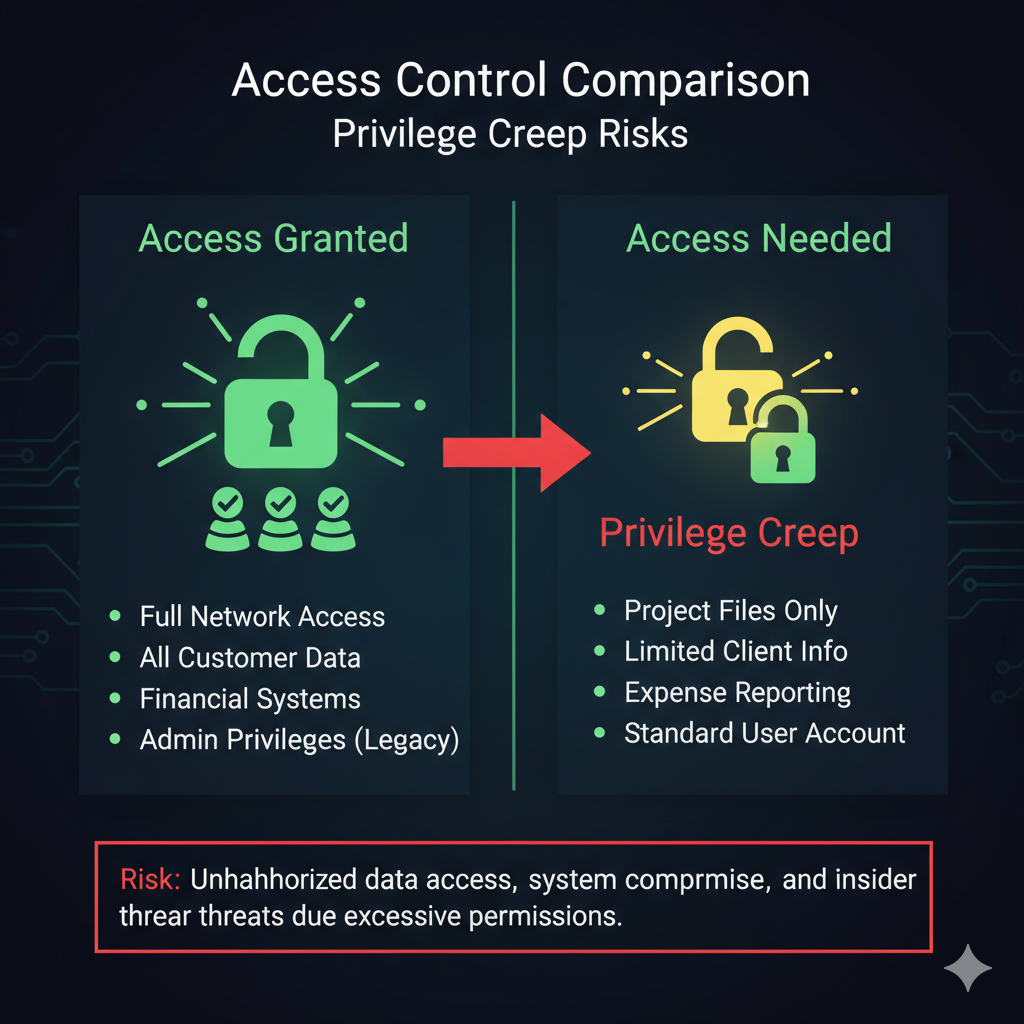
Lesson 1: Privilege Creep is Your Silent Enemy
Roque had “recently transitioned into a junior back-end development role” at C&M. This suggests his access permissions may have accumulated over time as he moved between positions, or he was granted excessive privileges inappropriate for his new role.
For Las Vegas businesses: When employees change roles, their old permissions often remain active. A former accounting clerk promoted to marketing may still have financial system access. An IT technician who moved to project management might retain administrative privileges. Regular access audits aren’t optional—they’re essential.
Lesson 2: Social Engineering Begins Outside Your Office
The threat actors didn’t hack C&M’s systems—they approached an employee at a bar. This demonstrates that social engineering attacks increasingly happen in the physical world, not just through phishing emails.
For Las Vegas businesses: Your employees are targets everywhere—at bars on Fremont Street, during conventions, in casino lounges, at industry networking events. Cybercriminals research your organization on LinkedIn, identify employees with system access, and create opportunities for “chance encounters.”
Lesson 3: The $920 Price Point Reveals Vulnerability
Roque didn’t demand millions for his betrayal. He accepted $920 for credentials and $1,850 for executing commands—a total of $2,770. This suggests either financial desperation or a lack of understanding of the value he was providing.
For Las Vegas businesses: Employees facing financial hardship, gambling debts, or unexpected medical expenses are particularly vulnerable to social engineering. Your IT staff, payroll administrators, and operations personnel should be compensated fairly and have access to employee assistance programs.
Lesson 4: Cryptocurrency Enables Rapid, International Laundering
Within hours of the theft, $30-40 million had been converted to cryptocurrency and dispersed across multiple jurisdictions. Traditional banking systems have controls that slow down large transfers—cryptocurrency does not.
For Las Vegas businesses: If your organization handles large financial transactions, cryptocurrency monitoring should be part of your fraud detection strategy. Suspicious activity involving crypto exchanges or OTC platforms should trigger immediate investigation.
Immediate Actions for Las Vegas Organizations
- Conduct an Access Audit: Review every employee’s system permissions. Remove access that isn’t required for current job functions. Implement automated access reviews quarterly.
- Implement Mandatory Multi-Factor Authentication: Credentials alone should never grant access to sensitive systems. Use hardware tokens, biometrics, or time-based one-time passwords (TOTP) for privileged accounts.
- Deploy User and Entity Behavior Analytics (UEBA): Monitor for unusual access patterns, after-hours logins, large data transfers, and changes to security settings. Anomalies should trigger automatic alerts.
- Create an Insider Threat Program: Train managers to recognize warning signs of employee vulnerability or suspicious behavior. Establish confidential reporting mechanisms.
- Enforce the Principle of Least Privilege: Employees should have the minimum access required to perform their jobs. Elevated privileges should be temporary and logged.
- Regular Security Awareness Training: Employees need to understand they’re targets both online and offline. Training should cover recognizing social engineering approaches in bars, restaurants, and social settings.
- Implement Privileged Access Management (PAM): Critical systems should require approval workflows, session recording, and just-in-time access provisioning for administrative tasks.
- Monitor Cryptocurrency Transactions: If your business processes large payments, implement monitoring for cryptocurrency conversion attempts or unusual blockchain-related activity.
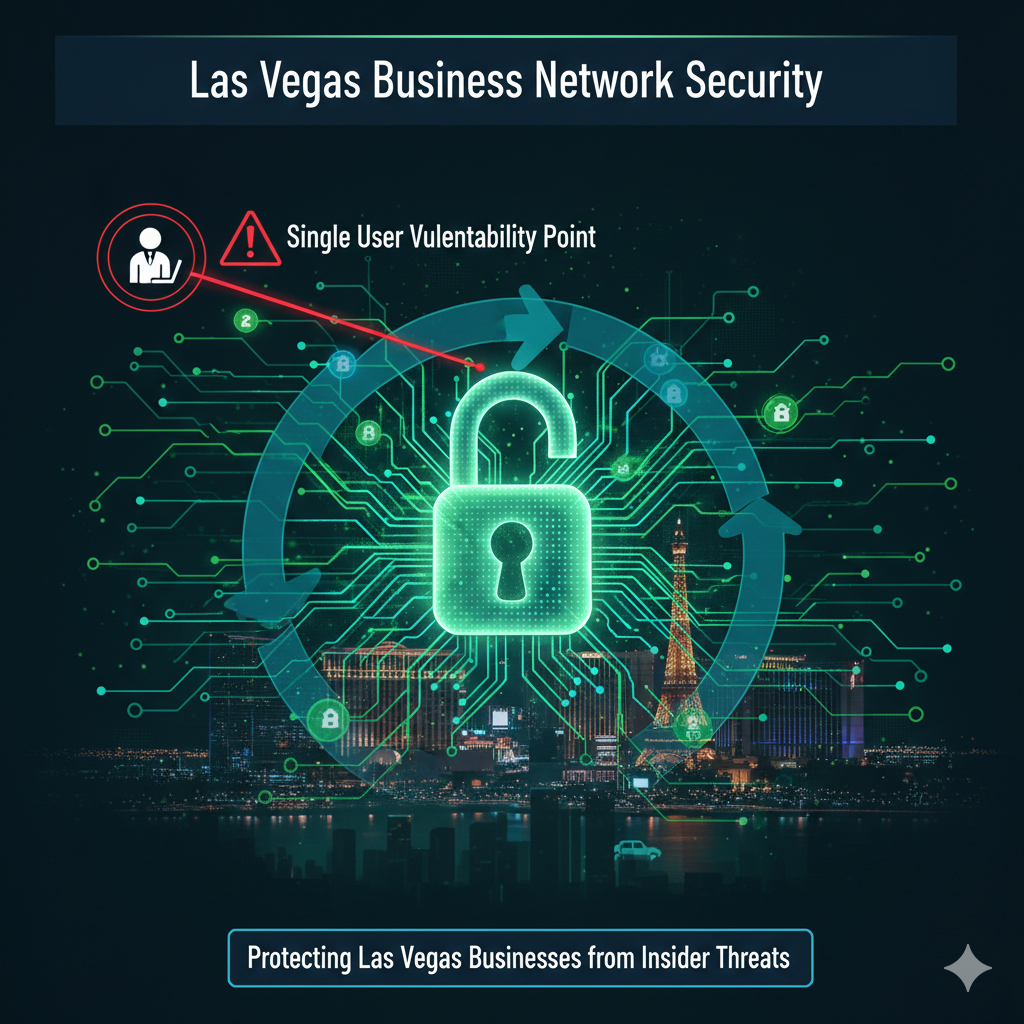
Industry-Specific Vulnerability Assessment
Different Las Vegas industries face unique credential theft risks. Understanding your sector’s specific vulnerabilities is the first step toward protection.
Casino & Hospitality
Property Management Systems, gaming platforms, loyalty databases, and payment processors all contain valuable credentials. A single compromised account could expose millions in customer data or enable cash manipulation.
Legal Services
Case management systems, e-discovery platforms, and trust accounting software hold sensitive client information. Compromised credentials could lead to data breaches with severe professional liability implications.
Healthcare Providers
Electronic Health Records (EHR), billing systems, and prescription databases are attractive targets. HIPAA violations from credential theft could result in millions in fines plus reputational damage.
Financial Services
Banking platforms, investment management systems, and client account databases are prime targets. The C&M breach demonstrates how financial system credentials can facilitate massive theft.
The Role of Enterprise IT Support in Preventing Insider Threats
Small and medium-sized businesses often believe enterprise-grade security is beyond their budget or technical capabilities. The C&M breach proves otherwise—lack of proper IT governance can result in losses that dwarf the cost of professional IT management.
Why Las Vegas SMBs Need Managed IT Services:
24/7 Security Monitoring
Unlike a single IT employee who works 40 hours per week, managed IT providers offer round-the-clock monitoring of system access, user behavior, and threat indicators. The C&M breach occurred on June 30—likely during off-hours when internal monitoring was minimal.
Objective Access Control Management
Internal IT staff may hesitate to restrict access for colleagues or superiors. Third-party IT providers enforce security policies objectively, implementing least privilege access regardless of internal politics.
Regular Compliance Audits
Professional IT services conduct quarterly access reviews, ensuring employees have only the permissions required for current roles. This prevents the privilege creep that enabled Roque’s excessive access.
Incident Response Expertise
When a breach occurs, response time is critical. Managed IT providers have established incident response protocols, forensic capabilities, and relationships with law enforcement—resources most SMBs lack internally.
Regulatory Implications: What Nevada Businesses Must Know
The C&M breach occurred in Brazil, but the regulatory implications apply globally. Nevada businesses face similar obligations under various frameworks:
Nevada’s Data Privacy Law (SB 220) requires businesses to implement reasonable security measures to protect personal information. Failure to prevent unauthorized access through compromised credentials could constitute a violation.
PCI DSS Compliance for businesses processing credit cards mandates strict access controls, including unique user credentials, access logging, and regular permission reviews. Casino, hospitality, and retail businesses must demonstrate compliance or face penalties.
HIPAA for Healthcare Providers requires comprehensive access controls, audit trails, and sanctions for employees who misuse credentials. A breach like C&M’s in a healthcare setting would trigger mandatory reporting and potential multi-million dollar fines.
SEC Cybersecurity Rules for financial services firms now require disclosure of material cybersecurity incidents and demonstration of adequate security governance. Insider threats must be addressed in risk assessments.
⚖️ Legal Exposure from Credential-Based Breaches
Criminal Prosecution: Roque faces criminal charges in Brazil. In Nevada, employees who sell credentials could be prosecuted under computer fraud and abuse statutes, facing significant prison time.
Civil Liability: Organizations that fail to implement reasonable security measures may face lawsuits from affected customers, partners, or shareholders.
Regulatory Penalties: Depending on your industry, inadequate access controls could trigger fines from the FTC, HHS, PCI Council, or state attorneys general.
Insurance Complications: Cyber insurance policies often exclude coverage for losses resulting from employee malfeasance. Proving you had adequate controls in place is essential for claims.
Building a Credential Security Framework for Your Business
Preventing a C&M-style breach requires a comprehensive approach to credential management. Here’s a practical framework Las Vegas businesses can implement:
Phase 1: Inventory and Assessment (Week 1-2)
Document All Systems and Access Points: Create a comprehensive list of every application, database, server, and service that requires authentication. Include cloud platforms, SaaS applications, and on-premises infrastructure.
Map User Permissions: For each system, document which employees have access and what level of privileges they possess. Identify instances where access exceeds job requirements.
Classify Data Sensitivity: Categorize your data into tiers (public, internal, confidential, highly confidential) and ensure access controls match sensitivity levels.
Phase 2: Access Control Implementation (Week 3-6)
Deploy Multi-Factor Authentication (MFA): Implement MFA for all systems, prioritizing those with access to financial data, customer information, or critical infrastructure. Hardware tokens provide stronger security than SMS-based authentication.
Establish Role-Based Access Control (RBAC): Define standard permission sets for each job role. When employees join or change positions, apply the appropriate role template rather than granting permissions ad hoc.
Implement Just-in-Time (JIT) Access: For administrative tasks, use temporary privilege elevation that automatically expires. Employees request elevated access for specific tasks, which is logged and time-limited.
Enable Session Monitoring: Record privileged sessions so suspicious activities can be reviewed. This both deters misuse and provides forensic evidence if needed.

Phase 3: Monitoring and Detection (Ongoing)
User and Entity Behavior Analytics (UEBA): Deploy tools that learn normal user behavior patterns and alert on anomalies like accessing systems at unusual times, downloading large datasets, or accessing resources outside typical job functions.
Access Logging and SIEM Integration: Centralize logs from all systems into a Security Information and Event Management (SIEM) platform. Configure alerts for suspicious patterns like failed login attempts, privilege escalation, or unauthorized access attempts.
Regular Access Recertification: Quarterly, managers should review and certify that their team members still require current permissions. Unused access should be automatically revoked.
Phase 4: Employee Security Culture (Continuous)
Security Awareness Training: Conduct quarterly training on social engineering, insider threats, and proper credential handling. Include real-world case studies like the C&M breach to illustrate consequences.
Confidential Reporting Mechanisms: Establish channels for employees to report suspicious approaches, unusual requests from colleagues, or concerns about security practices without fear of retaliation.
Financial Wellness Programs: Since financial desperation increases vulnerability to social engineering, consider offering financial counseling, emergency loans, or other support that reduces employee financial stress.
How CMIT Solutions Protects Las Vegas Businesses from Insider Threats
At CMIT Solutions of Las Vegas, we understand that securing your business requires more than installing antivirus software. Our enterprise-grade approach to IT security combines advanced technology with human expertise to protect against both external attacks and insider threats.
Comprehensive Access Control Management: We implement and maintain role-based access controls across your entire IT infrastructure, ensuring employees have only the permissions necessary for their current roles. Our quarterly access reviews identify and eliminate privilege creep before it becomes a vulnerability.
24/7 Security Monitoring: Our Security Operations Center monitors your systems around the clock, detecting unusual access patterns, after-hours activity, and anomalous behaviors that could indicate compromised credentials or insider threats. Unlike a single IT employee, we never sleep.
Multi-Layered Authentication Strategy: We deploy and manage multi-factor authentication solutions tailored to your industry requirements, from hardware tokens for financial systems to biometric authentication for healthcare facilities.
Regular Security Assessments: Our team conducts quarterly security audits, penetration testing, and vulnerability assessments to identify weaknesses before they can be exploited. We provide detailed reports with prioritized remediation plans.
Incident Response Expertise: If a security incident occurs, our incident response team acts immediately to contain the breach, preserve evidence, and restore operations. We work with law enforcement and have experience managing the legal and regulatory aftermath of security events.
Industry-Specific Compliance: Whether you need PCI DSS compliance for retail operations, HIPAA security for healthcare practices, or SOX controls for financial services, we implement and maintain the specific frameworks your industry requires.
The Cost of Prevention vs. The Cost of a Breach
Organizations often hesitate to invest in comprehensive IT security, viewing it as an expense rather than insurance. The C&M breach provides a stark cost comparison:
C&M Software’s Breach Costs:
- Direct Financial Loss: $140 million stolen from client accounts
- Reputational Damage: Public disclosure of security failures affecting client confidence
- Legal Expenses: Investigation costs, potential lawsuits from affected banks
- Regulatory Penalties: Likely fines from Brazilian financial regulators
- Operational Disruption: Systems taken offline, emergency response efforts
- Client Losses: Potential contract cancellations from affected financial institutions
- Insurance Impact: Increased premiums or coverage denial for future policies
Professional IT Security Investment:
- Managed IT Services: $3,000-$8,000/month depending on organization size
- 24/7 Security Monitoring: Included in comprehensive managed services
- Multi-Factor Authentication: $5-15 per user/month
- Privileged Access Management: $2,000-$10,000 one-time + $500-2,000/month
- Security Awareness Training: $25-50 per employee annually
- Annual Security Assessments: $5,000-$15,000
For most medium-sized Las Vegas businesses, comprehensive security costs $50,000-$150,000 annually. The C&M breach cost $140 million—equivalent to 933 to 2,800 years of security investment.
Frequently Asked Questions
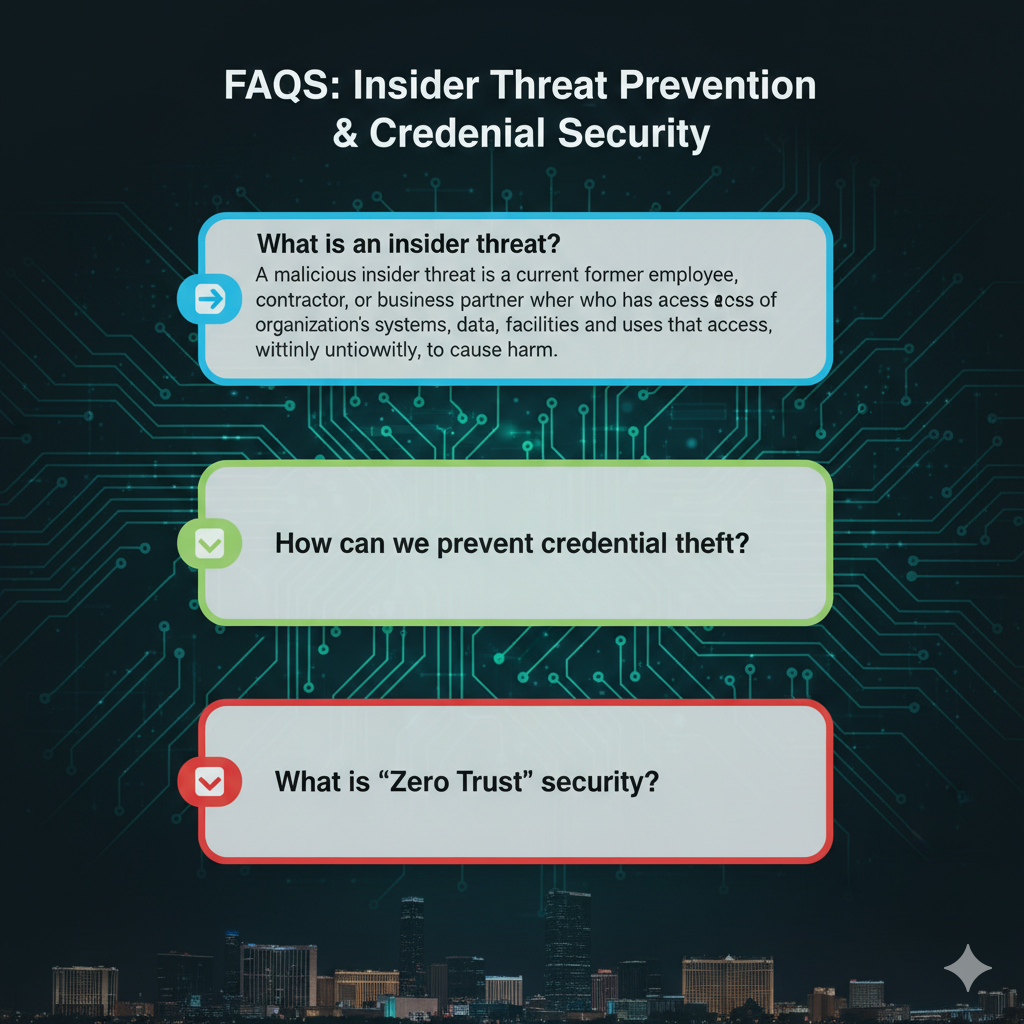
How can small businesses afford enterprise-grade security?
Managed IT services make enterprise security affordable for SMBs. Instead of hiring multiple specialized security professionals, you get access to an entire team for a predictable monthly fee. At CMIT Solutions Las Vegas, we offer scalable packages starting at levels appropriate for businesses with 10-15 employees.
Can’t we just train our employees better instead of implementing technical controls?
Training is essential but insufficient. The C&M employee knew selling credentials was wrong—he did it anyway for $920. Technical controls like multi-factor authentication, session monitoring, and access restrictions prevent compromised credentials from being exploited, regardless of employee behavior.
How do I know if we have privilege creep in our organization?
Signs include: employees who’ve been with your company 3+ years have access to systems they no longer use; staff who changed roles still have old permissions; IT administrators can’t quickly list what each employee can access; former employees’ accounts remain active; or you’ve never conducted an access audit.
What’s the difference between managed IT and having an in-house IT person?
A single IT employee works 40 hours per week, may lack specialized security expertise, and creates a single point of failure. Managed IT provides 24/7 monitoring, access to specialists across multiple domains (security, compliance, cloud, networking), redundancy if someone is sick or on vacation, and objective enforcement of security policies.
Is multi-factor authentication really necessary for our small business?
The C&M breach demonstrates that credentials alone are insufficient protection, regardless of organization size. If your business handles customer data, processes payments, or manages any sensitive information, MFA should be mandatory. The minimal cost ($5-15 per user monthly) is negligible compared to breach consequences.
How quickly can insider threat damage occur?
The $140 million theft occurred within hours once attackers had authenticated access. Modern digital systems enable criminals to extract data, transfer funds, or deploy ransomware in minutes. This is why real-time monitoring and automated response are critical—by the time you discover a breach the next morning, millions could be gone.
What specific compliance frameworks should Las Vegas businesses follow?
It depends on your industry: Retail/Hospitality needs PCI DSS for payment card data; Healthcare requires HIPAA security controls; Legal should follow ABA cybersecurity guidelines; Financial Services must comply with SEC cybersecurity rules and state regulations; Gaming/Casino faces Nevada Gaming Control Board requirements. CMIT Solutions manages compliance across all these frameworks.
Can cyber insurance protect us if an employee sells credentials?
Most cyber insurance policies have exclusions for employee malfeasance or require proof of adequate security controls. If you can’t demonstrate you had proper access controls, MFA, monitoring, and employee screening in place, your claim may be denied. Insurance complements security—it doesn’t replace it.
Take Action: Protect Your Las Vegas Business from Insider Threats
The C&M Software breach demonstrates that insider threats are not theoretical risks—they’re real, they’re happening now, and they can destroy organizations in hours. For $920, a trusted employee opened the door to $140 million in losses. The question isn’t whether your business could be targeted; it’s whether you’re prepared when it happens.
Las Vegas businesses operate in a unique environment: The hospitality and gaming industries handle massive financial transactions daily. Legal firms manage sensitive client information worth millions. Healthcare providers protect patient records under strict regulatory requirements. Financial services firms are constant targets for sophisticated threat actors.
You don’t need a massive internal IT department to achieve enterprise-grade security. You need experienced partners who understand the Las Vegas business landscape and the specific threats facing your industry.
Free Insider Threat Assessment for Las Vegas Businesses
CMIT Solutions of Las Vegas is offering complimentary insider threat assessments for qualified businesses. We’ll review your current access controls, identify privilege creep, test your authentication mechanisms, and provide a detailed report of vulnerabilities—with no obligation.
During your assessment, we’ll answer:
- ✓ Do your employees have more access than their jobs require?
- ✓ Could a single compromised credential enable a major breach?
- ✓ Are you monitoring for suspicious access patterns and unusual behaviors?
- ✓ Does your current IT setup meet your industry’s compliance requirements?
- ✓ What would a breach cost your business in reality?
Schedule Your Free Security Assessment
Or call us directly at (702) 725-2877
Serving Las Vegas, Henderson, North Las Vegas, Summerlin, and surrounding Nevada communities with enterprise IT support for small and medium-sized businesses.
About CMIT Solutions of Las Vegas
CMIT Solutions of Las Vegas provides enterprise-grade IT support and cybersecurity services specifically designed for small and medium-sized businesses. We specialize in serving the unique needs of Las Vegas’s hospitality, gaming, legal, healthcare, and financial services industries.
Our local team understands Nevada’s regulatory environment, business challenges, and the specific threat landscape facing Las Vegas organizations. We’re not a national call center—we’re your neighbors, protecting businesses in our community with 24/7 monitoring, rapid response, and the kind of hands-on support that only comes from being truly local.
Services Include: Managed IT Services, 24/7 Cybersecurity Monitoring, Compliance Management (PCI DSS, HIPAA, SOX), Cloud Services, Data Backup & Recovery, Network Management, Fractional CTO Services, and IT Strategy Consulting.