
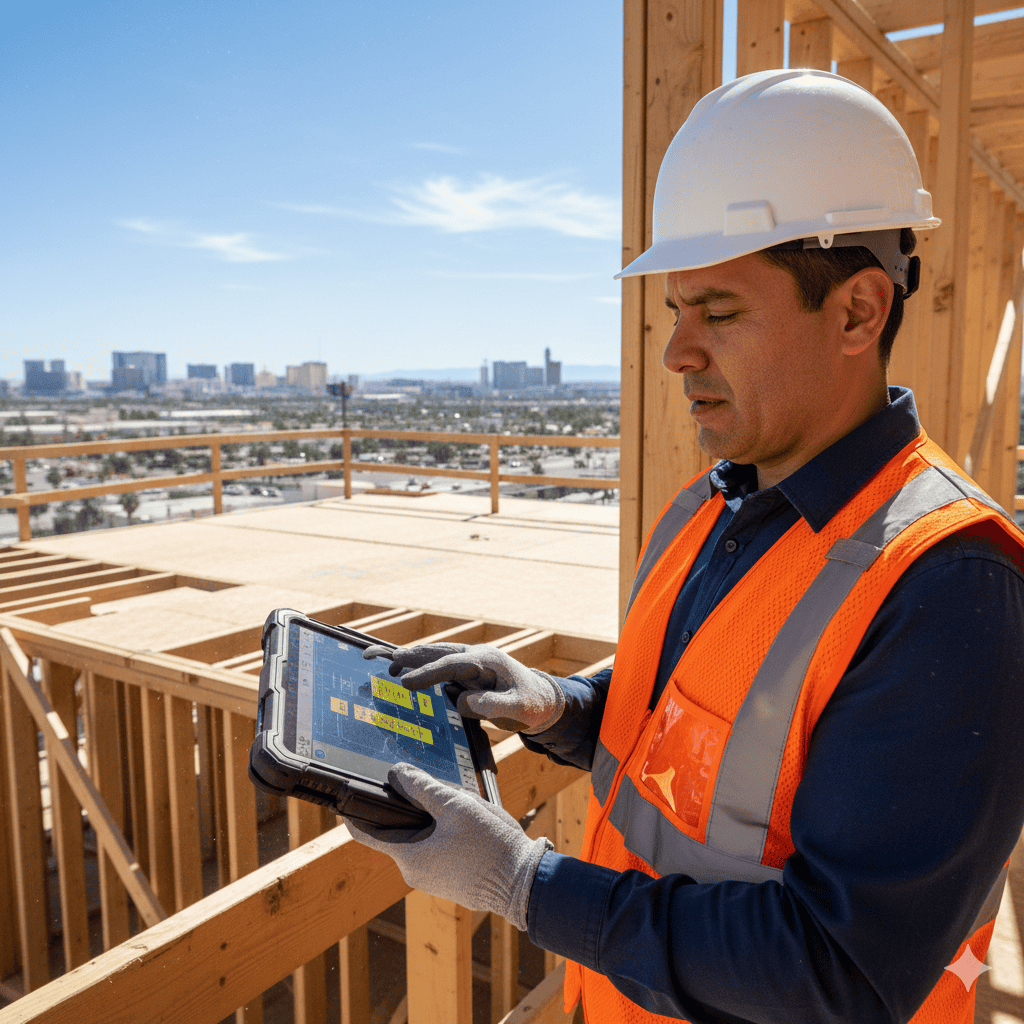
Managed IT Services for Construction Companies in Las Vegas
Construction climbed to the fourth most ransomware-targeted industry in early 2026. Here is what Las Vegas contractors should demand from an IT partner.
Published by CMIT Solutions of Las Vegas · Cybersecurity · 6 min read
Why Construction Became a Top Ransomware Target
In Las Vegas construction, the most expensive words you can hear are “I can’t open the drawing.” When a superintendent on a Summerlin job site can’t pull the latest Bluebeam revision, work stops. When the project manager in the office can’t sync Procore with Sage 300, billing stops. For years that was the whole IT conversation for contractors: keep the field talking to the office.
That conversation changed in 2026. Construction is now one of the few industries where ransomware activity is climbing while the overall victim count falls. Threat actors worked out something contractors have been slow to accept: a construction firm cannot absorb downtime. Halted work triggers liquidated damages, blows schedules, and sours relationships with general contractors and owners. That combination makes contractors unusually likely to pay quickly, and attackers price accordingly.
There is a second reason, and it is specific to the trade. Your project documentation carries independent extortion value. Blueprints, structural drawings, geotechnical reports, and bid packages are leverage on their own — even if the attacker never encrypts a single file. For contractors working Clark County school projects, federal buildings, casino renovations, or the Henderson industrial corridor, a leaked plan set is a security problem for your client, not just a headache for you.
Construction recorded 131 ransomware victims in Q1 2026 — up 12% from the previous quarter and 44% year over year — moving the sector from sixth to fourth place behind only manufacturing, technology, and healthcare. Twenty-two separate threat groups claimed construction victims in that quarter alone.
How the Attacks Actually Reach Contractors
Four groups — Qilin, Play, Akira, and DragonForce — accounted for roughly 55% of construction victims in Q1 2026. Their methods are not exotic, and that is precisely the problem. These are opportunistic intrusions that succeed because construction networks tend to be stretched across sites, subcontractors, and personal devices.
- Edge device exploitation: Unpatched VPN appliances and firewalls at the office are the most common front door. Akira in particular has a documented history of entering through known VPN vulnerabilities on gear that was never put on a patch schedule.
- Backup infrastructure as the first target: Modern crews hunt your backup server before they touch production data. Akira and Fog have both exploited Veeam Backup & Replication flaws specifically to remove your ability to restore.
- Subcontractor and vendor access: Shared plan-room logins, standing VPN accounts for trades, and guest Wi-Fi bridged to the internal network give attackers a path that bypasses your perimeter entirely.
- Invoice and payment fraud: Progress billing runs on email. A compromised mailbox lets an attacker sit quietly, learn your draw schedule, then redirect a payment with a convincing lien-waiver attachment.
- Unmanaged field devices: iPads and phones running PlanGrid or Raken, enrolled in nothing, are effectively unlocked filing cabinets left at supply houses.
What Is Actually at Stake for Las Vegas Contractors
- ⚠ Liquidated damages and schedule penalties when a job stops for days rather than hours
- ⚠ Bid data exposure that hands competitors your margins on the next Clark County solicitation
- ⚠ Prequalification failures — owners and GCs increasingly ask for security attestations before award
- ⚠ Nevada NRS 603A breach-notification obligations when employee or client records are exposed
- ⚠ Federal contract exposure for firms touching Nellis, VA, or GSA work with flow-down security clauses
- ⚠ Denied cyber insurance claims when required controls were listed on the application but never deployed
Three Gaps We Find in Almost Every Contractor’s Network
• The job trailer is on the same network as accounting
The Gap A 5G hotspot in the trailer gets VPN’d straight into the office LAN so the super can reach the plan room. Every subcontractor device that touches that trailer Wi-Fi now has a route to your Sage server.
The Fix Segment the field. Job sites get their own VLAN with point-to-point wireless or construction-grade 5G, and reach only the specific applications they need. Subcontractors get isolated guest access that cannot see internal systems at all.
• Backups exist, but nothing stops an attacker from deleting them
The Gap The backup server sits in the same domain, reachable with the same admin credentials, running a version of its software that has not been patched since installation. That is the first thing Akira looks for.
The Fix Immutable, object-locked backup copies held outside the production domain, with separate credentials and a patch schedule. Then test a restore of a full project directory quarterly and time it, so your recovery estimate is a measurement rather than a hope.
• Nobody owns the software stack that runs the business
The Gap Most generalist IT providers cannot tell a CAD file from a PDF. So Procore-to-Sage sync breaks, Bluebeam Studio sessions lag, Revit workstations crash mid-render, and each failure gets logged as a user problem instead of an architecture problem.
The Fix Insist your provider names your stack in the service agreement — Procore, Sage 300 or 100 Contractor, Bluebeam Revu, AutoCAD, Revit, PlanGrid, Raken — and owns the integrations, licensing, and workstation specs behind them. Add mobile device management so any lost iPad can be wiped in minutes.
Las Vegas Businesses: Don’t Wait for the Breach.
Get a construction IT audit covering your software stack, trailer connectivity, backup integrity, and security gaps.
Defending Las Vegas with CMIT Solutions
CMIT Solutions of Las Vegas supports general contractors, trades, architects, and engineering firms across the Valley — Summerlin, Henderson, North Las Vegas, and the industrial corridors in between. We know the difference between a Revit crash and a network problem, and we know that a contractor’s uptime is measured in schedule days, not help desk tickets.
If you are relying on an IT provider who thinks “cloud” means Dropbox, the gap between your current setup and what Qilin or Akira is looking for is wider than you think. We will show you exactly where it is.
GuidePoint Security — The Top 5 Industries Most Impacted by Ransomware in Q1 2026
ReliaQuest — Report Shows Ransomware Has Grown 41% for the Construction Industry
BleepingComputer — Akira and Fog Ransomware Now Exploiting Critical Veeam RCE Flaw
Protect Your Las Vegas Business Today
Managed IT services built for contractors who cannot afford a stopped job site.
Prefer to talk? Call (702) 725-2877 or email LVSales@cmitsolutions.com