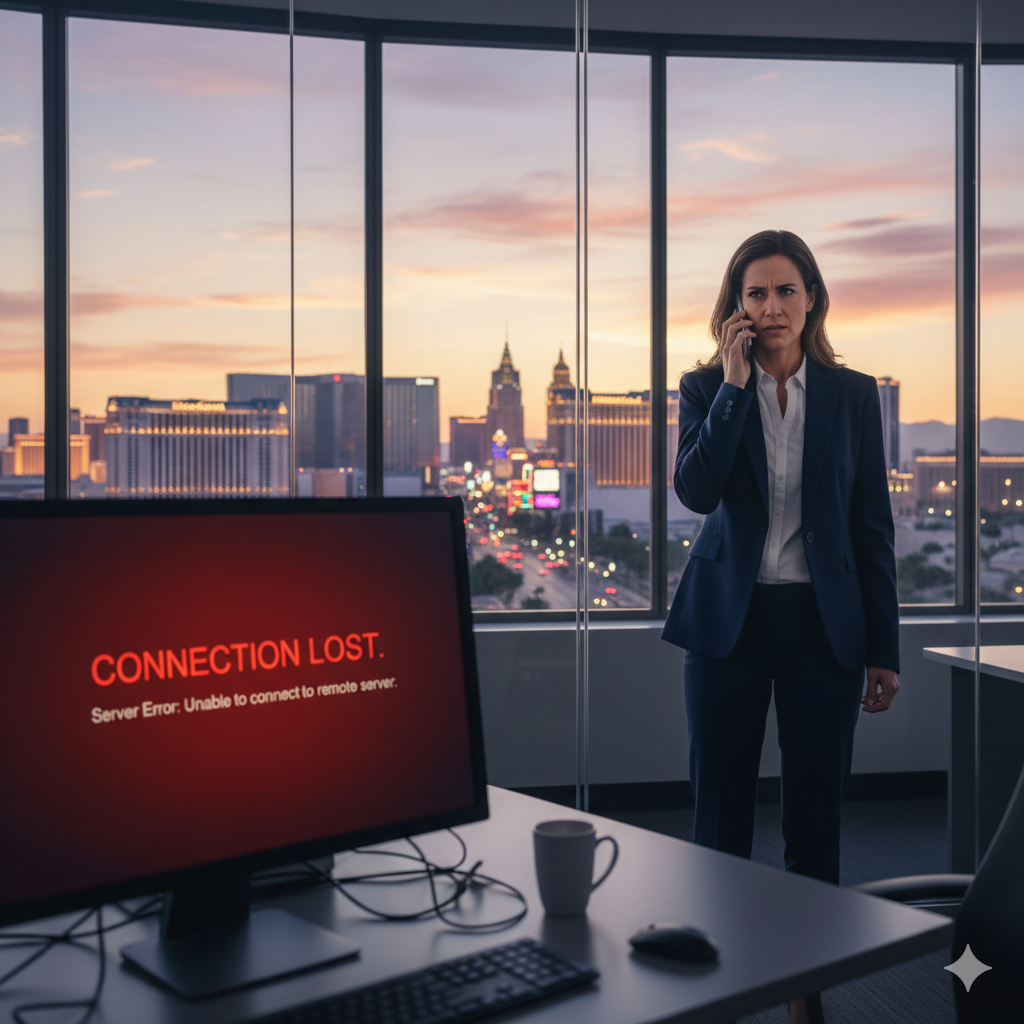
Emergency IT Support in Las Vegas: Why the 2 A.M. Gap Is Costing Businesses Millions
Las Vegas never closes. Most IT help desks do — and attackers have built their entire schedule around that fact.
Published by CMIT Solutions of Las Vegas · Cybersecurity · 6 min read
Emergency IT Support Is a Las Vegas Problem in a Way It Isn’t Anywhere Else
In most American cities, a server that dies at 11:40 p.m. on a Saturday is an inconvenience. Somebody notices Monday morning, opens a ticket, and the business absorbs a few hours of cleanup. Las Vegas does not work that way. Our hotels are checking in guests at 3 a.m. Our restaurants are running third seatings. Our hospitals and urgent care clinics are at their busiest. Our warehouses in North Las Vegas are loading trucks. Clark County has one of the highest concentrations of genuinely round-the-clock commerce in the United States — and a startling number of those businesses are paying for IT support that answers the phone from 8 a.m. to 5 p.m., Monday through Friday.
That mismatch is not a minor scheduling annoyance. It is a security posture. Ransomware operators pick their timing deliberately, and they pick the hours when nobody is watching. If your point-of-sale system, your property management system, or your electronic health records go down at 2 a.m. and your provider’s answer is a voicemail box, you are not buying IT support. You are buying business-hours IT support and hoping your risk politely conforms to it.
Semperis found that 52% of ransomware attacks hit on a weekend or holiday — while 78% of organizations cut security operations staffing by half or more during exactly those windows, and 6% shut it off entirely. Attackers are not guessing when you’re understaffed. They’re counting on it.
How an After-Hours Attack Actually Unfolds
The 2026 Sophos State of Ransomware report, based on interviews with 2,158 IT and security decision-makers across 17 countries, reframed how these attacks begin. For the first time in four years, unpatched software is no longer the leading root cause. Identity is. Here is the mechanism, in order:
- Credential theft, not exploitation. Sophos found that 79% of ransomware attacks now start with a compromised identity. Malicious email (26%) and phishing (24%) are the top entry points — a stolen login, not a hacked firewall.
- MFA is present but incomplete. Multi-factor authentication was deployed in some form in 97% of incidents where stolen credentials were the root cause. The attacks succeeded through the coverage gaps: a legacy protocol, a service account, a contractor login, a VPN nobody enrolled.
- A quiet dwell period. The intruder logs in as a valid user and looks like normal traffic. Nothing crashes. No alarm fires unless someone or something is actively reviewing authentication behavior.
- Deployment at the low-water mark. Encryption is triggered when response capacity is thinnest — overnight, Friday night, a holiday weekend. The FBI and CISA have formally warned organizations about this pattern and recommend designating on-call security staff for precisely these windows.
- Small businesses lose the race. Only 34% of organizations with 100–250 employees stopped an attack before encryption or extortion, versus 46% of larger firms. The gap is not talent. It is coverage.
What’s Actually at Stake for a Las Vegas Business
The average cost to recover from a ransomware incident climbed to $1.7 million in 2026, and the majority of that figure is not the ransom. It is downtime, replaced hardware, rebuilt networks, and revenue that never came back. Translated into Clark County terms:
- ⚠ Hospitality and gaming vendors: a property management or reservation outage during a convention weekend means walked guests, manual check-in, and a service failure your brand agreement may treat as a breach.
- ⚠ Healthcare and dental practices: an encrypted EHR is a HIPAA incident with a 60-day notification clock, not just an IT ticket. Downtime procedures on paper are the difference between a rough day and a reportable event.
- ⚠ Restaurants and retail: a dead payment terminal on a Friday night on the Strip is straightforward lost revenue that never returns, plus PCI DSS exposure if card data was in scope.
- ⚠ Construction and manufacturing: project files, submittals, and shop drawings held hostage stall crews on Monday and push schedules that carry liquidated damages.
- ⚠ Government contractors: a weekend incident you cannot evidence or timeline properly can jeopardize contract eligibility long after systems are restored.
- ⚠ Cyber insurance: carriers increasingly ask whether you have 24/7 monitoring and a documented response process. Answering no can raise your premium or void a claim outright.
Three Fixes That Close the After-Hours Gap
• Stop confusing an emergency phone number with emergency coverage
The Gap Most Las Vegas SMB contracts include an “after-hours emergency line.” Read the fine print and it is frequently a voicemail with a four-hour callback target, billed at an overtime rate, staffed by whoever is on rotation — and it only helps if you already know something is wrong. At 2 a.m., nobody knows.
The Fix Require a contractual response time, in writing, that applies at 2 a.m. on a Sunday and not just at 10 a.m. on a Tuesday. Ask what triggers a call to you without you calling first. Genuine 24/7 IT support is monitoring plus escalation, not a number that rings into the dark.
• Put identity under continuous watch, not just behind MFA
The Gap Nearly every organization breached through stolen credentials already had MFA deployed somewhere. The successful attacks walked through what MFA did not cover: shared mailboxes, service accounts, a legacy authentication path, a vendor’s remote access tool nobody audited after the project ended.
The Fix Inventory every identity in your environment, including non-human service and application accounts, and confirm each one is enrolled in phishing-resistant MFA. Then add detection that flags impossible logins — a Las Vegas payroll admin authenticating from overseas at 3 a.m. should generate a human response, not a log entry read three days later.
• Rehearse the 2 a.m. call before you need to make it
The Gap Most incident response plans exist as a document nobody has opened. When systems are encrypted overnight, the night manager does not know who to call, whether to unplug anything, who notifies the insurer, or how the business keeps taking orders on paper until systems return.
The Fix Run a one-hour tabletop exercise with an overnight scenario, and include the people who actually work those hours. Print the call tree and the manual workaround procedures — if your plan lives only in the system that just got encrypted, you do not have a plan. Verify your backups are immutable or offline and that someone has tested a restore this quarter.
Las Vegas Businesses: Don’t Wait for the Breach.
Find out exactly what your current contract covers at 2 a.m. — before you find out the hard way.
Defending Las Vegas with CMIT Solutions
CMIT Solutions of Las Vegas builds emergency IT support around how this city actually operates — continuous monitoring, defined response commitments that hold overnight and on holidays, and a local team that knows the difference between a hotel property management system and a dental practice’s EHR. We are based here, on South Valley View Boulevard, and we answer to Clark County businesses rather than a distant call center queue.
If your business runs past 5 p.m., your IT support should too. The most expensive version of this conversation is the one that happens after the encryption.
• Sophos, “79% of Ransomware Attacks Now Originate from Compromised Identities” — State of Ransomware 2026 (July 2026)
• Semperis, 2025 Holiday Ransomware Risk Report
• CISA & FBI, Advisory AA21-243A: Ransomware Awareness for Holidays and Weekends
Protect Your Las Vegas Business Today
Get emergency IT support and 24/7 monitoring built for a city that never closes.
Schedule Your Free IT Assessment
Prefer to talk? Call (702) 725-2877 or email LVSales@cmitsolutions.com
3111 S. Valley View Blvd., Suite A205, Las Vegas, NV 89102