Weaponizing IT: The 2026 Iranian Cyber Escalation & Stryker Wiper Attack

Iranian state-sponsored groups are weaponizing Microsoft Intune to wipe corporate networks. See the 72-hour checklist to protect your Las Vegas business.


Critical Infrastructure Threat Alert | March 2026

Weaponizing Our Own Tools: Inside the 2026 Iranian Cyber Escalation

State-sponsored groups weaponize Microsoft Intune, deploy wiper malware, and execute Living off the Land attacks against critical infrastructure


⚠️ ACTIVE CAMPAIGNS: Handala Wiper & MuddyWater Espionage

200,000+ devices wiped at Stryker Corporation (March 11, 2026). Iranian-linked threat actors Handala (Void Manticore) and MuddyWater (Seedworm) executing coordinated attacks against Western critical infrastructure, medical technology, finance, and defense sectors. Standard MFA and firewalls provide zero protection against these tactics.


1. Executive Summary: The Death of the “Standard” Defense

If you think a basic firewall and a standard text-message MFA app are enough to keep state-sponsored hackers out of your network, the events of March 2026 should be a massive wake-up call.

Over the past two weeks, Iranian-linked cyber groups—specifically Handala (also known as Void Manticore) and MuddyWater (also known as Seedworm)—have executed some of the most devastating attacks we have ever seen against Western critical infrastructure, medical technology, financial institutions, and defense contractors.

The Most Terrifying Part

These threat actors aren’t relying on custom-coded zero-day exploits. They are executing “Living off the Land” (LotL) attacks: logging in with stolen credentials, hijacking our own IT management tools (Microsoft Intune, RMM platforms, PowerShell), and weaponizing them against us. Because the tools are legitimate and the credentials are valid, security software sees nothing wrong — until 200,000 devices suddenly receive a “factory reset” command.


For Las Vegas businesses—particularly those in 24/7 hospitality, healthcare, defense supply chain, and logistics—this represents an existential threat. A destructive wiper attack doesn’t just steal data or demand ransom; it instantly paralyzes operations, effectively halting revenue, patient care, and guest services. There is no negotiation. There is no recovery unless you have air-gapped backups.


2. The Technical Details: Wipers and Silent Espionage

The March 2026 escalation is defined by two distinct, highly sophisticated campaigns running in parallel — one loud and destructive, one silent and patient:

Campaign 1: The Stryker Wipe (Handala / Void Manticore)

On March 11, 2026, the global medical technology giant Stryker Corporation was paralyzed by a pure destructive “wiper” attack. Handala did not ask for a ransom. They did not steal patient data for extortion. They simply erased over 200,000 laptops, servers, and mobile devices across 79 countries.

Step 1 — AitM Phishing (MFA Bypass)

Attackers used Adversary-in-the-Middle (AitM) phishing to trick employees into logging into a fake Microsoft login portal. The phishing site acted as a proxy — capturing the user’s password and the MFA token in real-time, then immediately forwarding both to the real Microsoft login to steal an authenticated session token. This bypasses SMS codes, authenticator app push notifications, and time-based one-time passwords (TOTP). The only MFA that resists this attack is FIDO2 hardware keys, which cryptographically verify the domain before authenticating.

Step 2 — Privilege Escalation to Global Admin

Using the stolen session token, hackers escalated their privileges to Global Administrators within Stryker’s Microsoft Entra ID (formerly Azure AD) and Microsoft Intune environment. Once they had Global Admin, they controlled the entire cloud identity infrastructure — all users, all devices, all policies.

Step 3 — Weaponizing Microsoft Intune

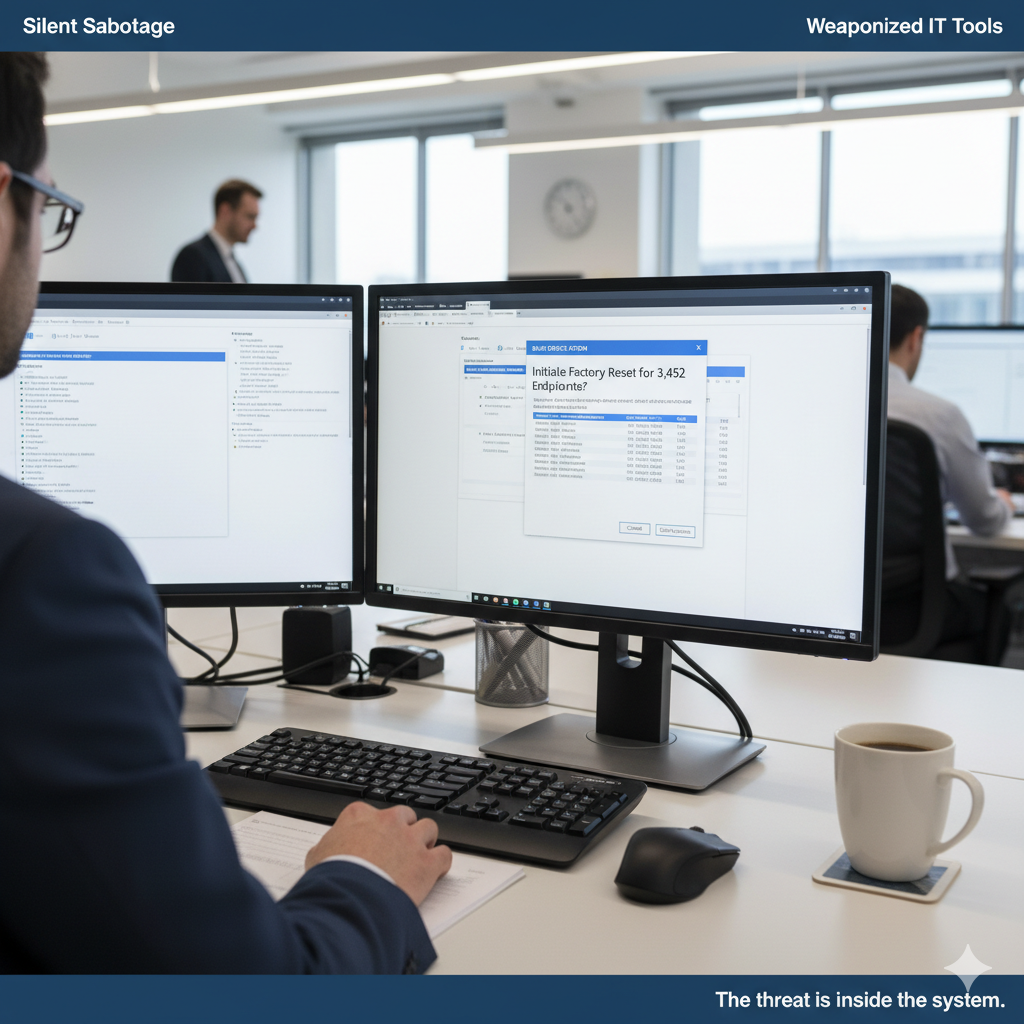
Because Microsoft Intune is a legitimate cloud-based Unified Endpoint Management (UEM) tool used to manage corporate devices — patching, policy enforcement, remote wiping — the hackers simply logged in as Global Admin and pushed a bulk “Factory Reset” command to every enrolled device worldwide. Security software (EDR, antivirus, SIEM) ignored it because it looked like a legitimate IT administrator action. Within hours, 200,000+ devices were bricked — laptops, tablets, medical workstations, executive phones. This is a Living off the Land (LotL) attack: using our own tools against us.


Campaign 2: The Silent Infiltrators (MuddyWater / Seedworm)

Simultaneously, MuddyWater (also tracked as Seedworm, TEMP.Zagros, Static Kitten) has been silently infiltrating U.S. banks, airports, defense suppliers, and logistics companies. Instead of loud destruction, they are focused on long-term espionage — stealing intellectual property, financial data, and operational intelligence.

Stage 1 — Edge Device Exploitation

MuddyWater actively scans for and exploits unpatched internet-facing systems — particularly vulnerabilities listed on the CISA Known Exploited Vulnerabilities (KEV) catalog. Common targets include Fortinet FortiGate VPNs, Citrix NetScaler gateways, Ivanti Connect Secure, and Microsoft Exchange servers. Once they find an unpatched edge device, they gain remote code execution and establish initial access.

Stage 2 — Next-Gen Backdoors

Once inside, they deploy new stealthy backdoors designed to evade detection:
“Dindoor” — A JavaScript-based backdoor running on the Deno runtime (a modern alternative to Node.js). Because Deno is legitimate developer tooling, security software typically doesn’t flag it.
“Fakeset” — A Python backdoor that uses legitimate Python interpreters already installed on systems (again, Living off the Land). Both backdoors communicate using HTTPS to blend with normal web traffic.

Stage 3 — Cloud Exfiltration

Stolen data — financial records, customer databases, intellectual property, operational plans — is quietly funneled to legitimate cloud storage platforms like Wasabi, Backblaze, and AWS S3. This traffic blends perfectly with normal corporate internet usage (employees uploading files to cloud storage), making detection nearly impossible without deep packet inspection and behavioral analytics. The exfiltration can continue for months undetected.

Threat Actor Profiles:

Handala (Void Manticore)

Attribution: Iranian state-sponsored

Objective: Destructive attacks, wiper deployment

Tactics: AitM phishing, Intune weaponization, credential harvesting

Recent Target: Stryker Corporation (200,000 devices wiped March 11, 2026)

MuddyWater (Seedworm)

Attribution: Iranian MOIS (Ministry of Intelligence)

Objective: Long-term espionage, IP theft, surveillance

Tactics: VPN exploits, Dindoor/Fakeset backdoors, cloud exfiltration

Recent Targets: U.S. banks, airports, defense suppliers, logistics (ongoing)


3. The Risk: Why Las Vegas CEOs Must Act Now

Why should a Las Vegas business care about state-sponsored attacks targeting medical technology companies or defense contractors? Because threat actors increasingly target the supply chain as the path of least resistance.

🔗 Supply Chain Targeting

If you are a vendor, legal partner, IT contractor, HVAC provider, or logistics company for a major casino, defense contractor, hospital, or Strip property — you are the stepping stone. Iranian threat actors (and Russian, Chinese, North Korean counterparts) routinely compromise smaller, less-defended suppliers to leapfrog into their high-value clients. The 2013 Target breach started with an HVAC vendor. The 2023 MGM breach started with a help desk social engineering call. Your weak security becomes their entry point.

💀 Wiper Attacks = Instant Business Death

A wiper attack like the one that hit Stryker is devastating to a 24/7 operation. If the endpoints running your hotel check-in systems, medical carts, casino floor POS terminals, or logistics dispatch receive a rogue “factory reset” command — your entire business goes dark in seconds. There is no ransom negotiation. There is no recovery timeline unless you have air-gapped, immutable backups tested and ready. For Las Vegas hospitality with razor-thin operational margins, even 12 hours of downtime can trigger permanent customer loss and insurance exclusions.

🎯 Las Vegas as Critical Infrastructure

Las Vegas isn’t just entertainment — it’s critical infrastructure. Nellis Air Force Base, defense contractors, logistics hubs serving the Southwest, and healthcare facilities supporting nearly 3 million residents and 40+ million annual visitors create a high-value target ecosystem. State-sponsored actors view disrupting Las Vegas as both economically damaging (tourism revenue) and strategically significant (defense operations). You are on the target list whether you know it or not.


4. The 72-Hour Mitigation Checklist

Standard cybersecurity hygiene is no longer sufficient. Based on the latest CISA and NIST frameworks, your IT leadership must execute the following “Defense-in-Depth” strategies immediately:

1

Upgrade to Phishing-Resistant MFA

The Gap: Text-message codes and push-notification apps are trivially bypassed by Adversary-in-the-Middle (AitM) proxy attacks. The Stryker breach succeeded despite MFA being in place because they used SMS-based 2FA. AitM phishing captures the token in real-time and replays it before expiration.

The Fix: Transition administrative accounts (Global Admin, Domain Admin, any account with elevated privileges) to FIDO2 hardware security keys (YubiKey 5 Series, Titan Security Key). FIDO2 cryptographically verifies the domain before authenticating — making phishing impossible. Alternatively, enforce strict Microsoft Entra Conditional Access policies that tie logins only to compliant, company-owned devices with managed EDR. Prioritize: Azure AD/Entra admins, email, VPN, and any system with access to Intune, RMM, or cloud management tools.

2

Lock Down IT Management Tools with JIT & PIM

The Gap: Global Admin accounts in Entra ID/Intune/Microsoft 365 have permanent “God Mode” access. A single compromised account can wipe every device, delete all data, and destroy backups. The Stryker attackers had Global Admin for hours before executing the wipe command — plenty of time to explore, escalate, and prepare.

The Fix: Implement Just-in-Time (JIT) Access and Privileged Identity Management (PIM) in Microsoft Entra ID. Administrators should only have elevated rights for a few hours at a time, requiring secondary approval (from another admin or manager) to activate privileges. For mass commands in Intune or RMM platforms, require dual authorization — one person requests, another approves. Break the “always-on” admin model. Additionally, monitor for bulk device commands (factory reset, wipe, mass policy change) and alert immediately.

3

Deploy Air-Gapped, Immutable Backups

The Gap: If an attacker compromises your central cloud identity (Entra ID Global Admin), they will attempt to delete your cloud backups to maximize destruction. Many businesses discover this after a wiper attack — when they try to restore and find the backup repository also wiped. Traditional cloud-only backups stored in the same tenant are vulnerable.

The Fix: Ensure your Backup and Disaster Recovery (BDR) platform is entirely air-gapped (physically or logically disconnected from the network) and immutable (meaning files cannot be edited or deleted, even by an administrator, for a set retention period — typically 30-90 days). Use platforms like Datto BCDR, Veeam with immutable Linux repos, or AWS S3 Glacier with Object Lock. Test restoration quarterly. For 24/7 Las Vegas operations, your RTO (Recovery Time Objective) must be under 4 hours for critical systems.


5. How CMIT Solutions Protects Your Network

At CMIT Solutions of Las Vegas, we do not rely on single points of failure. We secure your environment by assuming breach — designing defenses that contain and detect threats even after initial compromise. We enforce Zero Trust architecture, manage complex Privileged Access controls, and provide 24/7 SOC monitoring to catch anomalous behavior—like a massive device wipe command or a 100GB data push to an unknown cloud server—before the damage is done.

Zero Trust & Advanced Threat Protection:

FIDO2 Phishing-Resistant MFA Deployment: YubiKey implementation for executives and Global Admins, conditional access policies enforcing device compliance before authentication
Privileged Identity Management (PIM): Just-in-Time admin access, time-boxed elevation, dual authorization for mass commands in Intune/RMM, automated de-escalation
24/7 SOC with Behavioral Monitoring: US-based Security Operations Center watching for UEM anomalies (mass device wipes, bulk policy changes), cloud exfiltration to unusual destinations (Wasabi, Backblaze), LotL tool abuse (PowerShell, Deno, Python interpreters)
Air-Gapped Immutable Backups: Datto BCDR with ransomware-proof storage, tested quarterly recovery drills, RTO under 4 hours for critical systems, offline backup verification
CISA KEV Vulnerability Management: Automated patching of edge devices (VPN, firewall, RDP) prioritizing Known Exploited Vulnerabilities catalog — eliminating MuddyWater’s primary entry vector
Network Segmentation: Zero Trust micro-segmentation isolating cloud management tools, critical systems, and production environments — containing lateral movement
Threat Intelligence Integration: Continuous monitoring of Cisco Talos, CISA alerts, and state-sponsored threat actor IOCs — proactive blocking of known Handala and MuddyWater infrastructure
Incident Response Planning: Pre-established wiper attack playbooks, tested recovery procedures, business continuity safeguards for 24/7 Las Vegas operations


⚠️ Don’t Wait for Your IT Tools to Be Used Against You

We can audit your MFA implementation, Privileged Identity Management, and backup immutability within 72 hours. Find out if you’re protected against Living off the Land attacks.

Request Critical Infrastructure Security Audit


Standard Defenses Are Dead. Deploy Zero Trust.

Phishing-resistant MFA, Privileged Identity Management, and air-gapped backups for Las Vegas critical infrastructure — from hospitality to defense supply chain.

📞 702-725-2877

Schedule Zero Trust Assessment

cmitsolutions.com/lasvegas-nv-1206


Key Takeaways:

March 2026 Iranian escalation — Handala wipes 200,000 Stryker devices, MuddyWater infiltrates U.S. banks/defense
Living off the Land attacks — weaponizing Microsoft Intune, PowerShell, legitimate cloud tools to evade detection
AitM phishing bypasses standard MFA — SMS codes and push notifications provide zero protection; FIDO2 is required
Global Admin = God Mode vulnerability — permanent elevated access enables instant destruction
FIDO2 hardware keys — YubiKey for admins, phishing-resistant authentication that verifies domains cryptographically
Just-in-Time admin access with PIM — time-boxed elevation, dual authorization for mass commands
Air-gapped immutable backups — Datto BCDR or Veeam with ransomware-proof storage, tested quarterly
CMIT Solutions provides Zero Trust implementation, PIM configuration, and 24/7 SOC monitoring — call 702-725-2877


6. Threat Intelligence Sources

Dive deeper into the technical Indicators of Compromise (IOCs) and mitigation strategies:


Back to Blog

Share:

Related Posts

Las Vegas skyline — guide to choosing the best managed IT services in Las Vegas

Your 2025 Guide: Best Managed IT Services in Las Vegas | SMB Buyer’s Checklist

Your 2025 Guide: Choosing the Best Managed IT Services in Las Vegas…

Read More
From casino breaches to law firm hacks, here’s what 2025 looks like for Las Vegas cybersecurity — and how local SMBs can defend themselves.

Las Vegas Cybersecurity Threats in 2025

Las Vegas Cybersecurity Threats in 2025: What SMBs Must Know & How…

Read More

How Data Backup Protects You from Ransomware (Las Vegas SMB Guide)

How Data Backup Protects You from Ransomware: A Practical Guide for Las…

Read More