|
🚨 ACTIVE THREAT ALERT — HOSPITALITY SECTOR
The Method: How “TA558” Uses AI and Fake Guest Complaints to Breach Hospitality Networks
TA558 (RevengeHotels) is weaponizing your front desk’s best quality — customer service — against you. Las Vegas hotels, casinos, and travel operators are prime targets.
|
| THREAT PROFILE |
|
ACTOR
TA558 / RevengeHotels
|
|
ACTIVE SINCE
2015 (Escalating 2026)
|
|
SECTOR
Hospitality & Travel
|
|
THREAT LEVEL
CRITICAL
|
|
|
| KEY THREAT INDICATORS: |
🎭 AI-Generated Phishing | 🖼️ Steganography Malware | 💳 Credit Card Exfiltration | 🔑 MFA Bypass via Session Token Theft |
|
|
01 — EXECUTIVE SUMMARY
Weaponizing Customer Service
|
🚨 The Core Threat
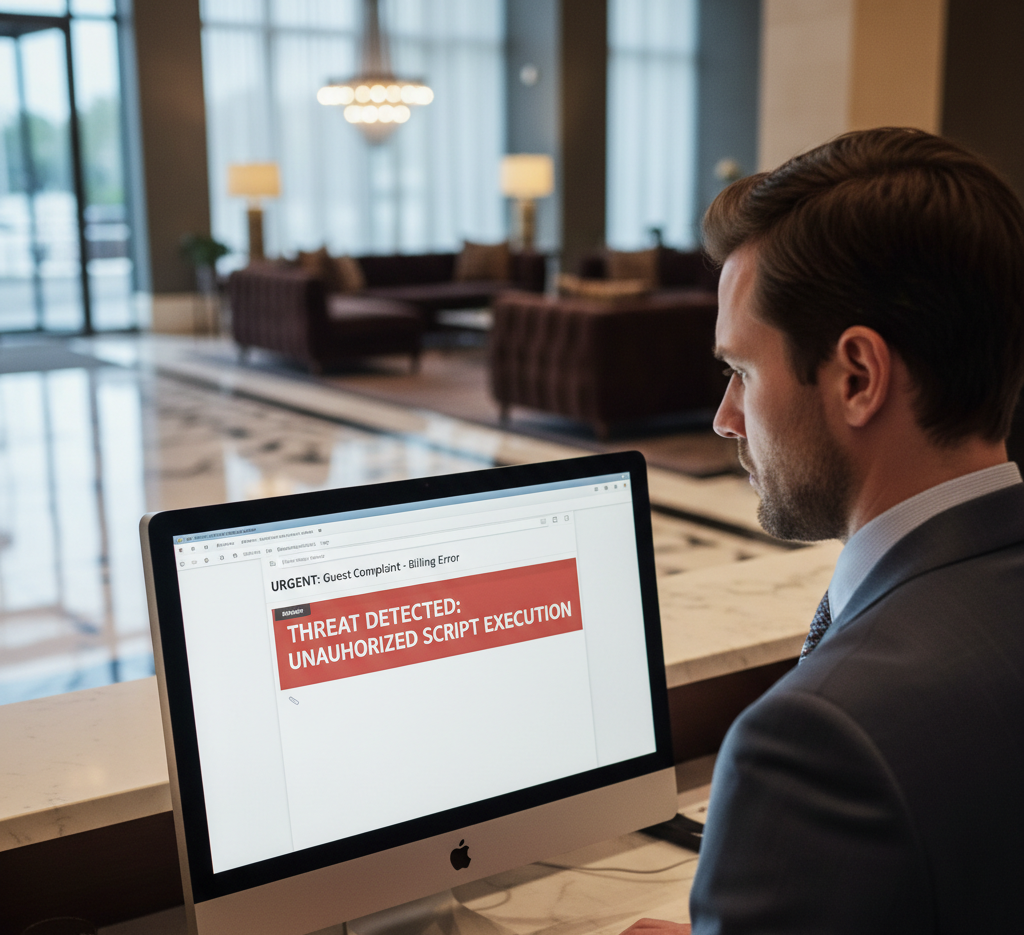
TA558 does not attack your firewall. It attacks your front-desk agent. A hyper-realistic AI-generated “guest complaint” email — complete with attachments — is all it takes to silently compromise your entire hotel network.
|
The hospitality, hotel, and travel sectors are facing a massive, highly coordinated wave of AI-powered cyberattacks from a financially motivated threat group known as TA558 (also tracked as RevengeHotels). Active since at least 2015, this group has recently escalated its tactics by integrating Generative AI into its infection chain.
Threat actors impersonate senior corporate leadership, VIP clients, or send urgent “fake guest complaints” complete with malicious attachments. Once an accommodating front-desk agent or booking manager opens the file, the malware silently bypasses identity verification, harvests authentication tokens, and begins siphoning credit card data directly from the hotel’s systems.
For Las Vegas — the world’s most hospitality-dense market — this threat is existential. Your front desk processes hundreds of emails per shift. All TA558 needs is one opened attachment.
|
|
|
02 — TECHNICAL DETAILS
AI Scripts and Steganography: The Attack Arsenal
According to threat intelligence from SecPod and MITRE ATT&CK framework mapping, TA558 has evolved from basic phishing to advanced evasion techniques specifically designed to defeat legacy defenses.
|
STAGE 1 — INITIAL ACCESS (T1566)
🤖 AI-Generated Phishing
Attackers use Generative AI to write flawless, contextually accurate phishing emails in multiple languages — masquerading as urgent booking confirmations, invoice disputes, or severe guest complaints containing a “photo” of the issue.
|
|
STAGE 2 — EXECUTION
🖼️ Steganography & Obfuscation
When the employee clicks the attachment, they aren’t downloading a file — TA558 uses steganography, hiding malicious VBS or PowerShell code inside innocent-looking image files or RTF documents. Legacy antivirus sees nothing.
|
|
|
STAGE 3 — PAYLOAD DELIVERY
💀 RATs & Info-Stealers
The AI-generated script pulls in a portfolio of Remote Access Trojans and Info-Stealers. Observed payloads:
| ▸ Agent Tesla |
| ▸ AsyncRAT |
| ▸ Loda RAT |
| ▸ Remcos RAT |
|
|
STAGE 4 — PERSISTENCE
🔒 Registry & Task Scheduler
The malware modifies OS registry keys and task schedulers, embedding itself as a critical system process. Standard antivirus cannot terminate it. The attacker now has a permanent foothold in your hotel network.
|
|
|
03 — THE RISK
Why Las Vegas Hotel GMs Must Act Now
Because Las Vegas hospitality networks process high volumes of transient data and rely heavily on third-party OTAs (Booking.com, Expedia, Hotels.com), they are prime targets for pure financial extortion. Here’s what a successful TA558 breach means for your property:
💳 Credit Card Theft & PCI-DSS Failure
TA558’s primary objective is the exfiltration of credit card data. A successful breach of your booking system will result in catastrophic PCI-DSS compliance fines and immediate loss of merchant processing privileges. You cannot check guests in without payment processing. The operation shuts down.
|
|
🔑 MFA & Identity Verification Bypass
The Info-Stealers deployed by TA558 steal cached credentials and authentication session tokens directly from the browser. This means attackers bypass your standard Multi-Factor Authentication and log into your PMS, booking systems, and back-office software as if they were a legitimate employee — with no MFA prompt triggered.
|
|
⭐ Brand Reputation Destruction
In Las Vegas hospitality, trust is the ultimate currency. If your property is identified as the source of a massive guest credit card leak — published on dark web forums, reported in local news, flagged by TripAdvisor — the reputational damage is often irreversible. Five-star reviews cannot undo a data breach headline.
|
|
⚠️ Why Las Vegas Is Ground Zero for TA558
Las Vegas processes more hotel reservations, OTA bookings, and high-value guest transactions than virtually any market on earth. The Strip’s 24/7 operations, multilingual staff, high employee turnover, and constant volume of VIP requests create the exact conditions TA558 exploits — overworked front-desk agents conditioned to act fast and accommodate urgently.
|
|
|
04 — MITIGATION PLAN
The 3-Step Defense Plan (Defense-in-Depth)
Standard “don’t click bad links” training is no longer sufficient when AI is writing the emails. To defend against TA558, hospitality IT leaders must implement these CISA-aligned strategies immediately:
|
1
|
Deploy AI-Driven Email Security (Zero Trust Inbox)
The Gap: Legacy Secure Email Gateways (SEGs) rely on known bad IP addresses and cannot stop AI-written phishing.
The Fix: Fight AI with AI. Implement behavioral email security platforms that analyze the intent and context of an email — flagging any message asking a front-desk agent to urgently download a file, even if the sender’s address looks completely legitimate.
|
|
2
|
Restrict Script Execution & Macros
The Gap: TA558 relies on malicious macros and PowerShell scripts executing locally when the “guest complaint” document is opened.
The Fix: Disable Microsoft Office macros by default across the entire organization via Group Policy. Enforce strict Application Control to prevent unauthorized PowerShell or VBS scripts from running on front-desk and back-office terminals.
|
|
3
|
Deploy Endpoint Detection and Response (EDR)
The Gap: Traditional antivirus looks for known signatures — it cannot catch malicious code hidden inside a steganographic image file.
The Fix: Deploy a Next-Generation EDR solution backed by a 24/7 Security Operations Center (SOC). EDR monitors behavior — if Microsoft Word suddenly opens a command prompt and contacts an external server, the EDR kills the process instantly, before the payload executes.
|
|
|
05 — HOW WE PROTECT YOU
Secure Your Hospitality Operations with CMIT Solutions
At CMIT Solutions, we understand the unique pressure hospitality businesses face: you must provide frictionless, accommodating service to your guests without compromising your network security. We implement enterprise-grade, Zero Trust architecture designed specifically for highly targeted industries like yours.
🤖 AI Email Security
Behavioral email platforms that detect AI-written phishing by analyzing intent — not just sender reputation or known bad IPs.
|
|
🛡️ 24/7 SOC + EDR
Next-Gen EDR backed by a Security Operations Center that monitors behavior around the clock — catching steganographic payloads before they execute.
|
|
🎓 Human Firewall Training
TA558-specific phishing simulations for front-desk and booking staff. We test your team with the exact tactics this group uses before a real attacker does.
|
|
“TA558 isn’t breaking down your front door — it’s knocking politely and asking your staff to let it in. The defense isn’t better locks. It’s training your team to verify every guest before opening the door, backed by technology that catches what human eyes miss.”
— Adam Lopez, CMIT Solutions of Las Vegas
|
|
|
FREQUENTLY ASKED QUESTIONS
TA558 & Hotel Cybersecurity: What Las Vegas Operators Ask
|
What is TA558 (RevengeHotels) and how does it target hotels?
TA558, also known as RevengeHotels, is a financially motivated threat group active since 2015. It uses AI-generated phishing emails disguised as fake guest complaints, booking disputes, or VIP communications to trick hospitality employees into opening malware attachments. The group recently integrated Generative AI to write hyper-realistic emails and uses steganography to hide malicious code inside image files and RTF documents.
|
|
|
How does TA558 bypass Multi-Factor Authentication (MFA)?
TA558 deploys info-stealer malware — including Agent Tesla, AsyncRAT, and Remcos RAT — that steals cached credentials and authentication session tokens directly from the browser. This means attackers bypass standard MFA and log into hotel PMS, booking, and back-office systems as legitimate employees without triggering an MFA prompt.
|
|
|
How can Las Vegas hotels defend against TA558 AI phishing attacks?
Three layers of defense: (1) AI-driven behavioral email security that analyzes intent, not just sender reputation; (2) disable Microsoft Office macros via Group Policy to block the attack’s primary execution method; and (3) deploy Next-Generation EDR backed by a 24/7 SOC to detect behavioral anomalies. CMIT Solutions of Las Vegas specializes in all three — call 702-725-2877 for a no-cost cybersecurity risk assessment.
|
|
Don’t Let Your Customer Service Be Weaponized Against You
TA558 is actively targeting Las Vegas hospitality businesses right now. A single opened attachment is all it takes. Let CMIT Solutions conduct a comprehensive Cybersecurity Risk Assessment — we’ll identify every gap TA558 would exploit before they do.
📞 702-725-2877
Request Your Free Hospitality Security Assessment → |
|
Threat Intelligence Source: SecPod: TA558 AI-Powered Attacks Target Hospitality Sector | Framework Reference: MITRE ATT&CK T1566
|
|
CMIT Solutions of Las Vegas |
702-725-2877 |
cmitsolutions.com/lasvegas-nv-1206 |
Serving Las Vegas, Henderson, Summerlin, North Las Vegas & The Strip
|
|