For many businesses, information technology once meant a relatively predictable collection of systems:
Computers. Servers. Email. Business applications. Networks. Printers.
For manufacturers, engineering firms, mobility companies, and other technology-intensive organizations, that definition is becoming increasingly incomplete.
Today’s environment can include:
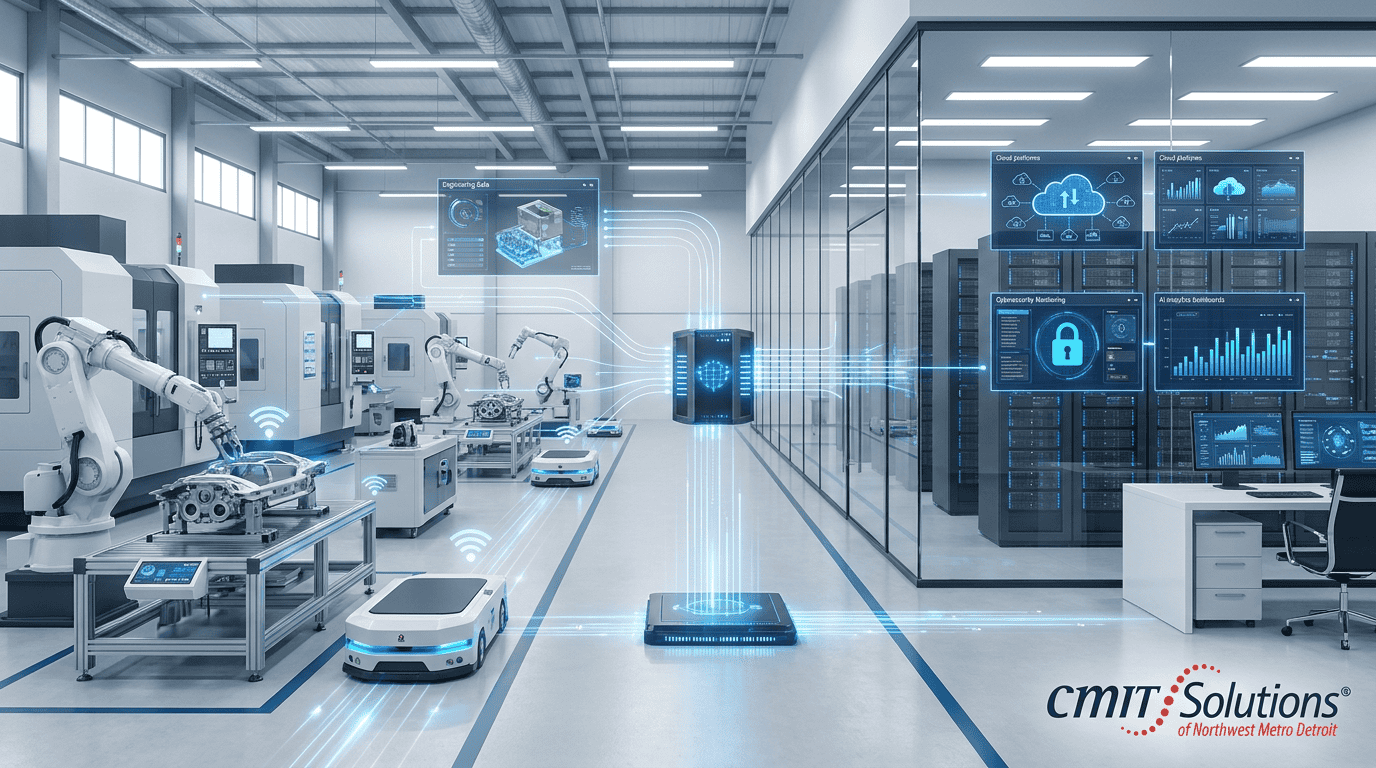
IT + Cloud + Engineering Data + Connected Devices + OT/Edge Systems + AI + External Partners
That convergence is changing both the technology environment and the leadership required to manage it.
Michigan’s continued investment in mobility and advanced technology provides a useful example of where this is heading.
Michigan’s Mobility Investments Point to a Bigger Technology Shift
On September 11, 2026, Michigan announced $1.5 million in funding through the Michigan Mobility Funding Platform for 10 projects intended to help companies test, validate, and commercialize emerging technologies in real-world environments.
The projects span technologies including autonomous systems, hydrogen production and fueling, electric vehicle charging, infrastructure inspection, traffic optimization, accessible transportation, robotics, and fleet-management technology.
Among the projects are Spot robots conducting mapping and inspection work in Detroit, traffic-signal optimization in Oakland and Macomb counties, underwater robotics inspecting municipal infrastructure, autonomous-vehicle safety monitoring, hydrogen technologies, and EV charging infrastructure.
At first glance, this might appear primarily relevant to automotive, mobility, engineering, or economic-development organizations.
But there is a broader technology story underneath it.
Every time physical products, infrastructure, sensors, equipment, vehicles, robotics, cloud platforms, and data become more connected, the traditional boundary between information technology and operational technology becomes less distinct.
And that creates an important question for Michigan businesses:
Who is responsible for making all of this technology work together securely, reliably, and strategically?
The Traditional Definition of IT Is Becoming Too Narrow
Consider a growing manufacturer.
Its business environment might include:
- Microsoft 365
- ERP software
- Engineering workstations
- CAD files
- Cloud storage
- Servers
- Remote employees
- CNC equipment
- Industrial controllers
- Connected sensors
- Quality systems
- Vendor remote access
- Production data
- Security cameras
- Building systems
- AI-enabled applications
- Customer and supplier portals
Which of those are IT?
Which are operational technology?
Which belong to engineering?
Which belong to cybersecurity?
Which belong to operations?
The technical answer matters.
But from a business leadership perspective, something else matters even more:
They are increasingly interconnected.
A problem in one environment can affect another.
An identity compromise can become an operational problem.
A poorly secured vendor connection can become a cybersecurity problem.
A network outage can become a production problem.
A cloud configuration can become a data-governance problem.
An unmanaged connected device can become an entry point into the broader environment.
And an AI application can create new connections among systems and information that previously operated independently.
This is why technology management increasingly needs to look across the entire business rather than treating each system as an isolated technical asset.
IT/OT Convergence Is Already Happening
Operational technology, or OT, refers broadly to programmable systems and devices that interact with the physical environment.
The National Institute of Standards and Technology’s Guide to Operational Technology Security includes examples such as industrial control systems, building automation, transportation systems, physical-access systems, and environmental monitoring systems.
For decades, many operational environments were relatively isolated from traditional corporate IT.
That separation is changing.
Modern businesses want operational information available for:
- Remote monitoring
- Analytics
- Predictive maintenance
- Quality management
- Supply-chain visibility
- Customer reporting
- Cloud applications
- AI analysis
- Business intelligence
- Workflow automation
Those capabilities require connectivity.
Connectivity creates opportunity.
It also creates dependencies and risk.
NIST has highlighted this changing relationship between IT and OT in manufacturing, noting that increased connectivity requires manufacturers to think carefully about cybersecurity where these environments meet.
That doesn’t mean every small manufacturer suddenly needs an industrial cybersecurity department.
It means leadership needs a better understanding of what is connected, why it is connected, who manages it, and what happens if it fails.
Connected Technology Changes Cybersecurity
Traditional business cybersecurity often focuses heavily on confidentiality.
Protect customer records.
Protect employee information.
Protect email.
Protect intellectual property.
Those remain important.
But operational environments can change the priority.
For a production system, availability and integrity may be equally or even more consequential.
A ransomware event that encrypts office documents is damaging.
A cybersecurity event that interrupts production can directly affect:
- Revenue
- Delivery commitments
- Customer relationships
- Employee productivity
- Equipment availability
- Supply-chain obligations
- Safety
- Reputation
This is why applying traditional office-IT security practices blindly to operational environments can be problematic.
OT systems may have unique uptime, performance, reliability, safety, lifecycle, and vendor-support requirements.
The objective isn’t simply to install more security software.
It is to understand the environment and manage risk appropriately.
Start With Visibility
This brings us back to a fundamental principle of technology management:
You cannot effectively manage what you don’t understand.
For manufacturers and engineering-oriented organizations, a meaningful technology assessment increasingly needs to look beyond laptops and servers.
Leadership should understand:
Business IT
Endpoints, identity, Microsoft 365 or Google Workspace, email, servers, networks, cloud platforms, business applications, backup, and support.
Engineering Technology
Engineering workstations, CAD/CAM applications, intellectual property, product data, simulation environments, source code, and specialized applications.
Operational Technology
Production equipment, industrial control systems, sensors, robotics, connected machinery, building systems, and other technologies interacting with physical operations.
Connectivity
How IT, OT, cloud platforms, remote users, vendors, facilities, and external partners communicate.
Data
Where engineering, production, customer, operational, and business information resides and how it moves between systems.
Cybersecurity
Identity, permissions, segmentation, endpoint protection, monitoring, remote access, vulnerability management, incident response, and recovery.
Business Continuity
Which systems are critical, how long the business can operate without them, and what happens when technology becomes unavailable.
Only after understanding those layers can leadership make informed decisions about architecture, cybersecurity, modernization, and automation.
Segmentation Becomes Increasingly Important
One important concept in converged environments is segmentation.
Not every device or system should communicate freely with every other system.
NIST has specifically examined security segmentation for smaller manufacturers.
The principle is straightforward:
Group assets based on their function, criticality, communication requirements, and cybersecurity needs—and control communication between those groups.
A manufacturing organization might separate:
- Corporate IT
- Production systems
- Guest networks
- Security cameras
- Building systems
- Engineering environments
- Internet-connected devices
- Vendor-access environments
The exact architecture will depend on the business.
But the broader principle matters:
Connectivity should be intentional.
A production machine should not automatically trust every laptop simply because both happen to be connected to the company’s network.
Likewise, a vendor should not necessarily receive broad network access simply because remote maintenance is required.
As IT and OT converge, network architecture becomes part of business-risk management.
External Partners Add Another Layer
Modern manufacturing and mobility ecosystems rarely operate in isolation.
A business may depend on:
- Equipment manufacturers
- Software providers
- Cloud providers
- Engineering partners
- Suppliers
- Customers
- Managed service providers
- Cybersecurity providers
- Remote technicians
- Automation specialists
- Telecommunications providers
Each relationship can introduce another technical connection.
That creates a governance question:
Who owns the whole environment?
A machine vendor may understand the machine.
A cloud provider understands its platform.
An MSP understands the corporate IT environment.
An automation company understands the workflow.
An engineering team understands the product.
A cybersecurity provider understands security controls.
But leadership still needs someone looking horizontally across those domains.
Otherwise, organizations can accumulate capable vendors without developing a coherent technology strategy.
This Is Where the CIO Role Changes
Large enterprises can maintain specialized teams for:
- Infrastructure
- Cybersecurity
- Cloud
- Data
- OT security
- Enterprise architecture
- Compliance
- AI
- Vendor management
- Business continuity
A 30-, 50-, or 100-person manufacturer usually cannot.
But the complexity doesn’t disappear simply because the organization is smaller.
This creates a growing gap.
An organization can become too technologically complex for reactive IT support while remaining too small to justify a complete internal technology leadership organization.
That is where a combined Managed IT + Fractional CIO model becomes particularly relevant.
Managed IT provides the operational foundation:
- Help desk
- Endpoint management
- Identity
- Microsoft 365
- Networking
- Backup
- Monitoring
- Cybersecurity operations
- Documentation
Fractional CIO leadership addresses the larger questions:
- What technology should we standardize?
- Which risks should we address first?
- How should IT and OT interact?
- Where should networks be segmented?
- How should vendors receive remote access?
- What should remain isolated?
- Which systems are business-critical?
- Where should cloud services be used?
- How should engineering data be protected?
- Where does AI actually create value?
- What needs to be modernized?
- How should technology investments support the business roadmap?
The value isn’t simply having another IT provider.
It is creating technology ownership across an increasingly interconnected business environment.
Build. Protect. Accelerate. in a Converged Environment
This evolution maps naturally into our Build. Protect. Accelerate. Business Technology Framework.
BUILD — Understand and Stabilize the Environment
The first objective is visibility.
Identify:
- Users
- Devices
- Networks
- Applications
- Cloud services
- Engineering systems
- Connected equipment
- Vendors
- Data flows
- Critical dependencies
Then establish reliable technology operations, documentation, standards, and ownership.
For manufacturing environments, Build increasingly means understanding both traditional IT and the systems IT depends on or connects with.
PROTECT — Secure the Connections
Once the environment is understood, organizations can better determine how it should be protected.
That may involve:
- Identity and access management
- Multifactor authentication
- Network segmentation
- Secure remote access
- Endpoint security
- Monitoring
- Vendor-access controls
- Backup and recovery
- Incident response
- Business continuity
- Data protection
- Vulnerability management
Importantly, the appropriate controls may differ between corporate IT and operational systems.
Protection should reflect business impact rather than simply applying identical tools everywhere.
ACCELERATE — Connect Technology to Business Outcomes
Once the foundation is stable and appropriately protected, the organization can more confidently pursue:
- Smart manufacturing
- IoT
- Operational analytics
- AI
- Workflow automation
- Predictive maintenance
- Cloud integration
- Business intelligence
- Connected equipment
- Digital transformation
This sequence matters.
Connectivity without architecture creates complexity.
Connectivity without security creates risk.
Connectivity with architecture, governance, and strategy can create competitive advantage.
AI Makes IT/OT Convergence Even More Important
AI adds another dimension to this evolution.
The more information businesses can collect from equipment, applications, sensors, operations, customers, and employees, the more opportunities AI has to identify patterns and automate decisions.
Imagine AI helping a manufacturer:
- Analyze production information
- Identify quality trends
- Summarize maintenance records
- Predict equipment problems
- Correlate business and operational data
- Generate management reporting
- Assist engineering workflows
- Coordinate information between systems
Those capabilities depend on data moving across previously separate technology environments.
That means AI strategy cannot be separated entirely from infrastructure, cybersecurity, cloud, data governance, and OT.
The question eventually becomes:
What information should connect—and under what controls?
That’s a technology leadership question.
What Michigan’s Mobility Ecosystem Tells Us
Michigan’s mobility funding announcement is not significant to most businesses because they will receive one of these grants.
The more interesting signal is the type of companies and technologies Michigan continues to cultivate.
Autonomous systems.
Robotics.
Connected infrastructure.
EV charging.
Hydrogen systems.
Transportation technology.
Advanced manufacturing.
These environments increasingly combine software and physical systems.
And the businesses supporting them—including suppliers, engineering firms, manufacturers, service providers, and technology companies—will increasingly operate environments where traditional IT is only one component of the technology landscape.
For Metro Detroit businesses, IT/OT convergence isn’t an abstract enterprise trend.
It is becoming part of the regional business environment.
The Technology Leadership Gap
The opportunity for small and mid-sized organizations isn’t to recreate the technology department of a Fortune 500 company.
It’s to develop the appropriate level of capability for their actual complexity.
That might mean combining:
Internal expertise + specialized vendors + Managed IT + cybersecurity + Fractional CIO leadership.
The exact model will vary.
But someone needs to maintain visibility across the whole environment.
Someone needs to translate technical dependencies into business risk.
Someone needs to coordinate vendors.
Someone needs to connect cybersecurity to operations.
And someone needs to determine which emerging technologies actually deserve investment.
That’s increasingly what modern technology leadership looks like.
Start by Understanding the Environment
If your organization has grown beyond traditional office IT—or if your manufacturing, engineering, connected-device, cloud, or operational environments are becoming increasingly interconnected—the first step doesn’t have to be a major technology overhaul.
Start with visibility.
A structured Business Technology Assessment can help identify technology dependencies, cybersecurity risks, operational gaps, and strategic opportunities across the business.
From there, leadership can establish a roadmap around the same principles:
Build the foundation.
Protect the business.
Accelerate with purpose.
Because as Michigan’s technology economy continues evolving, the distinction between “IT” and “the business” will become increasingly difficult to maintain.
Frequently Asked Questions
What is IT/OT convergence?
IT/OT convergence is the increasing connection between information technology systems—such as networks, cloud platforms, servers, business applications, and data—and operational technology systems that monitor or interact with physical equipment, processes, or environments.
What is operational technology?
Operational technology, or OT, includes programmable systems and devices that interact with the physical environment. Examples can include industrial control systems, manufacturing equipment, building automation, transportation systems, sensors, and physical monitoring systems.
Why does IT/OT convergence matter for small manufacturers?
Smaller manufacturers increasingly use connected equipment, cloud platforms, remote vendor access, sensors, automation, and data analytics. As these systems become connected, technology failures or cybersecurity incidents can potentially affect both business IT and physical operations.
Should an MSP manage operational technology?
The answer depends on the MSP’s capabilities and the operational environment. An MSP can often manage or coordinate supporting IT infrastructure, networking, identity, security, monitoring, documentation, and vendor access without directly administering specialized industrial control systems. Clear responsibility boundaries between IT providers, internal teams, equipment vendors, engineers, and OT specialists are important.
What does a Fractional CIO do for a manufacturer?
A Fractional CIO helps leadership align technology with business objectives. In manufacturing, this can include technology roadmaps, IT/OT strategy, cybersecurity priorities, vendor management, business continuity, cloud strategy, AI planning, budgeting, risk management, and coordination among internal and external technology specialists.