Debunking the “We’re Too Small to Be a Target” Myth
For many small and midsize businesses in Eastern Idaho, cybersecurity can feel like something primarily meant for large corporations. After all, why would a cybercriminal spend time targeting a local business when there are much larger companies with more data and money?
That assumption is becoming increasingly risky.
Ransomware attacks are not limited to major corporations in large cities. In fact, current threat data shows that small and midsize businesses are a significant part of the ransomware landscape. Verizon’s 2026 Data Breach Investigations Report found that about 96% of ransomware victims with known organization size were SMBs. The report also notes that many attacks are opportunistic, with attackers looking for compromised credentials or unpatched vulnerabilities rather than necessarily choosing businesses based on revenue or location.
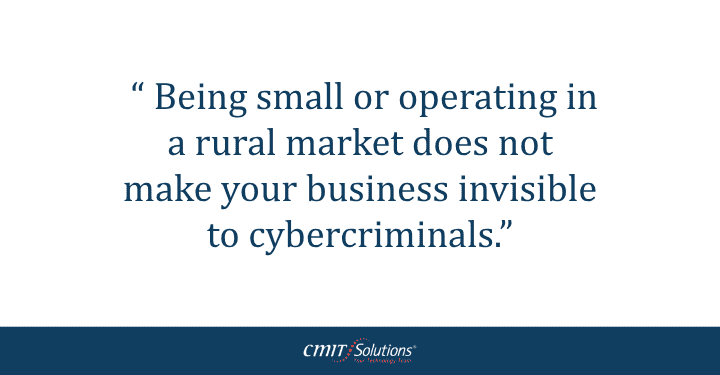
For businesses across Eastern Idaho, including Idaho Falls and surrounding communities, the message is simple: being small or operating in a rural market does not make your business invisible to cybercriminals.
The Myth: “Hackers Only Go After Big Companies”
One of the most persistent cybersecurity misconceptions is that attackers are primarily interested in Fortune 500 companies.
Large organizations certainly face significant threats, but cybercriminals often use automated tools that allow them to scan thousands of systems for weaknesses. That means an attacker may not know or care whether the business behind a vulnerable system is a national corporation or a local company.
The 2026 Verizon DBIR specifically describes ransomware attacks against SMBs as often opportunistic, with attackers casting wide nets to compromise as many organizations as possible. Compromised credentials and unpatched vulnerabilities are among the common paths attackers use to gain access.
In other words, an Eastern Idaho business doesn’t necessarily have to be famous, large, or high-profile to attract attention.
It simply needs to have something an attacker can access.
Why Small Businesses Can Be Attractive Targets
Cybercriminals look for opportunity.A smaller organization may have fewer IT resources, limited security monitoring, older equipment, or employees who have not received extensive cybersecurity training.
That doesn’t mean small businesses are careless. It means they may have fewer resources available to identify and address every potential weakness.
Verizon’s 2025 DBIR found that 88% of SMB breaches in its analysis involved ransomware, compared with 39% for large organizations. The report also found that stolen credentials were involved in about one-third of SMB breaches.
For a local company, a successful ransomware attack could affect much more than a few computers.
It could disrupt:
- Customer records
- Accounting and financial systems
- Scheduling and operations
- Shared files and documents
- Email and communication
- Production or service delivery
- Employee access to critical applications
- Business continuity
The result can be days of disruption, unexpected recovery costs, lost productivity, and damaged customer relationships.
Rural Does Not Mean Disconnected
Eastern Idaho businesses may operate in smaller communities, but modern businesses are deeply connected to the digital world.
A local construction company may use cloud-based project management. A medical practice may depend on electronic records. A manufacturer may rely on network-connected production systems. A professional services firm may store sensitive client information in Microsoft 365 or another cloud platform.
These technologies create tremendous benefits, but they also create potential entry points for attackers.
A business can be located miles away from a major metropolitan area and still be connected to the same internet, cloud applications, email platforms, remote-access tools, and software services used by companies around the world.
Geography does not create a cybersecurity shield.
How Ransomware Can Get In
Ransomware doesn’t always require an elaborate attack.
Common entry points can include:
- Phishing and Social Engineering
An employee receives a convincing email or message and clicks a malicious link, opens an attachment, or provides login credentials. - Stolen Credentials
Attackers may use compromised usernames and passwords to access business systems. Verizon’s 2026 DBIR identifies compromised credentials as one of the major ways SMBs are being victimized. - Unpatched Software
Security vulnerabilities in applications, servers, VPNs, firewalls, and other devices can provide attackers with a path into the network. - Remote Access
Remote work and remote management tools can create additional opportunities for unauthorized access when they are not properly secured. - Third-Party Access
Your business may have strong security practices while still depending on vendors, software providers, or other partners whose systems create additional risk. Verizon’s 2025 DBIR reported that third-party involvement in breaches had doubled to 30%.
“We Have Antivirus, So We’re Protected” Isn’t Enough
Antivirus software remains useful, but modern ransomware defense requires multiple layers.
If one security measure fails, another should be able to detect, block, or contain the threat.
A stronger cybersecurity strategy can include:
- Multi-factor authentication
- Endpoint detection and response
- Email and phishing protection
- Firewall protection
- Regular security patching
- Secure data backups
- Employee security awareness training
- Access controls and least-privilege practices
- Continuous monitoring
- An incident response plan
CMIT Solutions of Idaho Falls uses a multilayered cybersecurity approach that includes endpoint protection, threat monitoring, firewalls, email security, phishing protection, MFA, security awareness training, and SIEM/SOC capabilities.
Backups Are Part of Your Ransomware Strategy
Preventing ransomware is critical, but businesses should also prepare for the possibility that an attack could succeed.
That’s where reliable, protected backups become especially important.
A backup strategy should not simply mean keeping another copy of files on a computer or connected drive. Businesses need to consider whether backups are protected from unauthorized access, whether they can be restored, and whether recovery procedures have actually been tested.
A ransomware attack can be particularly damaging if attackers compromise both production systems and accessible backups.
For Eastern Idaho businesses, having a tested recovery strategy can help turn a potentially devastating incident into a manageable business interruption.
What Eastern Idaho Businesses Can Do Now
You don’t have to wait for an attack to discover where your weaknesses are.
Start by asking:
- Are all business-critical systems regularly patched and updated?
- Does every employee use MFA where available?
- Are important systems and accounts protected by strong access controls?
- Are backups protected and regularly tested?
- Can suspicious activity be detected outside normal business hours?
- Does your team know how to recognize phishing and social engineering attempts?
- Do you have a documented ransomware response and recovery plan?
- Do you know which systems and data would be most critical to recover first?
If several of these questions are difficult to answer, that’s not necessarily a reason to panic. It is a reason to start identifying the gaps.
Local Businesses Need Local, Proactive IT Support
Cybersecurity doesn’t have to mean building an enormous security department or trying to manage every threat yourself.
For businesses in Eastern Idaho, working with an experienced IT and cybersecurity partner can provide access to security expertise, monitoring, technology, and strategic guidance without requiring a large internal IT team.
CMIT Solutions of Idaho Falls serves businesses throughout Eastern Idaho and combines local support with broader technology resources. Its cybersecurity services include 24/7 monitoring and a range of layered security solutions designed to help businesses prevent, detect, and respond to threats.
The goal isn’t to assume that every Eastern Idaho business will be attacked.
The goal is to make sure your business is prepared if someone tries.
Don’t Let “We’re Too Small” Become Your Biggest Security Risk
Ransomware doesn’t require a business to be famous. It doesn’t require a business to be located in a major city. And it doesn’t necessarily require an attacker to specifically choose your company.
Sometimes, attackers are simply looking for an opening.
For small and midsize businesses in Eastern Idaho, that makes proactive cybersecurity an important part of protecting operations, customer information, employees, and long-term business continuity.
Your business may be local. Your cybersecurity threats aren’t.
If you’re unsure where your business stands, a cybersecurity assessment can help identify vulnerabilities and prioritize the steps that can make your environment more resilient.
Ready to strengthen your business’s cybersecurity?
Talk with CMIT Solutions of Idaho Falls about building a layered IT and cybersecurity strategy for your business.