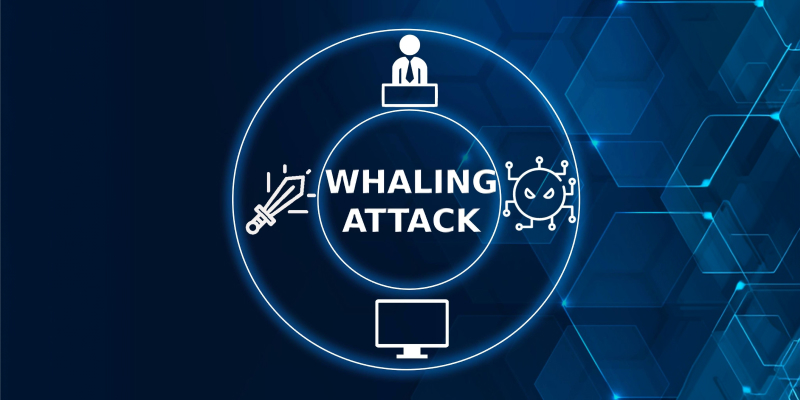
You think your SMB is too small to face a major cyber threat; a whaling attack now ranks among the most dangerous risks for companies of all sizes. At its core, a whaling attack is a sophisticated form of Phishing, also known as CEO fraud, that targets an organization’s high-profile individuals and Executives. The term “whaling” is used because of the high status of these targets, such as CEOs and CFOs, who have significant access to critical company assets.
When we look at this type of whaling phishing, it’s not so much a wide-net scam as it is a highly personalized and strategic operation. To build a robust defense using modern cybersecurity services, it is essential to dissect the intricate psychological manipulation and deep intelligence-gathering that make these executive attacks so devastatingly effective.
Understanding the Psychology Behind a Whaling Attack
Instead of breaching firewalls, the primary goal of a whaling attack is to breach human judgment. This technique uses sophisticated social engineering to manipulate a victim’s decision-making process. Whaling attacks don’t rely on volume; they rely on precision.
To achieve this precision, cybercriminals invest considerable time in personalizing and researching their targets — executives with access to financial accounts and confidential data. They conduct thorough research, gleaning details from publicly available executive information, such as social media profiles, company announcements, and press releases, to personalize their approach.
This intelligence-gathering phase focuses on several key areas:
- Identifying a high-value target, such as a CEO or CFO.
- Gathering personal details like hobbies, recent travel, family names, or even birthdays to build rapport.
- Understanding corporate communication styles, internal projects, and key personnel.
This meticulous research allows attackers to craft a convincing narrative and create a false sense of familiarity and trust. Because of the detailed and personalized nature of the message, these attacks are particularly challenging to detect, as they often lack the usual red flags of whaling phishing, such as malicious links.
Since a target’s level of trust and access within an organization is high, cybercriminals find it worthwhile to put extra effort into making the attack seem believable. This exhaustive preparation lays the groundwork for the most critical phase of the attack: the direct manipulation of human psychology.
How Cybercriminals Exploit Trust and Urgency
Rather than fighting firewall software, a whaling threat targets executive influence and the organizational chain of command. Messages that successfully impersonate business leaders naturally bypass an employee’s usual defenses, making immediate action far more likely. This creates a powerful element of social engineering; hence, staff are reluctant to question requests from senior leadership when they come from someone they deem important.
Phishing scammers then manipulate this dynamic by using alarmist language to push the target into a high-pressure state. Subject lines in these attacks often feature words like ‘urgent’ or ‘important’ to immediately capture attention and short-circuit critical thinking. Additionally, terms like ‘Request,’ ‘Follow Up,’ or ‘Fwd:’ are used to make the recipient believe they have communicated before, creating a false sense of familiarity.
The messages are designed to feel so incredibly time-sensitive and potentially disastrous that the recipient feels compelled to act quickly, setting normal security hygiene practices aside. Ultimately, fear is the key social engineering tactic these attackers rely on to exploit a breach in human judgment under pressure.
When this judgment is breached, a fraudulent request is fulfilled. Common whaling attack examples include the finance department wiring large sums of money for a supposed urgent business acquisition, or HR teams leaking sensitive executive credentials directly to an attacker’s spoofed account. Since these threats so effectively exploit human behavior, the most powerful defenses must, in turn, be built around reinforcing the human element of your security.
Also Read: AI powered Cyber Attacks
Creating a Culture of Verification to Counteract Deception
To counter these human-focused threats, your most powerful defense is a “human firewall” built on a culture of healthy skepticism and verification. This strategy begins with the fundamental action of creating a “trust but verify” culture.
The cornerstone of this approach is enforcing strict verification procedures for requests, especially those involving financial transactions or sensitive data. This means all such requests must be confirmed through an out-of-band channel, such as a direct phone call or face-to-face conversation, rather than replying to the email.
Building this robust organizational shield requires several practical, consistent actions:
- First, conduct regular security awareness training for executives and financial teams, tailoring sessions to the specific whaling/phishing scenarios they are most likely to encounter.
- Next, run simulated whaling/phishing exercises to test how key staff will react in a controlled environment and to reinforce their training.
- Implement multi-person approval for financial transactions exceeding a set threshold to ensure that no single individual can authorize a significant payment via email.
- Finally, explicitly empower all employees to question unusual requests without fear of reprisal, communicating that verification is an expected and valued security measure.
While this human-centric defense is your primary shield against a whaling attack, it becomes nearly impenetrable when reinforced by a supporting technological safety net.
Implementing Key Technical Defenses Against a Whaling Attack
Prevention is possible, but it requires a combination of technology and education. You need a multi-layered strategy to thwart a whaling attack, with technology providing critical reinforcement for your first line of defense.
For this reason, securing executive accounts with Multi-Factor Authentication (MFA) is a critical safeguard. MFA defends your corporate network by ensuring users clear at least two separate verification checks before gaining entry. Compromised passwords alone are not enough for an intruder; accessing the account still requires a secondary validation step, such as a physical security key or a unique smartphone notification.
Next, use email filtering software that incorporates artificial intelligence to detect and block sophisticated whaling attempts. These tools can automatically flag emails that originate outside your network but appear to use internal addresses. They also run active email gateways that perform real-time inspections of all incoming files and URLs, completely neutralizing digital threats before an end user can interact with them.
Another essential layer involves employing domain authentication protocols to prevent email spoofing. Protocols like Domain-based Message Authentication, Reporting, and Conformance (DMARC), Sender Policy Framework (SPF), and DomainKeys Identified Mail (DKIM) are technical standards that help determine whether an email from a given domain is valid or fake. Additionally, specialist anti-impersonation software recognizes the social engineering tactics frequently used in these emails.
This layered security approach is crucial, as it reinforces your workforce defense and provides a robust protection system against a determined whaling attack.
A Layered Defense Is Your Strongest Shield
Protecting your organization from a sophisticated whaling attack requires more than a single solution; it demands a robust, layered security approach. Building true cyber resilience is what turns your people from a potential vulnerability into your strongest asset. This is exactly why cybersecurity must be treated as a shared responsibility: it fosters a security-first mindset that empowers everyone.
Empowering your teams and educating your leaders is the most effective first step you can take. For leaders ready to build this robust defense, CMIT Solutions of Statesville, NC, provides expert business IT solutions tailored to your needs. Contact us today for a comprehensive IT assessment to secure your organization’s future.