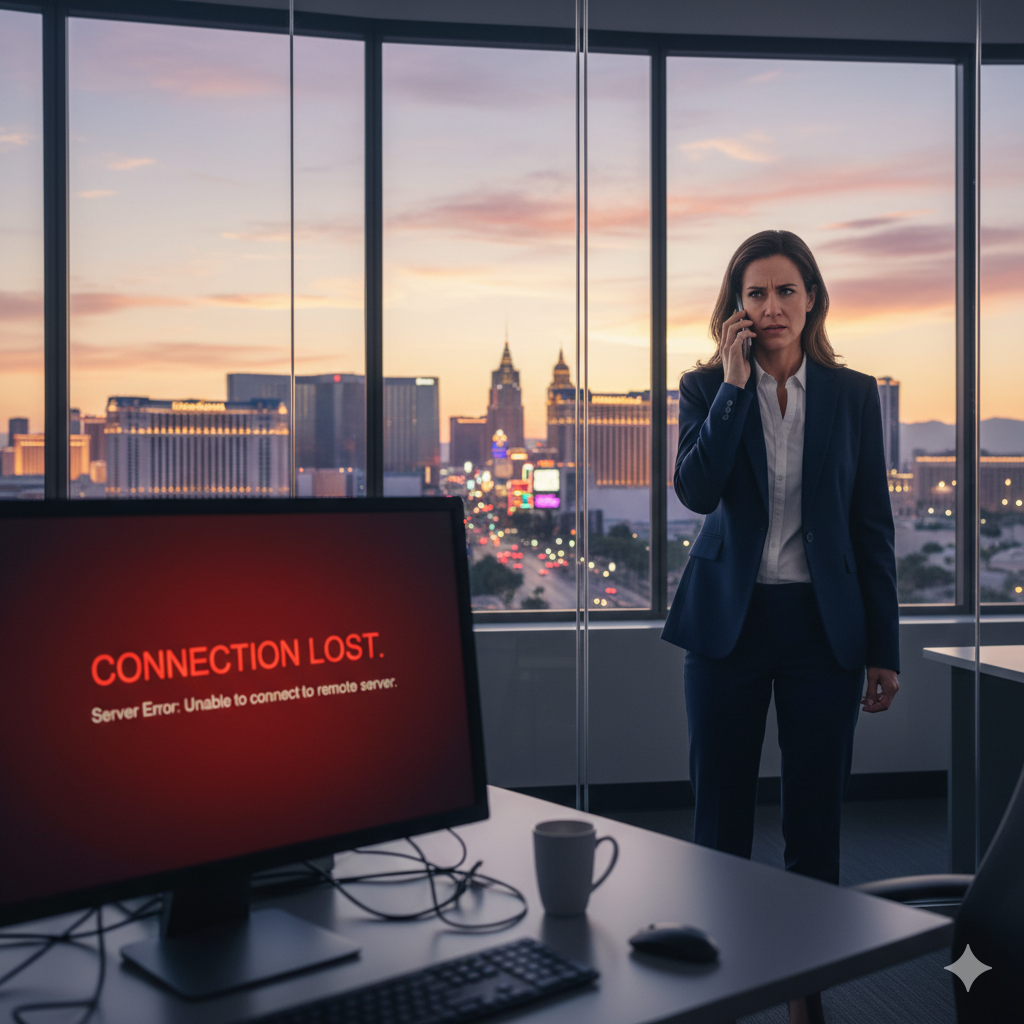
Ransomware Goes Personal: Gangs Now Threatening Employees’ Families — What Las Vegas Businesses Must Do
A new 2026 report reveals ransomware groups are escalating beyond data theft — targeting executives and their families with physical threats, AI-driven attacks, and relentless repeat strikes.
Published by CMIT Solutions of Las Vegas · Cybersecurity · 6 min read
Ransomware Is No Longer Just an IT Problem — It’s Becoming a Safety Issue
For years, Las Vegas business owners have been told that ransomware is an IT problem: back up your data, patch your systems, and you’ll be fine. That advice is now dangerously incomplete. A landmark report published October 14, 2026 by Semperis — a leading identity security firm — reveals that ransomware gangs have crossed a disturbing new line: they are now threatening employees’ families, orchestrating swatting attacks, and using AI-driven precision to crush organizations into paying.
The Semperis 2026 Ransomware Risk Report surveyed 1,200 IT and security professionals whose organizations had been successfully attacked in the past year. What they found should alarm every Las Vegas small business, hotel, law firm, medical practice, and government contractor operating in Clark County today. This is not hypothetical. This is happening now, and Southern Nevada’s economy — built on hospitality, gaming, healthcare, and professional services — makes it a target-rich environment for these groups.
In 40% of ransomware attacks, criminals used psychological or physical threats against staff. In 37% of cases, threat actors targeted victims’ family members — and in roughly 53% of those cases, they followed through. Nearly 1 in 4 victims (24%) were swatted. This is extortion, not just encryption.
How Ransomware Attacks Have Evolved in 2026
Traditional ransomware worked like this: attackers encrypt your data, demand payment, and release a decryption key if you pay. That model has been supercharged in 2026. Modern ransomware operations — run by organized criminal groups with corporate-style structures — layer multiple pressure tactics to ensure payment:
- AI-assisted attacks (84% of incidents): Attackers now use AI to automate reconnaissance, personalize phishing lures, identify high-value targets within your organization, and accelerate lateral movement once inside.
- Triple extortion: Data encryption + data theft + personal threats. Criminals exfiltrate sensitive files first, then encrypt systems, then threaten to publish the data AND harm individuals if payment is refused.
- Repeat targeting (70% of victims hit again): Paying the ransom does not end your exposure. Nearly 70% of organizations that paid were attacked again — often by the same group, exploiting the same weaknesses.
- Physical follow-through: Swatting (calling in false police emergencies to a victim’s home), threats to family members, and surveillance of executives are increasingly documented by law enforcement.
- Phishing and VPN exploitation: Akira, one of the most active 2025–2026 ransomware groups, has earned over $244 million targeting organizations through SonicWall VPN vulnerabilities and credential theft from acquired companies.
Why Las Vegas and Clark County Businesses Are High-Value Targets
Las Vegas is not immune. In 2025, the state of Nevada itself became a ransomware victim — more than 60 state agencies were disrupted, including the DMV and Department of Health and Human Services. Attackers entered through a single employee’s malware-laced software download and spent three months inside state systems before being detected. The recovery took 28 days and cost $1.3 million.
Your Clark County business faces the same risk profile. Hospitality and gaming companies hold vast stores of customer payment data and personal information — prime exfiltration targets. Healthcare practices hold HIPAA-covered records, creating enormous leverage. Law firms and government contractors handle sensitive client and contract data that can be weaponized in triple extortion. And many Las Vegas SMBs operate with lean IT teams that simply cannot detect a stealthy intrusion over days or weeks.
- ⚠ Customer data exposure: A ransomware breach exposes hotel guests, patients, and clients to identity theft — triggering PCI-DSS, HIPAA, and Nevada privacy law breach notifications.
- ⚠ Personal safety for your leadership team: The Semperis findings mean C-suite executives and managers may now face personal risk beyond the office — swatting, family threats, and surveillance.
- ⚠ Operational shutdown: The Verizon 2026 DBIR found ransomware present in 48% of breaches. A successful attack can shut down point-of-sale systems, reservation platforms, EMR systems, or billing software for days.
- ⚠ Repeat victimization: Paying once does not protect you. Without closing the underlying security gaps, you become a “confirmed payer” — and a prime target for the next campaign.
- ⚠ Reputational damage: In a city built on trust — whether that’s a hotel, a law office, or a dental practice — a public data breach or extortion announcement can permanently damage client relationships.
Three Steps Las Vegas Businesses Must Take Now
1. Audit and Harden Every Remote Access Point
THE GAP Akira and other active ransomware groups are actively exploiting VPN vulnerabilities, weak credentials, and legacy remote desktop configurations. Many Las Vegas businesses are running VPN appliances that have never had their local credentials rotated — even after firmware patches were applied.
THE FIX Immediately inventory all remote access tools — VPNs, RDP, remote monitoring software — and enforce phishing-resistant MFA on every one. For SonicWall users specifically: patch to the latest firmware AND reset all local user credentials, including SSL VPN passwords and OTP secrets. Disable any LDAP group rules that grant unnecessary VPN access. A managed IT provider can run this audit and close gaps in a single engagement.
2. Implement Immutable, Offsite Backups and Test Recovery
THE GAP Most small businesses either have no offsite backup or have backups connected to the same network that ransomware can reach and encrypt. Cloud backup configurations that store credentials in the same ecosystem (e.g., on-device cloud backup clients) can also be compromised — as SonicWall customers with MySonicWall cloud backups discovered when those configurations were exposed.
THE FIX Maintain a 3-2-1 backup strategy: three copies of data, on two different media types, with one stored offsite and air-gapped or immutable. Test restoration quarterly — not just backup creation. If you cannot restore from backup in under four hours, the backup is not a real recovery option. CMIT Solutions manages this end-to-end for Las Vegas clients so there is no guesswork in a crisis.
3. Train Employees on AI-Powered Phishing and Personal Safety Risks
THE GAP Semperis found that 84% of 2026 attacks weaponized AI — meaning phishing emails are now hyper-personalized, grammatically perfect, and tailored using publicly available information about your team (LinkedIn profiles, company websites, social media). Device-code phishing attacks — where employees are tricked into approving an attacker’s login on their own device — rose 1,380% between late 2025 and spring 2026. Your employees are the front line and cannot recognize threats they haven’t been trained to spot.
THE FIX Implement quarterly security awareness training that covers AI-personalized phishing, device-code authentication scams, and — given the new Semperis findings — what employees should do if they receive personal threats. Establish a clear incident response policy that includes HR, legal counsel, and if needed, law enforcement. Educate senior staff about reducing their personal digital footprint to limit attacker reconnaissance.
Ransomware groups now target your data, your operations, and your people. CMIT Solutions of Las Vegas gives you the managed IT services and proactive security that keep your business — and your team — protected.
Defending Las Vegas with CMIT Solutions
CMIT Solutions of Las Vegas provides managed IT services and cybersecurity support specifically built for Clark County businesses. From proactive threat monitoring and endpoint protection to employee security training and tested disaster recovery, we help local hospitality, healthcare, legal, and professional services firms stay ahead of threats — including the escalating ransomware landscape described in the Semperis 2026 report. You should not have to face a ransomware gang alone. That is exactly what managed IT services are for.
• Semperis 2026 Ransomware Risk Report (October 14, 2026) — Survey of 1,200 IT/security professionals on ransomware trends, physical threats, and AI-driven attacks.
• Las Vegas Review-Journal: Nevada Ransomware After-Action Report — Details on the 2025 Nevada state government attack timeline, impact, and $1.3M recovery cost.
Protect Your Las Vegas Business Today
Ransomware groups are escalating tactics in 2026. Don’t leave your team — or their families — exposed.
CMIT Solutions of Las Vegas — 3111 S. Valley View Blvd., Suite A205, Las Vegas, NV 89102
Prefer to talk? Call (702) 725-2877 or email LVSales@cmitsolutions.com