
Your business has an invisible presence online. It goes far beyond your website and social media accounts. Every mention on the Internet, every public record, every employee post adds to something bigger: a digital footprint. Cybercriminals pick through this data systematically, hunting for weaknesses. Harmless-looking details get pieced together fast. Suddenly, your own marketing assets double as a roadmap for targeted attacks, the kind that need costly, reactive cybersecurity services to clean up. For business owners, this stopped being just a privacy issue a while ago. It’s a critical cybersecurity concern now, one with real financial and reputational teeth. Seeing this threat the way an attacker does is step one. Defense comes after.
Mapping Your Business Through Publicly Available Information
Picture your business’s digital footprint as a map. Not a flattering one, either, since it reveals your company’s structure, operations, and weak points to anyone willing to look. There are two parts to it:
- Intentional digital traces: information you choose to share, like your corporate website and official social media accounts and posts.
- Unintentional digital footprint: data that builds up without you noticing, through website cookies, metadata buried in documents, and location data tucked inside photos.
There’s a name for this pile of available data: open-source intelligence (OSINT). Most businesses have far more of it floating around than they’d guess. And the biggest vulnerability usually isn’t a technical flaw at all. It’s the blurred line between an employee’s personal life online and their professional one. That blur creates a blind spot. Post about a technical issue on a forum, mention a new client on a professional profile, and suddenly you’ve handed attackers something useful without meaning to.
Government databases add another layer:
- Incorporation documents
- Property records
- Licensing filings
None of it looks dangerous on its own. But cybercriminals aren’t looking at single data points. They’re assembling fragments into full profiles, and that’s exactly what makes targeted attacks possible.
Assembling the Attack Plan From Your Digital Footprint
Cybercriminals keep getting better at this. Their attacks aren’t lucky guesses. They’re the product of planning, patience, and targeted reconnaissance. Automated software does a lot of the heavy lifting. Common tools include:
- Email harvesting software that pulls corporate addresses from sources like conference attendee lists
- Social media monitoring tools that track company mentions and employee activity
- Web scrapers and forum trackers that quietly log mentions of your company online
All of them are hunting for an opening. Then the real work starts: connecting dots. Small, unrelated-looking data points get stitched into profiles. Who’s an executive? Who handles the money? Once that profile is done, an attacker knows exactly who holds the keys to sensitive financial data, customer records, or high-privilege credentials.
Here’s how it plays out. A financial controller posts about an upcoming business trip. Nothing unusual there, except it hands an attacker a window. Pair that trip with a public merger announcement, and now the attacker has a target and a pretext that actually holds up. High-risk business events work in their favor for a simple reason: employees expect unusual communication during them, and trust it. Patient attackers wait for exactly this moment. And spotting the pattern early is the only real way to interrupt it before damage is done.
Also Read: Cyber Risk Assessment: Process and Benefits
Launching Targeted Attacks Using Your Own Information
Enough intelligence has been gathered, and criminals move to the next stage: building a story. A false pretext, dressed up to look real, aimed at manipulating one of your employees. These attacks come in several shapes:
- Phishing and spear phishing: attackers use lookalike email addresses to impersonate managers or executives. A fake email might quote a real project, copy your chief executive officer’s (CEO) writing style, and ask for a wire transfer.
- Vishing (voice phishing): a phone call using insider lingo and a real manager’s name dropped at the right moment to trick employees.
- AI-enhanced voice and video cloning: criminals use artificial intelligence (AI) to clone a CEO’s voice convincingly enough to authorize a fraudulent transfer, often using audio pulled from speeches or earnings calls posted on the company website.
Each one is built around a weakness that the reconnaissance already found. Geotagged photos, casual mentions of travel plans; employees hand this material over without realizing what it’s worth.
Put the pieces together, and the risk is obvious. Spotting that early is how you close the gap before attackers do.
Building Your Defenses Against Digital Footprint Exploitation
Shrink your organization’s digital footprint, and you limit what outsiders can learn. Simple as that. It’s step one in taking back control, not some optional extra. The defense comes down to three pillars:
- Policy: secure information-sharing policies that clearly define what can be shared, through which channels, and by whom. Tighten who has access to corporate social media accounts, too.
- People: security awareness education so employees recognize sophisticated social engineering attempts and handle data correctly, turning them from easy targets into active participants.
- Technology: multi-factor authentication (MFA) across every critical platform, paired with continuous monitoring and threat detection to catch vulnerabilities before they’re exploited.
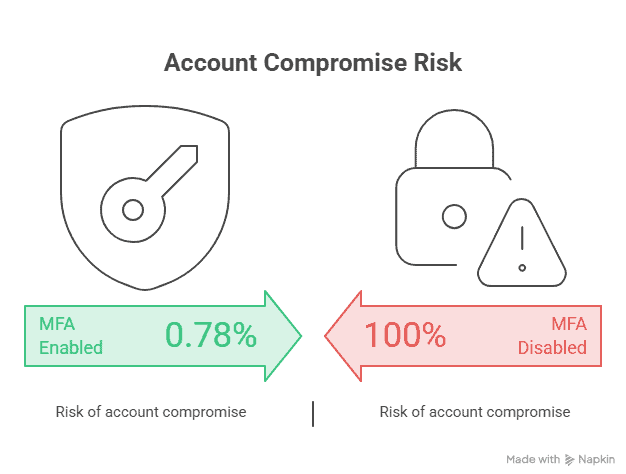
Multi-factor authentication (MFA) reduces the risk of account compromise by 99.22% — even on accounts with already-leaked credentials (98.56%).
Get all three working together, and your digital footprint stops being a threat you can’t control. It becomes an asset instead.
Take Control of Your Company’s Online Narrative
Your business’s digital footprint isn’t going away. Not in today’s connected economy. But it doesn’t have to become a liability either. Everything you do online gets logged somewhere, and attackers can and will misuse it if given the chance. The fix isn’t complicated: clear policies, the right technology, and employees who actually know what to watch for. Keep at it, and that’s how real cyber resilience gets built.
Even small changes in how you share information add up. To secure your digital footprint, contact CMIT Solutions of Silverspring today for a comprehensive cybersecurity assessment. As an IT solution provider, we can help you close the gaps before attackers find them.