
With cyberattackers increasingly focusing their efforts on exfiltrating valuable corporate data, protecting the lifecycle of your business information, including how it is accessed, stored, and transmitted, plays a massive, non-negotiable role in maintaining organizational security. This is where Data Loss Prevention (DLP) comes into play as a foundational pillar of your cybersecurity service strategy.
So, what is DLP? It is a robust security strategy engineered to prevent sensitive information from being shared outside your organization’s perimeter, whether accidentally or intentionally. It functions by systematically identifying sensitive assets and applying granular policies to control how that information is accessed, processed, and shared. The primary goal is to proactively prevent data breaches, mitigate leakage, and stop exfiltration — ensuring your sensitive data remains under strict organizational control.
This comprehensive strategy protects your information from a wide spectrum of threats, ranging from everyday employee negligence to calculated theft by external adversaries. To fully appreciate how these systems safeguard your enterprise, we must establish what this protective strategy means for your operations.
What Data Loss Prevention Actually Means for Your Business
Essentially, DLP addresses two primary, distinct categories of risk that businesses face in today’s hyper-connected environment:
- Unintended Exposure
This risk stems from simple human negligence or accidental Insider Threats. This category is surprisingly common and can include anything from misaddressed emails containing confidential attachments to the loss of unencrypted company devices or the misconfiguration of cloud-based storage buckets. - Malicious Threats
In this category, the unauthorized transfer of data, often referred to as Data Exfiltration, is entirely intentional. This could manifest as malicious Insider Threats, such as a disgruntled former employee seeking to sabotage the company, or as external cybercriminals who have successfully bypassed your network security controls and are now pivoting to steal your most valuable intellectual assets.
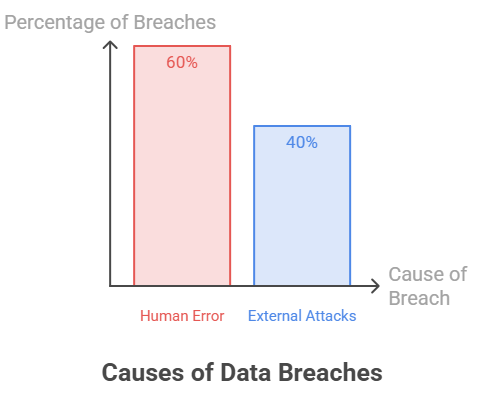
The urgency of this proactive approach is supported by industry data, which reveals that human error such as accidental misconfigurations or simple negligence accounts for 60% of all data breaches, compared to 40% stemming from external or malicious attacks.
Understanding these two risk categories is the first step. However, it is equally crucial to recognize why proactively protecting against them is a business necessity, not just a technical preference. Once you recognize these foundational organizational risks, the next step is understanding the specific technical mechanisms used to counteract them.
How Data Loss Prevention Systems Safeguard Your Information
A modern, high-performance DLP solution combines advanced technology, well-defined policies, and repeatable processes to identify, monitor, and control sensitive data across the enterprise.
The process begins with Data Discovery and Data Classification, where the system performs a deep scan of your entire IT infrastructure to locate and label sensitive information. This scanning process is comprehensive — covering all endpoints, internal file servers, remote cloud storage, and corporate email systems.
The system utilizes advanced Content Inspection to achieve this by recognizing specific, high-risk patterns such as credit card numbers, Social Security numbers, or matches to predefined, proprietary keywords. Once your data is appropriately classified, your organization can move forward with Policy Creation to define strict, enforceable rules for how that specific data type should be handled by staff and systems alike.
With these policies firmly in place, the true core of data loss prevention becomes Continuous Monitoring. This ensures that protection is applied across the information’s three distinct states:
- Data in Motion (or in transit) – This refers to sensitive information that is actively traveling across your internal network or via the public internet. Monitoring this state prevents data from being intercepted or sent to unauthorized external destinations.
- Data in Use – This state refers to information that is being actively processed, updated, or read on an employee’s workstation or mobile device. Monitoring this state prevents accidental copying or pasting of sensitive info into unauthorized applications.
- Data at Rest – This is information that is currently stored on a physical server, an employee’s hard drive, or in cloud-hosted databases. Monitoring this state ensures that stored data remains encrypted and that access permissions are not overly permissive.
When the system detects a potential policy violation, it immediately initiates Policy Enforcement by triggering an automated, pre-configured response. These actions can include sending a real-time alert to the security team, automatically encrypting the data to prevent unauthorized viewing, or blocking the transfer entirely to prevent a leak.
This systematic cycle of discovery, monitoring, and enforcement can be deployed in diverse ways to provide a layer of protection across your entire, evolving IT infrastructure. Modern corporate networks are highly decentralized. These monitoring systems are built to deploy across multiple environments.
Also Read: Zero Trust Security for Small Business
Exploring Different Types of Data Loss Prevention Solutions
A data loss prevention solution is rarely a one-size-fits-all product. Rather, it is a versatile strategy that is typically deployed in three primary models to safeguard data across your disparate IT environments:
- Network DLP – This solution is strategically deployed at your network’s perimeter, where it serves as a digital gatekeeper, monitoring and controlling all data traffic entering and leaving your organization. It inspects traffic from critical sources like enterprise email systems and web applications, offering robust protection across both legacy on-premises data centers and modern cloud-based environments.
- Endpoint DLP – In contrast, Endpoint DLP tools operate differently, as they run directly on individual user devices (endpoints) to manage data actions at the very source of creation. This DLP solution monitors all network endpoints, including corporate servers, employee laptops, and workstations, and can block high-risk actions, such as copying sensitive files to an unencrypted USB flash drive or uploading them to personal cloud storage.
- Cloud DLP – Finally, Cloud DLP is purpose-built to protect the data you store, collaborate on, and share within cloud-native environments and SaaS applications. Its primary function is to secure sensitive information stored in the cloud from unauthorized access, ensuring your data remains protected even when it resides outside your physical office walls.
While each of these types serves a specific, vital purpose, a truly comprehensive DLP security strategy often combines these deployment models for maximum, layered protection. However, successful deployment is about far more than just purchasing the right technology. It requires a clear, strategic, and human-centric plan to be truly effective.
To bridge the gap between technical deployment and operational success, organizations must follow structured implementation guidelines.
Key Best Practices for Implementing a DLP Strategy
Simply having a powerful DLP solution installed is not enough to keep advanced attackers at bay. Its real-world effectiveness depends entirely on a well-defined and consistently updated data loss prevention strategy. To ensure a successful, long-term rollout, you should follow these foundational industry best practices:
- Define your objectives clearly
Begin by establishing your primary goals, whether for regulatory compliance, general data protection, or rapid incident response, and then focus on identifying and classifying your most sensitive data so you know exactly what needs to be protected first. - Map your data flows
Carefully document where sensitive information is created, how it is stored, and with whom it is shared. This includes mapping your cloud-based applications, third-party service partners, and the requirements of your remote and hybrid workforce environments. - Start with high-risk channels
Prioritize your controls on the most common high-risk channels, such as email attachments and removable storage devices. This allows you to achieve the highest possible security impact very early in the implementation process. - Balance security with productivity
Develop a DLP policy that carefully balances robust security with employee productivity. Policies that are overly strict can disrupt legitimate business operations, frustrate your team, and increase false positives that overwhelm your security analysts. - Invest in user education
Prioritize ongoing awareness programs. Comprehensive, engaging cybersecurity training is absolutely essential, as it helps your employees understand their critical role in safeguarding sensitive company data.
Performing regular, scheduled testing and deep-dive audits will confirm that your DLP solution is functioning exactly as intended and identify any subtle gaps that may require attention to ensure the system remains effective as your business grows and changes. Adhering to these best practices allows your business to transition from a reactive defense posture to a long-term security framework.
Building a Proactive Data Protection Strategy
Data Loss Prevention is a fundamental, critical component of any modern, mature cybersecurity strategy. Implementing a proactive DLP strategy is a vital step toward achieving comprehensive data protection that improves your overall cybersecurity posture. This ongoing, iterative process demonstrates a proactive, board-level commitment to safeguarding sensitive information — ensuring you consistently meet complex regulatory requirements and preserving the long-standing trust of your customers.
Because protecting your business from these complex, evolving threats is an ongoing commitment, partnering with a trusted, experienced expert is essential to your success. For comprehensive IT services that protect your infrastructure and your reputation, trust the dedicated experts at CMIT Solutions of Silver Spring, MD. Contact us today for a comprehensive IT assessment to get started.