

On the morning of April 1, 2026, two weeks before the filing deadline, one of the most widely used cloud accounting platforms stopped letting people sign in. Outage reports started climbing around 8:30 a.m. Eastern. Users could not reach payroll, invoicing, bank feeds or tax tools, while the provider’s own status page still showed no incidents. Service came back gradually through the afternoon. For a CPA office in Woodbridge or Gainesville, that is a lost morning in the busiest month of the year. It is also the mild version. A ransomware attack or a dead server with no working backup can shut a firm down for weeks. A plan for data backup and recovery for accounting firms decides which of those two outcomes you get.
What Happens When Accounting Software Goes Down?
The first hour looks harmless. Staff refresh the page, restart computers and wait. Then client calls start, and nobody can pull up a file, confirm a payment or finish a return. By the afternoon, the costs are adding up. Payroll may run late, bank reconciliations stall, and partners spend billable hours apologizing to clients instead of serving them. If the outage hits close to a deadline, some returns may need extensions that clients did not expect.
A longer outage is a different problem. A case shared through the AICPA’s professional liability insurance program this fall shows how bad it can get. Ransomware locked one firm’s workstation, both of its servers and its local backups. The firm’s cloud backup had stopped syncing, so there was no clean copy to fall back on. The firm was down for several weeks and had to redo hours of finished work. That firm owned backups. They simply did not work when needed. Data backup for CPA firms is only as good as the last copy someone checked.
The wider numbers show how common this is. In Sophos’s State of Ransomware in Financial Services 2026 survey, attackers encrypted data in 59% of attacks on financial firms. The average recovery cost, not counting any ransom, was $1.5 million. The better news: 75% of those firms got their data back from backups, up from 44% the year before. This is why business continuity for accounting firms matters as much as the backup itself. Continuity is about how your people keep serving clients while systems are being restored, and which work can wait.
Few small firms have this written down. Providers of business continuity services in Prince William County usually start with a short working session: which work can wait, which clients get a call first, and who can reach what from home.
How Do Accounting Firms Recover Financial Records?
Recovery depends on what broke. These are the three situations most firms face, and what gets you back in each one.
When the Software Vendor Has an Outage
If your accounting software lives in the cloud, an outage on the vendor’s side is out of your hands. What you control is whether your team can still work. Accounting software backup and recovery starts with a regular export or separate copy of your data, stored outside the vendor’s system. With it, staff can still look up balances, client records and prior work while the vendor fixes its side.
The same thinking applies to email and shared files. Microsoft 365 keeps your data running, but it is not a full backup. A separate cloud backup for accounting firms lets you restore deleted emails, overwritten spreadsheets or a departed employee’s OneDrive. Test this once before you need it. Ask a staff member to pull last month’s numbers from the copy, without opening the software, and see how long it takes.
When a Server or Computer Fails
Hardware fails without warning, and it rarely picks a quiet week. If your firm still runs a server for tax software or document storage, a failure can stop everyone at once. A file-level backup brings back documents. A full image backup brings back the whole server, with its settings and software, so you rebuild in hours instead of reinstalling everything over several days. CISA’s StopRansomware Guide calls these “golden images” and recommends keeping them updated.
That is the part of disaster recovery for accounting firms that most offices skip. Copies of files are not much use until the systems that open them are running again, in the right order. If a drive is badly damaged and no image exists, specialist recovery from the failed hardware is the fallback. It is slow, costly and never guaranteed.
When Ransomware Strikes
Ransomware is the hardest case, because attackers often go after backups first. Any copy that stays connected to your network can be locked along with everything else. CISA’s guidance is plain: keep offline, encrypted backups of critical data, and test them regularly in a recovery scenario. Ransomware recovery for accounting firms then means restoring from a clean copy taken before the attack, once the infection is removed.
Speed also depends on how early someone notices. A monitoring team that sees unusual activity at 2 a.m. can cut off one machine before the attack reaches the server or the backups. That kind of round-the-clock watch is what managed cybersecurity services in Prince William provide. Our guide to what managed cybersecurity costs in Northern Virginia explains how pricing works.
Backup and Disaster Recovery Are Not the Same Thing
A backup is a copy of your data. Disaster recovery is the plan and the setup that turn that copy back into a working office. Most financial data backup solutions handle the first part well. The gap shows up when a firm has copies of its files but no tested way to restore a server, reconnect staff and get software running again.
Ask your current provider two questions: where are my copies, and how long until my staff can work again? Most can answer the first one quickly. Fewer have tested the second. With cloud backup and disaster recovery for financial firms handled by one team, the people who keep the copies also practice bringing them back.
What Should a Reliable Backup and Recovery Plan Include?
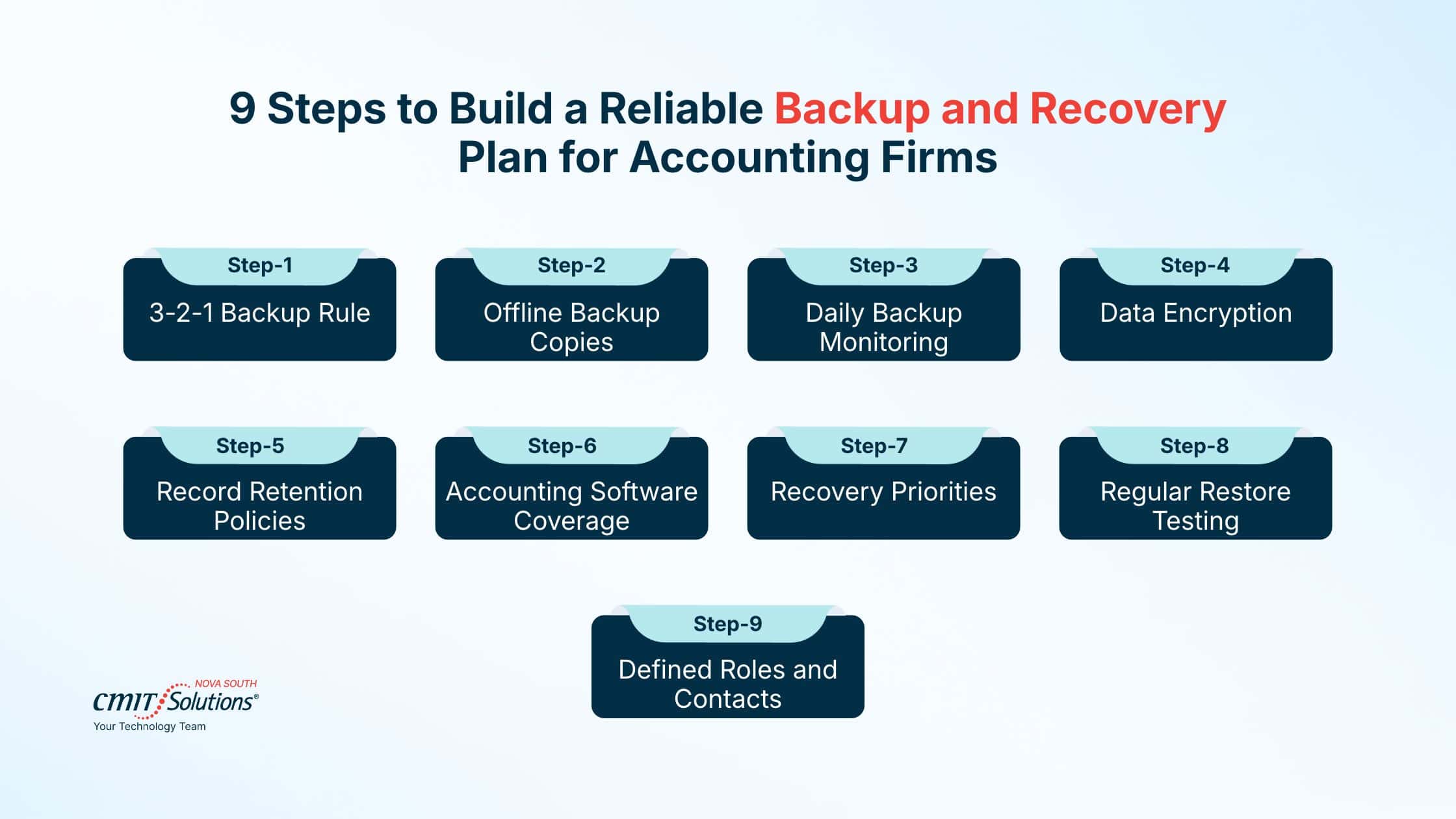
Disaster recovery planning for accounting firms does not need a thick binder. A few pages will do, as long as they cover these points:
- Three copies, two types of storage, one off-site. This 3-2-1 rule means one bad event cannot wipe out every copy.
- One copy the network cannot touch. An offline or locked copy survives ransomware that reaches everything else.
- Daily checks. Failed backups often go unnoticed for weeks. If nobody in the office has time to confirm each night’s backup finished, managed backup services in Prince William County can take that job over.
- Encryption. IRS Publication 4557 recommends encrypting backups of taxpayer data, and the FTC Safeguards Rule calls for encrypting customer information.
- Retention that matches your obligations. The IRS says businesses should generally keep records for three years, and employment tax records for at least four. Your own policies may run longer.
- Coverage for your software. Accounting software backup solutions for CPA firms should cover your tax program’s data and settings as well as the documents around it.
- A recovery order. Decide which systems come back first, how quickly, and how much recent work you can afford to lose.
- Restore tests. Restore real files and, at least once a year, a full server. Time how long it takes.
- Roles and contacts. Name who declares an outage, who calls the insurer, and who contacts your IRS Stakeholder Liaison if client data is involved. This is the heart of business continuity planning for CPA firms in Prince William County.
These points also belong in your Written Information Security Plan. IRS Publication 5708 gives tax and accounting practices a template to build from. Good data backup and recovery solutions for accounting firms make most of this automatic. What should never be automatic is the yearly review, where partners confirm the plan still matches how the firm works. For the wider security picture, read our guide to cybersecurity for Prince William County accounting firms.
Choosing a Backup and Recovery Partner in Prince William County
Many firms only go looking for data recovery services for accounting firms in Prince William County after something has already gone wrong. It is easier, and cheaper, to choose a partner while everything still works. Ask these questions before you sign:
- How often do you test restores, and will you show me the results?
- How quickly can you restore a single file, and how quickly a full server?
- Where are my backups stored, and is one copy kept off my network?
- Who watches the backups each day, and what happens when one fails?
- Can you come on-site if hardware needs to be rebuilt?
Vague answers are a warning sign. A good provider can answer each one in plain language and show you a recent restore test. Ask, too, who picks up the phone. IT support for accounting firms in Prince William County should mean a local team that knows your software and your deadlines, not a ticket queue in another state.
How CMIT Solutions of NOVA South Helps
CMIT Solutions of NOVA South works with accounting firms, CPAs and wealth managers from our office on Liberia Avenue in Manassas, a short drive from Woodbridge, Dale City, Gainesville, Bristow and Haymarket. Our managing partner, Somu Valliappan, spent years in banking and financial services, so the rules around client financial data are familiar ground. Our data backup services in Prince William County, VA cover servers, workstations, laptops and Microsoft 365. We follow the 3-2-1 approach, check every backup daily, run scheduled test restores and send you a short report showing what is protected.
When something does go wrong, we restore from clean copies taken before the attack and confirm the infection is gone before staff reconnect. Single files and mailboxes can usually be restored within hours. Every client gets a written plan that ranks which systems return first, and we review it with you each year. When hardware needs rebuilding, our technicians come on-site.
Some firms would rather have one team for everything. Our managed IT services in Prince William County combine backup with help desk support, security and network management, so a failing switch is caught before it takes the office offline. Call CMIT Solutions of NOVA South at (571) 720-9555 or book a free backup check. We will review your current backups, test a restore and tell you plainly where the gaps are.
Frequently Asked Questions
What happens to an accounting firm when its accounting software goes down?
Work stops on anything that depends on the software: returns, payroll, reconciliations and client questions. A short outage costs a few hours. A longer one, without a backup plan, can push filings past deadlines and force staff to redo finished work.
How often should accounting firms back up their financial data?
At least once a day, and more often in busy season if your team enters a lot of work. Ask how many hours of entries you could stand to redo, and set the schedule to match. With managed data backup services for accounting businesses, backups run on that schedule without anyone having to remember them.
How can accounting firms recover financial data after a server failure or ransomware attack?
After a server failure, restore from a full image backup onto new or repaired hardware. After ransomware, first remove the infection, then restore from an offline copy taken before the attack. If no usable backup exists, data recovery services in Prince William County may be able to pull files from damaged drives, though results are never guaranteed.
What is the difference between data backup and disaster recovery for accounting firms?
Data backup protects copies of your files. Disaster recovery restores the systems, software and access your staff need to work again. When comparing cloud backup services in Prince William County, check which of the two you are actually buying.
What should a disaster recovery plan include for a CPA or accounting firm?
For most firms, a disaster recovery plan for small accounting firms fits on a few pages. It should list your critical systems, the order to restore them and how much downtime and lost work you can accept, plus backup locations, restore test results and who is responsible for each step.
Who provides data backup and disaster recovery services for accounting firms in Prince William County, VA?
CMIT Solutions of NOVA South provides data backup and disaster recovery services in Prince William County, VA from its Manassas office, with monitored backups, tested restores and on-site recovery support. Call (571) 720-9555 to book a free backup check.