Two recent cyberattacks on independent Texas CPA firms highlight a dangerous trend: ransomware groups are aggressively targeting local accounting practices. In separate incidents during the summer of 2026, malicious actors successfully breached corporate networks to steal highly sensitive data.
One regional firm fell victim to the Akira ransomware group, resulting in the theft of 40 gigabytes of client and employee tax and payroll records. Around the same time, another firm was compromised by the Incransom group and placed on a dark web data leak site.
The wire fraud attempts, spoofed client emails, and ransomware hits we see against Prince William County accounting firms cluster around one thing: firms that treated cybersecurity as a January-to-April project and let it lapse the rest of the year. Client financial data is a year-round target, and the defenses have to be just as robust.
The IRS, the FTC, and your E&O carrier all agree: accounting firms in Prince William County are year-round targets. Yet, most measures of cybersecurity for accounting firms still aren’t treated that way. Here is what a small- to mid-size accounting firm in Prince William County actually needs to know and what it takes to stay defensible the other nine months of the year.
Why accounting firms are a top target
Accounting or wealth management firms usually have access to exactly the data that the attackers want. Social Security numbers, EINs, bank account details, wire instructions, prior year returns, W-2s. One firm can hold financial records for hundreds of clients, which is why cybersecurity for accounting firms has become a speciality category instead of a subset of general small business IT.
Small accounting firms get hit hardest. Attackers assume the defences are thinner than at a large regional firm, and they are usually right. Business email compromise, ransomware, and tax return fraud are the three attacks we see most often against cybersecurity service Northern Virginia accounting firms in the 5 to 40 person range.
What the compliance rules actually require
There are three regulations every accounting or CPA firm in Prince William needs to know about:
- IRS WISP requirements for CPAs: Every paid tax preparer is required by law to have a Written Information Security Plan. Not “should have”. Required. It is enforced through the PTIN renewal process, and the IRS publishes a template in Publication 5708. If you cannot produce a current WISP on request, you are out of compliance today.
- FTC Safeguards Rule for Accounting Firms: The updated Safeguards The rule pulled accounting and tax firms squarely into scope. It requires a designated qualified individual overseeing security, a written risk assessment, access controls, encryption of customer information at rest and in transit, multi-factor authentication, and an incident response plan. Larger firms also owe annual written reports to leadership.
- IRS Publication 4557: This is the practical guide the IRS points preparers to. It walks through safeguards for taxpayer data, breach reporting procedures, and vendor management. Making your CPA firm compliant with IRS Publication 4557 mostly means aligning your WISP and daily security controls to what 4557 lays out.
Cybersecurity compliance for accountants is not one framework. It is the overlap of these three, plus whatever your state board or malpractice carrier adds on top.
The threats a Prince William CPA firm actually faces
Ransomware protection for CPA firms matters because a locked-out firm during filing season is a firm that misses deadlines, loses clients, and pays extortion. Attackers know the calendar.
Business email compromise is the single most expensive attack on small accounting firms right now. A spoofed email from a partner telling staff to change a client’s wire instructions, sent on a Friday afternoon, works far more often than it should.
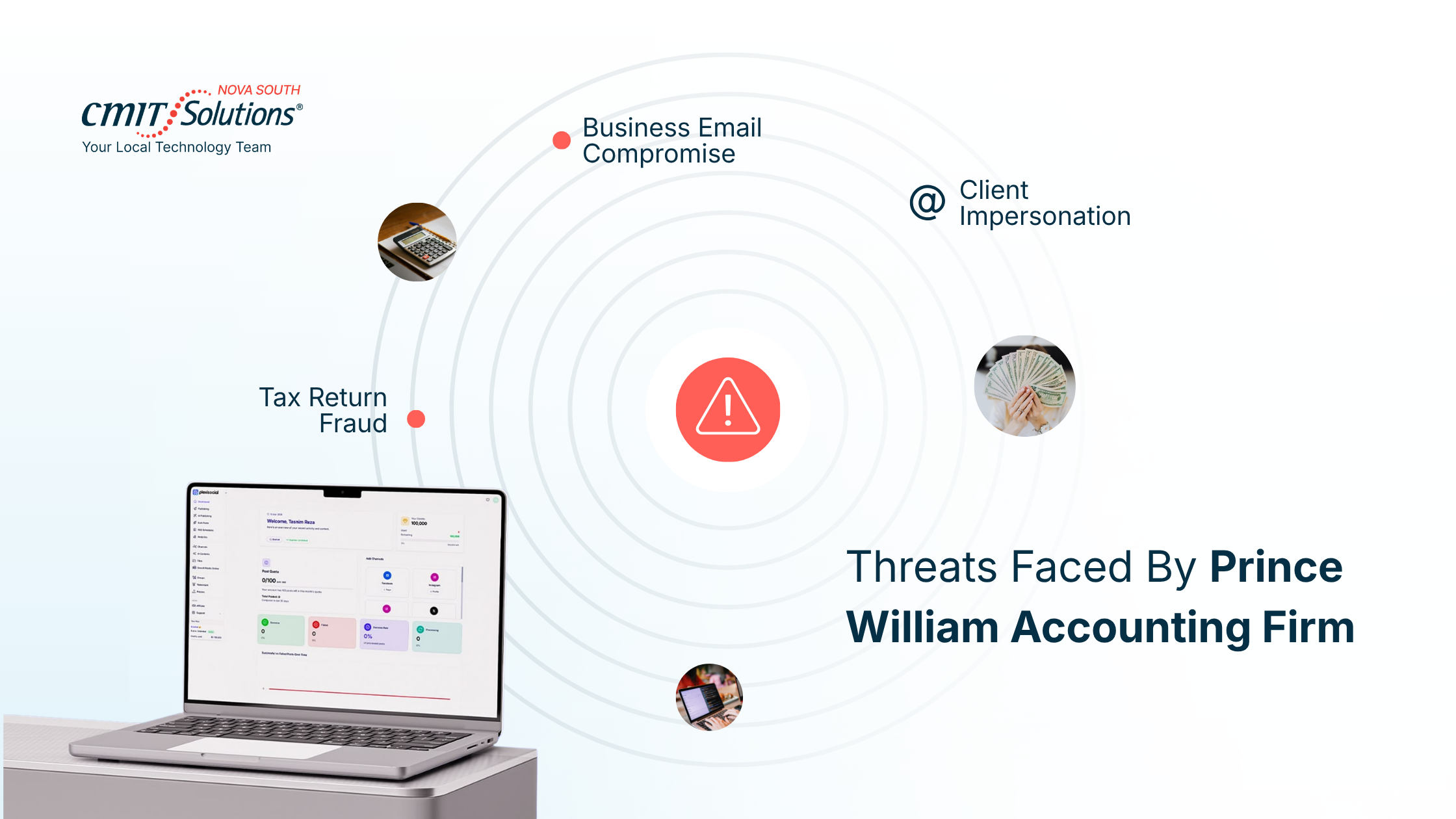
Tax return fraud, where attackers file fraudulent returns using client data pulled from a compromised preparer. Client impersonation, where attackers hijack a client’s email and use it to redirect refunds or request document releases.
Cybersecurity best practices for accountants
Year-round protection comes down to a short list done consistently. Here’s what the list entails:
- Multi-factor authentication on every application that touches client data, including your tax software, your document portal, your email, and your accounting platform. No exceptions.
- Endpoint protection and 24/7 monitoring on every laptop and workstation so that you catch ransomware before it spreads.
- Encrypted email or a secure client portal for any document exchange. Attachments over regular email are a Safeguards Rule violation waiting to happen.
- Backups that get tested, not just installed.
- Documented incident response, so if something goes wrong at a random time, someone actually knows what to do.
- Vendor management, including a written record of who touches your data and what security controls they have in place.
- Staff training, particularly on wire fraud and invoice spoofing, is refreshed at least twice a year.
Dealing with accounting firm data breach protection must involve the sum of these steps, instead of simply relying on a tool.
Is your firm’s data safe in the cloud?
Yes, when the cloud is configured correctly. No, when it is not. Cloud tax platforms and document portals are generally more secure than the on-premise setups they replaced, but they still require MFA, correct sharing permissions, and a real backup of your data outside the vendor’s environment. Cloud is not a substitute for security. It is a different surface to secure.
What it costs
Managed cybersecurity services in Northern Virginia sit within a fairly predictable range for accounting firms, though the exact number depends on the size of your team, the depth of response you want, and how much compliance work is bundled in. Firms handling client financial data almost always land toward the higher end of the market range because of the documentation, audit trail, and vendor management work involved.
The honest answer is that pricing is a conversation, not a form. What matters more than the number is knowing what is actually inside the bundle before you sign, and whether it covers what the IRS and FTC now expect.
What to do if you get breached
- Do not touch anything.
- Isolate affected systems, call your cyber insurance carrier and your MSP immediately, and preserve evidence for the forensic team.
- Notify the IRS Stakeholder Liaison.
- Notify affected clients per state breach law and per the Safeguards Rule.
- Document everything.
A firm that responds well to a breach usually keeps most of its clients. A firm that responds badly usually does not.
Working with a local partner
Prince William County has a strong bench of cybersecurity and managed IT providers supporting local small businesses, and choosing the right one comes down to whether they actually understand the compliance load an accounting firm carries.
As a locally operated CMIT Solutions location backed by a national network of IT and security resources, we bring big-provider infrastructure to a Prince William County accounting firm without the big-provider price tag. We support CPAs and small firms across Prince William, Manassas City, Fairfax, and Stafford with managed IT security Prince William firms can rely on, cybersecurity service Prince William County accounting practices actually need, and the compliance documentation the IRS and FTC now expect.
Call CMIT Solutions of NOVA South at (571) 720-9555 or book a scoping call, and we will walk through your current setup and what it would take to close the gaps.
Frequently Asked Questions
1.What cybersecurity requirements do CPA firms have to follow?
The IRS WISP requirement, the FTC Safeguards Rule, and the safeguards laid out in IRS Publication 4557. Most states and malpractice carriers add their own on top.
2. Do accounting firms need a Written Information Security Plan (WISP)?
Yes Every paid tax preparer is required to have one, and it is tied to your PTIN renewal.
3. What is the FTC Safeguards Rule, and does it apply to CPAs?
It is a federal rule requiring specific security controls, written risk assessments, and incident response plans. It applies to accounting and tax firms of nearly every size.
4. Why are accounting firms a common target for cyberattacks?
They hold high-value financial data on hundreds of clients per firm, and small firms typically have thinner defenses than a large regional firm would.
5. How can CPAs protect client financial data year-round, not just at tax time?
MFA everywhere, 24/7 monitoring, tested backups, encrypted client communication, and a documented incident response plan.
6. What should a CPA firm do after a data breach?
Isolate the systems, call your insurer and MSP, notify the IRS Stakeholder Liaison, notify affected clients per state and federal rules, and document the response.
7. How much does cybersecurity cost for a small accounting firm?
It depends on user count, device count, depth of response, and compliance load. Firms handling financial data typically sit toward the higher end of the market range. A scoping call is the fastest way to a real number.
8. What are the most common cyber threats facing accountants?
The most common accountants must be wary of include ransomware, business email compromise, tax return fraud, and client email impersonation.
9. Is my accounting firm’s data safe in the cloud?
Only if MFA, permissions, and an independent backup are configured correctly. The cloud is a surface to secure, not a security solution on its own.
10. How do I make my CPA firm compliant with IRS Publication 4557?
Build a WISP aligned to it, put the safeguards it describes into daily practice, and document your vendor and incident response processes.