Deepfake scams slip past basic cybersecurity services because those tools scan email attachments and network traffic, not whether the voice on a call actually belongs to who it claims to be. A A convincing voice or video call doesn’t need to go through your spam filter to reach your team, a risk Shenandoah Valley , Winchester businesses are running into more often.
Key Takeaways:
- Your security tools watch for email, malware, and network threats, but voice and video impersonation slips right past almost all of them
- A Hong Kong employee at engineering firm Arup wired $25 million after joining a video call where every other participant turned out to be an AI-generated deepfake, according to CNN
- Deloitte’s Center for Financial Services projects generative AI is projected to significantly increase US fraud losses in coming years, according to Deloitte’s Center for Financial Services
- FinCEN issued a formal alert in November 2024 warning financial institutions about fraud schemes built around deepfake media
- A deepfake voice scam can be built from just a few seconds of publicly available audio, according to FTC consumer warnings
- Verification callbacks, not caller ID or voice recognition alone, are still the most reliable defense Shenandoah Valley businesses have against AI-enhanced impersonation
Why Deepfake Scams Slip Past Basic Cybersecurity Services
Most small business cybersecurity tools catch a specific set of threats: malicious attachments, suspicious links, unusual network activity. None are built to ask whether the voice on the phone belongs to the person it claims to be.
Basic cybersecurity services typically include antivirus software, spam filtering, and a firewall. Those tools do real work against traditional threats, but a deepfake attack doesn’t arrive as a malicious file or link. It arrives as a phone call or video meeting that looks and sounds normal, going straight after human judgment instead of the controls you already trust.
Read More About: Network Security Threats Hitting Virginia in 2026
How Does a Deepfake Voice Scam Actually Work?
A deepfake voice scam clones a real person’s voice from public audio, then uses that clone on a call to pressure a Winchester employee into transferring money or handing over credentials. Standard email protection never sees it coming.
Deepfake voice scam defined:
It’s a fraud technique where AI-generated audio clones a real person’s voice, often pulled from public recordings, then uses it in a call to convince someone to transfer money or share credentials.
According to FTC consumer alerts, criminals can clone a voice from just a few seconds of audio pulled from a public video or social clip. Executives who speak at industry events may have unknowingly handed scammers that material.
How little audio a deepfake needs:
Three to five seconds of publicly available audio, like a company video or voicemail greeting, is enough for AI tools to generate a convincing voice clone.
The scam usually opens with urgency: a caller posing as a boss demands an immediate wire transfer, gift card purchase, or password reset. AI-generated phishing calls carry a believability a phishing email never had.
Read More About: Microsoft 365 Small Business Setup & Security Guide
CEO Fraud Deepfake Calls Targeting Small Businesses
CEO fraud isn’t new, but deepfake technology has made it far more convincing. In one widely reported case, an employee at British engineering firm Arup sent $25 million after joining a video call where senior executives, all AI-generated deepfakes, requested the transfer. CNN reported the employee made 15 separate transfers before the fraud was caught.
CEO fraud deepfake defined:
Attackers use AI-generated audio or video of a real executive to authorize fraudulent payments, exploiting the trust employees naturally place in a request from leadership. Deloitte’s Center for Financial Services projects generative AI could push US fraud losses to $40 billion by 2027, up from $12.3 billion in 2023. Shenandoah Valley businesses aren’t immune just because they’re smaller than Arup.
A Familiar Voice Isn’t Proof Anymore
We can help you build verification protocols and layered protection that catch what basic antivirus and spam filters miss.
Why Is Multi-Factor Authentication Bypass a Growing Risk?
Multi-factor authentication bypass is a growing risk because deepfake-enabled social engineering beats it through human manipulation, not a technical exploit. An AI-generated voice impersonating IT support can talk a Shenandoah Valley , Winchester employee into reading a verification code aloud, and the second factor is gone.
FinCEN’s November 2024 alert warned institutions that fraudsters use deepfake media to bypass identity verification, including video checks once considered reliable.
What Does a Managed Cybersecurity Services Provider Add?
A managed cybersecurity services provider adds the layered approach basic antivirus software can’t: verified callback procedures, employee training, and account monitoring built to catch human-targeted fraud.
Callback verification should apply to any request involving money or sensitive data, confirmed through a known phone number, not the call that came in. Staff who understand how convincing these calls have become are more likely to pause and check.
Most reliable defense against deepfake fraud:
A callback verification rule that confirms any unusual request through a known phone number, independent of the call or video where the request was originally made.
A cybersecurity company Winchester VA businesses can rely on should also watch for the account-access patterns these scams typically produce, like unusual wire requests or after-hours password resets.
Build Verification Into Every High-Risk Request
We can help Winchester-area businesses put callback procedures and layered monitoring in place before a deepfake call ever reaches an employee, so you have the right fit for how you actually operate.
Business Cybersecurity Services Cost for Deepfake Protection
Business owners searching for cybersecurity services near me often assume protection against deepfake fraud has to come with an enterprise-level budget. That’s rarely true for small and mid-sized businesses.
Business cybersecurity services cost for layered protection, including verification protocols, training, and monitoring, is usually bundled into one predictable monthly plan rather than billed as a standalone product. The real comparison isn’t that fee against doing nothing. It’s that fee against a single deepfake incident, which can run into hundreds of thousands of dollars in wire fraud losses.
How to Protect Your Business From Deepfake Fraud
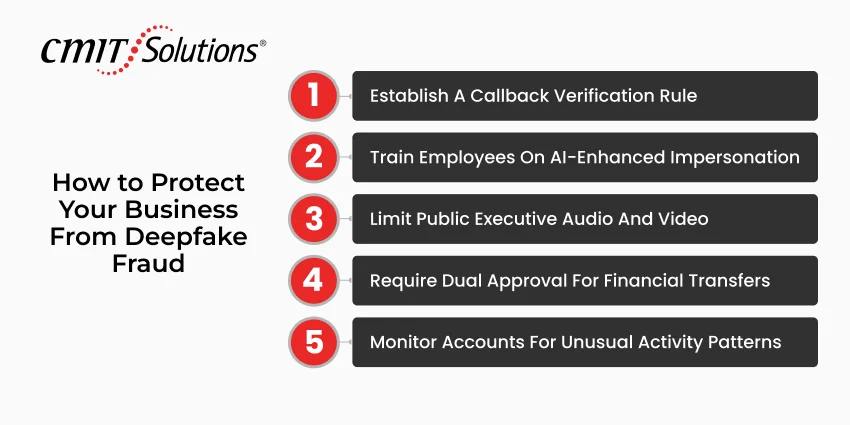
Step 1: Establish a Callback Verification Rule
Every employee should independently verify any unusual payment or data request by calling back on a known phone number, never one given during the suspicious call itself.
Step 2: Train Employees on AI-Enhanced Impersonation
Train your staff on just how convincing AI-generated phishing calls and deepfake voices have gotten, so they pause and verify instead of acting on urgency alone.
Step 3: Limit Public Executive Audio and Video
Take stock of how much public audio and video of your executives is already online, since even a few seconds can supply enough material for a convincing voice clone.
Step 4: Require Dual Approval for Financial Transfers
Require two separate people to sign off on any wire transfer above a set threshold. Dual approval breaks the single point of failure most CEO fraud deepfake scams rely on.
Step 5: Monitor Accounts for Unusual Activity Patterns
Put monitoring in place that flags unusual login times, password resets, or financial requests outside normal patterns, catching what slips past employee judgment.
Conclusion
Deepfake fraud exploits what basic cybersecurity services were never built to check: whether the voice or face on a call is genuinely who it claims to be. As AI-generated impersonation gets easier to pull off, businesses relying only on antivirus software and spam filters stay exposed.
CMIT Solutions Northern Shenandoah Valley can help Winchester-area businesses build the verification protocols, employee training, and layered monitoring that basic tools miss, so you’re not so your business has the layered protection modern threats require.
If your current protection stops at email filtering, contact our Winchester team to schedule a free assessment of your deepfake and impersonation risk.
FAQs
How do deepfake scams work?
Deepfake scams use AI-generated audio or video that clones a real person’s voice or face, then use that clone on a call to convince an employee to transfer money or share credentials.
Can deepfake voice scams get past basic cybersecurity tools?
Yes. Basic cybersecurity tools scan for malicious files and links, not whether the voice or face on a call is real. A convincing deepfake slips right past them.
How can businesses protect against deepfake fraud?
You can protect your business by requiring callback verification for unusual requests, training employees on AI impersonation, and requiring dual approval for transfers.
What is a deepfake phishing attack?
It’s an attack that uses AI-generated audio or video impersonation instead of a fake email to trick an employee into approving a payment or sharing credentials.
How much does managed cybersecurity protection against deepfake fraud cost?
Layered protection against deepfake fraud is usually bundled into a predictable monthly managed cybersecurity plan, not sold as a separate enterprise product.