

Moving your business to the cloud sounds straightforward until something goes wrong. A misconfigured server. Data that won’t sync properly. Security gaps you didn’t even know existed. For small and mid-sized businesses across Virginia’s Shenandoah Valley, these aren’t hypothetical scenarios. They’re the everyday reality of cloud migration when proper IT infrastructure management isn’t in place.
Cloud adoption isn’t just about signing up for Microsoft 365 or moving files to a remote server. It’s about building a foundation that supports your business operations, protects sensitive data, and scales as you grow. Your network infrastructure, servers, endpoints, and security systems need to work together seamlessly before, during, and after any cloud migration. For Virginia businesses, getting this right means reduced downtime, stronger ransomware protection, and technology that actually supports growth rather than creating constant headaches.
The Real Cost of Skipping Infrastructure Planning
You’ve probably heard cloud migration horror stories from other business owners. Data loss during transfer. Weeks of productivity disruption. Security breaches that happened because old systems weren’t properly decommissioned. These problems don’t occur because cloud technology is inherently risky. They happen because businesses skip the essential infrastructure groundwork.
Consider what unfolds when you migrate to cloud-based infrastructure without addressing your existing network setup. Legacy systems can’t communicate with new cloud applications, creating frustrating bottlenecks. Security policies don’t extend properly to remote workforce infrastructure, leaving gaps that cybercriminals love to exploit. Backup systems develop holes during the transition period, and performance tanks because your network was never designed to handle cloud traffic patterns. A comprehensive business IT infrastructure management approach addresses every one of these concerns before you flip the switch on cloud services.
Read More About: The Hidden Costs of DIY IT Support for Shenandoah Businesses
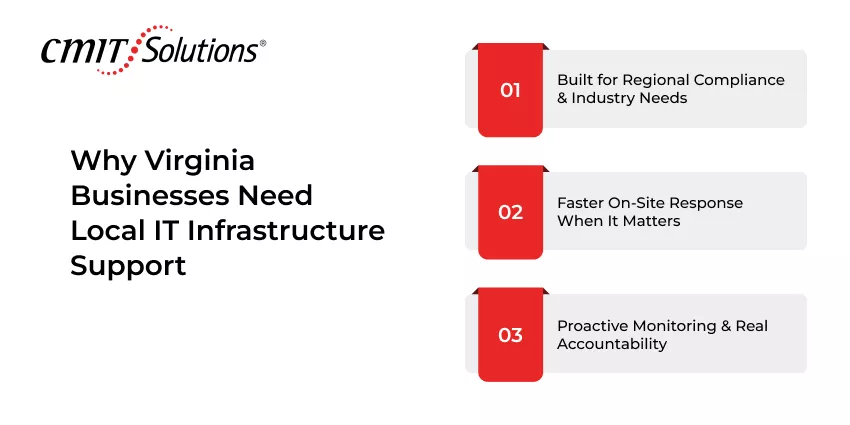
Why Virginia Businesses Need Local IT Infrastructure Support
Healthcare practices face strict compliance demands. Retailers rely on stable point-of-sale systems. Professional firms must safeguard confidential data. Manufacturers depend on specialized equipment that cannot afford downtime. A local IT infrastructure management partner delivers enterprise-class capabilities with the responsiveness only a community-based team can provide.
Built for Regional Compliance & Industry Needs
From healthcare to financial services, Virginia businesses must meet evolving regulatory standards. Local experts understand these requirements and help align your infrastructure accordingly.
Faster On-Site Response When It Matters
Remote support solves many issues—but not all. When hardware fails or networks go down, having technicians nearby means quicker resolution and less disruption.
Proactive Monitoring & Real Accountability
24/7 monitoring catches issues early. Real people answer your calls. And technicians who know your systems can start troubleshooting immediately—keeping your business productive and protected.
Building Secure IT Infrastructure for Cloud Success
Cloud migration without proper infrastructure security is like installing an expensive alarm system in a house with no locks on the doors. The technology only works when the foundation supports it properly.
Before any cloud adoption initiative, several infrastructure security elements need attention. A thorough network infrastructure assessment identifies vulnerabilities lurking in your current setup. Are there outdated firewalls? Unpatched systems creating exposure? Devices connected to your network that shouldn’t be there at all? Endpoint management becomes significantly more critical with cloud adoption since every laptop, tablet, and smartphone accessing your cloud systems represents a potential entry point for threats. Proper IT systems management services ensure every single device meets your security standards before connecting to anything important.
Your data backup systems need to function seamlessly across both on-premise and cloud environments. Disaster recovery planning should account for scenarios where cloud services become unavailable, local systems fail, or both happen simultaneously. Ransomware protection requires multiple defensive layers working together. Secure IT infrastructure includes endpoint protection, network segmentation to contain potential breaches, regular backup verification, and ongoing employee training. This isn’t a single product you can purchase. It’s a comprehensive strategy that evolves with emerging threats.
Need a Clear Picture of Your IT Infrastructure?
CMIT Solutions offers free IT assessments for Virginia businesses considering cloud migration. We’ll identify gaps, security risks, and optimization opportunities specific to your operations.
Hybrid IT Infrastructure: Bridging Current and Future States
Most businesses don’t flip a switch and move everything to the cloud overnight. The practical reality involves a hybrid IT infrastructure, where some systems remain on-premise while others migrate to cloud-based infrastructure over time. This phased approach makes sense for businesses that have legacy applications resistant to easy migration, need to maintain certain data on local servers for compliance reasons, or require specific hardware for specialized operations that cloud alternatives can’t replicate.
Managing hybrid environments successfully requires IT infrastructure support services with expertise in both traditional and modern approaches. Managed infrastructure serving the Top of Virginia & Eastern Panhandle of West Virginia partner needs deep knowledge of conventional server management alongside strong cloud infrastructure management capabilities. Making hybrid work without constant headaches requires consistent security policies across all environments, unified monitoring providing visibility into everything from a single dashboard, clear data governance ensuring everyone knows where information should live, and scalable IT systems accommodating next year’s growth without starting over.
Cloud Migration Services That Actually Deliver Results
Successful cloud adoption follows a predictable pattern when done correctly. Assessment, planning, execution, and ongoing management. Skip any step in this sequence, and you’re inviting trouble that could have been easily avoided.
The process of protecting your business includes these essential phases:
- Assessment phase examining what you currently have, including hardware lifecycle management review, complete software inventory, and thorough security evaluation
- Planning phase, determining where things should go, since not everything belongs in the cloud, despite what some vendors claim
- Migration phase focusing on getting there safely with extensive testing, validation at every step, and rollback capabilities
- Optimization phase, ensuring you’re getting full value through infrastructure optimization and performance monitoring
Your IT infrastructure outsourcing partner helps determine the right destination for each system and dataset based on your specific needs rather than pushing one-size-fits-all solutions.
Ready to ensure a smooth cloud migration?
Let our experts guide you through the assessment, planning, migration, and optimization phases tailored to your needs.
Compliance and Remote Workforce Considerations
Healthcare practices, financial services firms, and legal offices. If you operate in a regulated industry, cloud adoption carries additional requirements that generic solutions can’t address. Your compliance-ready IT systems must maintain proper controls regardless of where data physically resides. Business continuity infrastructure planning becomes especially critical since regulators don’t care that your cloud provider experienced an outage. They care that you have a documented plan to maintain operations and protect sensitive information throughout any disruption.
If your team works remotely even part of the time, your infrastructure requirements have changed dramatically. Remote workforce infrastructure demands secure access to business systems from any location and a consistent user experience, whether someone’s in the office or working from home, and device management, maintaining security standards across personal and company equipment alike. Your IT asset management practices need to account for equipment that never sits in your office, and your IT infrastructure monitoring requires visibility into systems connecting from everywhere.
Moving Forward with Confidence
Cloud migration doesn’t have to feel risky or overwhelming. With proper IT infrastructure management established first, Virginia businesses can transition confidently to cloud-based infrastructure while maintaining security, compliance, and operational efficiency throughout the process. The businesses succeeding with cloud adoption share one common characteristic: they invest in their infrastructure foundation before making significant moves.
CMIT Solutions delivers reliable, enterprise-class IT support and cybersecurity services for small and mid-sized businesses throughout Winchester, Frederick County, and Virginia’s Shenandoah Valley region. Our team helps businesses reduce downtime, strengthen productivity, and protect critical data through proactive managed IT infrastructure services, continuous infrastructure monitoring, and responsive local support.
Our capabilities span managed IT support, cybersecurity and ransomware protection, cloud solutions, data backup and disaster recovery, network management, compliance support, and IT procurement services. Backed by a nationwide network of specialized resources and delivered by professionals who know your community, CMIT Solutions serves as your trusted technology partner. Focus on running and growing your business with confidence. We’ll handle the infrastructure, making it all possible. Schedule Your Free IT Assessment Today. Discover exactly where your infrastructure stands before your next cloud initiative.
FAQs
How does IT infrastructure management protect against ransomware?
Effective IT infrastructure management implements multiple defense layers working together. This includes endpoint protection across all devices, network segmentation to contain potential breaches before they spread, regular data backup verification ensuring recovery capability, and employee awareness training addressing the human element. This layered approach ensures that even if one defense fails, others remain active, protecting your business data.
What’s the difference between managed IT services and IT infrastructure management?
Managed IT services are a broad category covering ongoing technology support and maintenance activities. IT infrastructure management specifically focuses on the foundational systems supporting your technology environment: networks, servers, storage, endpoints, and security systems. Most managed infrastructure services providers offer both capabilities, ensuring your foundation stays solid while handling day-to-day support needs efficiently.
How long does cloud migration take for small businesses?
Timeline varies based on complexity, but most small business cloud migrations take four to twelve weeks when executed properly. Rushing the process creates security gaps and operational disruption, costing more to fix than the time saved. Your IT infrastructure management company should provide realistic timeline estimates based on your specific environment.
Can we keep some systems on-premise during cloud migration?
Absolutely. Hybrid IT infrastructure is common and frequently makes strategic sense. Some applications, especially legacy systems or those with specific compliance requirements, may need to remain on local servers indefinitely. Proper business IT infrastructure management ensures seamless operation across both environments.
What should Virginia businesses look for in an IT infrastructure partner?
Prioritize local presence combined with enterprise-grade capabilities, proven experience with businesses your size, proactive monitoring rather than reactive break-fix approaches, and demonstrated expertise in both traditional infrastructure and modern cloud infrastructure management.