

If your small company’s IT feels like controlled chaos, you’re not alone. Many businesses find break-fix support insufficient, yet a full-time Chief Information Officer (CIO) isn’t financially viable. This is where Fractional CIO Services come in, giving you a vCIO who provides strategic leadership with a key tool: the vCIO IT roadmap. This IT roadmap for small businesses shows how a vCIO delivers strategic IT guidance for Small and Medium-Sized Businesses (SMBs), aligning technology with business goals to drive better business outcomes. Let’s explore how this roadmap moves your business from reactive chaos to strategic clarity. It builds on five key components: goal alignment, risk assessment, prioritized initiatives, budget forecasting, and success metrics.
Sidestep Reactive IT Chaos with Proactive Strategic Planning
Most small and mid-sized businesses make technology decisions reactively. When a server fails, or an unexpected contract renewal notice appears, you scramble to find a quick solution. The trouble begins when this reactive cycle becomes the main planning model for your technology. This is a form of reactive IT planning, and it directly leads to unpredictable IT costs. Your budget gets filled with emergency hardware purchases, rushed software migrations, and last-minute compliance fixes. Without a strategic plan, your IT spending is defined by expensive surprises, when it should be made up of predictable, value-driven investments. This reliance on break-fix support is purely transactional — you only address problems after they have already happened.
However, falling behind on technology creates more than just budget headaches; it leads to increased operational risk and a significant competitive disadvantage. Spending becomes fragmented, upgrades happen out of sequence, and leadership loses visibility into what should come next. Strategic IT planning, guided by a vCIO IT roadmap, offers the solution. This structure is the difference between simply knowing what you should do and having a credible plan to do it. A technology roadmap provides the framework to make deliberate decisions ahead of time, moving your business away from constant firefighting. An IT roadmap for small businesses achieves this clarity by tying every technology decision to a core business priority.
A Strategic Roadmap Is Built on Five Key Business Pillars
A genuine vCIO IT roadmap drives trust by building a plan around specific, interconnected components rather than just a list of products. This document methodically addresses five pillars to ensure technology decisions are always tied to business value:
- Business Goals & Objectives Alignment: Every recommendation must trace back to a specific business goal, such as scaling headcount or opening a new location, so technology decisions never float free of business context.
- Current-State Assessment & Risk Evaluation: You can’t plan a route without knowing your starting point, so a vCIO first summarizes your current environment and evaluates operational and security risks to understand the cost of inaction.
- Prioritized Initiatives: Since not everything can happen at once, the vCIO groups work into logical initiatives and sequences them strategically, making the plan easier to understand and defend during budget conversations.
- IT Budget Forecast: A roadmap without a budget is a wish list; this component provides planning-grade financial ranges that turn technology planning into something your finance team can work with.
- Success Metrics: Finally, the roadmap defines how you’ll measure progress and ROI (Return on Investment), establishing accountability for the outcomes of your technology investments.
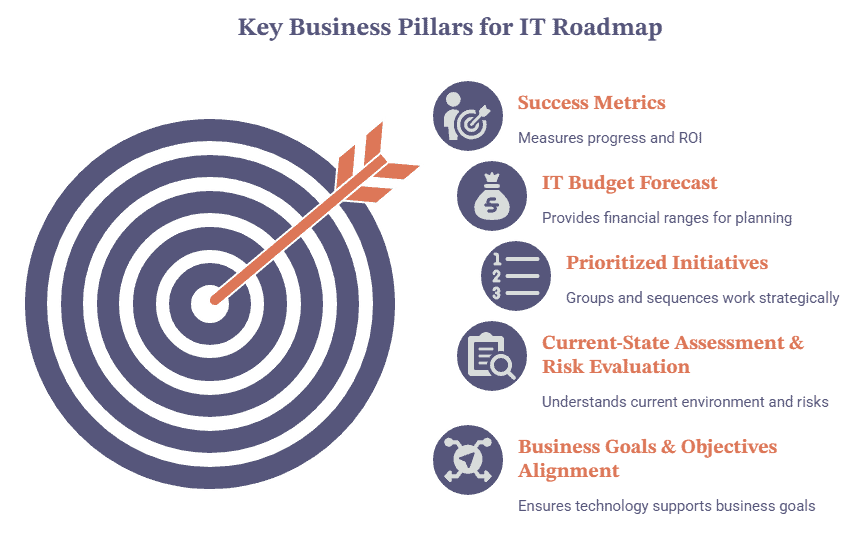
These five pillars form the ‘what’ of a vCIO IT roadmap; the collaborative process of creating it is an equally important journey.
Also Read: IT Roadmap for Business Growth
The Roadmap Process Turns Abstract Goals into Concrete Actions
Too often, a roadmap is built in isolation, producing a document that is quickly forgotten; this isn’t meaningful advice; it’s just paperwork. Instead, a true vCIO engagement begins with a structured discovery process, not a sales pitch. It typically starts with understanding your business goals before any technology is reviewed. If this step is skipped, the resulting roadmap might be technically sound but will be strategically useless.
Next, the process moves to reviewing your current environment, including infrastructure, security controls, and vendor contracts. From there, the vCIO maps the gap between where your business is today and where your goals require it to be and incorporates these findings into the vCIO IT roadmap as a clear, phased plan. The vCIO typically uses quarter-based timelines, specific enough for budgeting yet flexible enough to adapt.
This approach keeps recommendations grounded in your actual business goals rather than a generic checklist, producing an actionable plan that sets the stage for how the roadmap is kept current going forward.
Effective Roadmaps Evolve Through Ongoing Strategic Reviews
A technology roadmap is a living document. Business conditions change, priorities shift, and new risks emerge. Leaving a roadmap unchanged isn’t maintenance; it’s neglect. This is where the roadmap’s value is realized through ongoing reviews with your vCIO. A good review should answer several key questions: what got completed, what slipped, and whether priorities or budget assumptions have changed.
This recurring cadence creates defined ownership of responsibilities, response procedures, and oversight, giving leadership a practical way to adjust priorities without returning to guesswork. In practice, the active management of a vCIO IT roadmap is what ensures technology remains aligned with business goals. This ongoing conversation transforms the plan from a simple report into a powerful strategic asset that drives real business growth.
Your Technology Plan Should Drive Predictable Business Outcomes
Having clarity around your technology planning fundamentally changes how your business performs, turning a chaotic expense into a strategic tool for growth. This is where strategic consulting comes into play, delivering real value because it is tied to your business outcomes, not just reactive fixes. Turning reactive technical emergencies into predictable IT spending creates tangible value, allowing your organization to plan with confidence instead of reacting to failures. Ultimately, this disciplined approach plays a massive role in strengthening your company’s competitive advantage. If failures and renewal notices are still setting your IT priorities, it’s time to think again before another urgent decision narrows your options. Contact CMIT Solutions of Silverspring today for a comprehensive assessment of the IT services your Silverspring business needs to thrive.