

Building a Robust AI Acceptable Use Policy For Businesses
There is an AI acceptable use policy for businesses at its core, a framework that functions like a digital guardrail. By allowing unmanaged AI, you create shadow AI. Hence, you risk significant cyber exposure. In a nutshell, it is a corporate seatbelt that you embed in your operations. You love it.
Start by partnering with CMIT Solutions of Silver Spring for cybersecurity services. Before we discuss benefits, consider the NIST AI Risk Management Framework; despite AI’s prowess, structured governance remains invaluable. This is exactly the reason why a formal policy deserves a defined place in your strategy. It’s crucial to tread carefully; a new era calls for new tactics, so let’s lay out this blueprint.
Establishing The Core Pillars of an AI Acceptable Use Policy For Businesses
A strong AI policy rests on a practical framework built around four core functions. Each function addresses a different aspect of data governance to help businesses use AI responsibly while reducing operational risks.
The AI Governance Gap: Recent industry metrics reveal that 83% of businesses utilize AI, but only 25% have a policy to govern it.
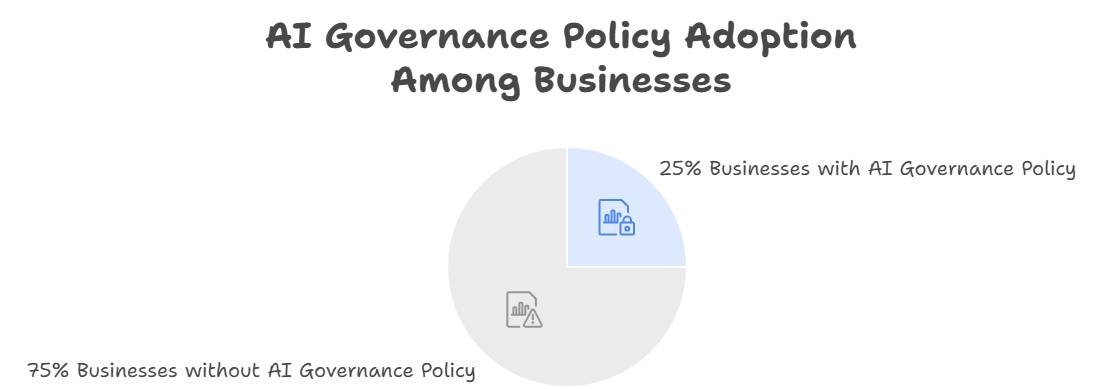
To close this operational security gap, organizations must implement a framework anchored by four distinct pillars:
- Govern
Businesses create clear policies, define employee responsibilities, and establish oversight procedures for AI usage. This includes leadership involvement, compliance monitoring, security standards, and accountability measures. Strong governance ensures employees understand how approved tools should be used across the organization. - Map
Organizations identify where AI tools are being used, what type of data they process, and which business functions they support. This stage helps companies understand potential risks related to customer information, intellectual property, compliance, and operational impact before wider adoption takes place. - Measure
Teams evaluate AI systems for accuracy, security, reliability, privacy concerns, and biased outputs. Businesses should regularly test generated content, review workflows, and monitor for risks such as misinformation, data exposure, or poor decision-making. Ongoing assessments help maintain quality and reduce compliance issues. - Manage
Organizations take practical steps to reduce identified risks and improve oversight. This may include updating acceptable use policies, limiting access to certain tools, strengthening approval processes, improving employee training, or introducing additional security controls. Businesses should also review policies regularly to address evolving risks and changing technologies.
When implemented effectively, these four pillars help businesses turn AI from a potential risk into a well-governed business asset.
Once these four core strategic pillars are established, businesses must look at how to apply them directly to daily workplace operations to protect sensitive data.
Operationalizing Safety in an AI Acceptable Use Policy for Businesses
Before getting into the technical side, businesses need to understand that an acceptable use policy is not just another document. It plays a key role in protecting company data, employees, and customers. Security risks are growing quickly, so companies need clear rules for how teams use digital tools in everyday work.
Employees should understand common risks such as prompt injection, inaccurate outputs, and biased results. They should also know how practices like fact-checking, data masking, and anonymization help protect sensitive information.
What is not to be uploaded to public platforms?
- Customer data
- Confidential records
- Intellectual property
- Source code
Practical and clear rules make it easier for employees to work safely without slowing down productivity.
Reviewing generated content is equally important. Teams should always check outputs for accuracy, originality, and compliance before using them in reports, marketing materials, or customer communication.
A quick review can prevent misinformation, copyright issues, and costly mistakes. Businesses should also confirm that content does not include third party material without permission.
Simple guidelines work best when employees can easily follow them.
- DO
Use approved tools for marketing, research, and business tasks.
- DON’T
Upload confidential files, customer information, or proprietary code to public systems.
Human oversight still matters. Managers and IT teams should regularly review processes, document how tools are used, and give employees a simple way to report concerns. Companies should also monitor for bias and keep their policies updated as technology changes.
It is imperative that any form of strict security be enforced by leadership. Once employees are properly trained and informed, companies can establish a safer workplace.
Although these practical technical guidelines provide safety, the maintenance of security will depend on leadership support to ensure company-wide adoption of such guidelines.
Also Read: Needs, Choices, and Adoption of AI for SMBs
Driving Organizational Adoption of an AI Acceptable Use Policy for Businesses
Strong leadership is the base of every successful acceptable use policy. When executives actively support security guidelines, employees are more likely to follow them.
A policy cannot succeed if leadership treats it as just another document. Managers and department heads need to show that security and responsible technology use matter across the organization.
Employee training is equally important. Many security incidents happen because employees are unaware of risks or do not fully understand company guidelines. Regular workshops, simple training sessions, and clear examples help teams use approved tools safely and responsibly. Short guides, internal announcements, and awareness campaigns also make policies easier to understand and follow.
Businesses should also create a simple process for adopting new tools. Employees need to know who approves requests, how reviews work, and where to report concerns. Working closely with IT teams and department leaders helps companies maintain consistency across the organization.
Digital acknowledgment adds another layer of accountability. After completing training, employees should confirm that they understand the company’s rules and responsibilities. Signed confirmations help businesses maintain records for audits and compliance reviews while showing that employees received the required guidance.
A successful rollout also depends on clear planning. Companies should
- Build a cross-functional governance team
- Create simple documentation for all departments
- Establish a formal approval process for new tools
- Conduct mandatory employee training sessions
Policies should not remain static. Technology changes quickly, and businesses need regular reviews to keep policies effective.
Annual evaluations help companies address
- New risks
- Improve security practices
- Update guidelines as tools evolve
Leadership teams should also monitor emerging threats, review training results, and ensure employees continue following best practices.
Clear communication, regular training, and active leadership support help businesses create a safer, more reliable workplace that employees and customers can trust.
With active leadership and structured training paths secured, your organization is fully equipped to finalize its long-term technology deployment strategy.
Finalizing the Strategy for an AI Acceptable Use Policy for Businesses
Applying an AI acceptable use policy for businesses is a critical step in mitigating modern digital vulnerabilities. Operating without a clear framework exposes your
- Operational infrastructure to prevent severe data leakage
- Compliance penalties
- The unauthorized exposure of proprietary intellectual property
Establishing structured oversight ensures that your organization navigates emerging technologies safely without compromising productivity. Protecting your corporate data requires a proactive approach to network security and corporate governance, as well as reliable IT Services.
By partnering with CMIT Solutions of Silver Spring, your business can safely scale its operations while staying fully compliant with modern compliance standards. Contact us today to safeguard your infrastructure with comprehensive cybersecurity and professional managed IT Services.