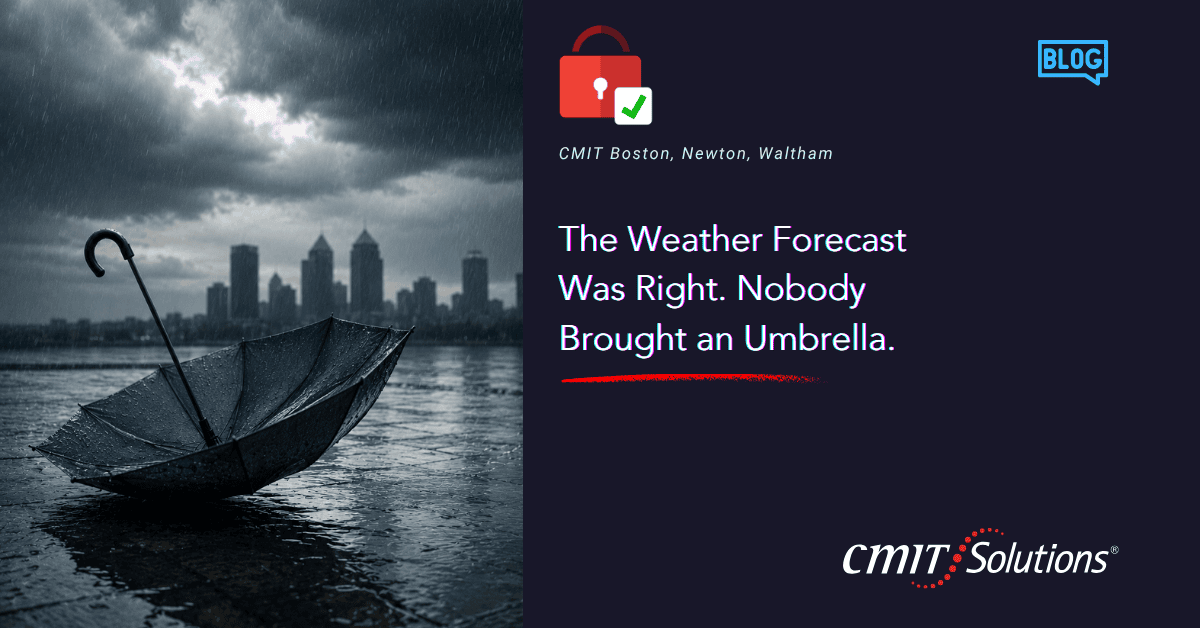
Meteorologists get a lot of grief for forecasts that miss. But modern weather prediction is remarkably accurate. When a forecaster says there is an eighty percent chance of rain by 3 p.m., it rains by 3 p.m. far more often than not.
And yet, every single day, people walk out the door without an umbrella, get caught in the downpour, and act surprised.
The forecast was not the problem. Nobody acted on it.
That gap between knowing and doing is exactly where most businesses find themselves with cybersecurity today. They have finally invested in tools that catch threats early and flag suspicious activity in real time. The alerts are accurate. The forecast is right. But when the alert fires, nobody grabs the umbrella.
AI changed the forecast, not the outcome
For years, the challenge in cybersecurity was visibility. Threats moved fast, and detection tools moved slow. By the time a business noticed something was wrong, the damage was already done.
AI-driven threat detection changed that equation. Modern tools can now spot unusual login patterns, flag strange file access, and notice in seconds when something on the network is behaving in a way it never has before. That is a real leap forward.
But a better forecast does not automatically produce a better outcome. A weather app that predicts rain with pinpoint accuracy still cannot keep you dry. It can only tell you. What happens next is still up to you.
The same is true of a security alert. AI can tell your business, with real confidence, that something is wrong. It cannot log the suspicious account out. It cannot isolate the infected device. Someone still has to act.
Detection is not protection
This is the distinction that trips up so many businesses: detecting a threat and stopping a threat are two completely different things.
A smoke detector does not put out a fire. It tells you there is one. What happens between the alarm going off and the fire actually being extinguished depends entirely on what the people in the building do next. If everyone hears the alarm and keeps working, the fire does not care that it was detected. It burns exactly the same.
Businesses that invest heavily in detection tools and stop there are, in effect, installing an excellent smoke detector and calling it a sprinkler system. The alert fires. The forecast was right. And the business still gets soaked.
We see this constantly. A monitoring tool flags a login from an unfamiliar location at 2 a.m. The alert sits in a queue or an inbox, and nobody looks at it until the next business day, sometimes not even then. By the time someone reviews it, the attacker has already moved through the network, found what they were looking for, and left.

Why alerts get ignored
Nobody sets out to ignore a security warning. It happens gradually, for reasons that make sense in the moment.
Alert fatigue is common: when a system generates dozens of low-priority notifications a day, the one that actually matters gets lost in the noise. Ownership is often unclear too. An alert fires, but nobody is sure whose job it is to respond, so it sits in a shared inbox assumed to be someone else’s problem. And even when someone does notice, without a defined next step, they hesitate, and that hesitation costs the one thing you cannot get back once an incident is underway: time.
None of this gets fixed by buying a better detection tool. It gets fixed by building a response process around the tool you already have.
The umbrella is the response plan
If the forecast is the alert, the umbrella is what you do with it. And just like an umbrella left in the closet does you no good during a downpour, a response plan that only exists on paper does you no good during an actual incident.
A real response plan answers a short list of questions before anything goes wrong, not during:
- Who gets notified the moment a high-priority alert fires?
- What is the very first action taken, before anyone confirms the full scope?
- Who has the authority to isolate a device or disable an account without waiting for a committee meeting?
- What gets communicated to clients, and when?
A plan that has never been tested is not really a plan. It is a hope. Businesses that treat alerts seriously do not wait for the fire to figure out where the extinguisher is. They already know.
A closer look at what happens without a plan
Picture a small accounting firm with strong AI-driven monitoring in place. One evening, the system flags something unusual: a login to a partner’s email from a country the firm has never done business with, followed minutes later by an attempt to access a shared folder of client financial records.
The alert fires exactly as it should. It lands in an inbox monitored by one employee who happens to be out that day. Nobody else is watching that queue. It sits there overnight.
By morning, the attacker had already copied several client files and sent convincing emails to clients requesting updated banking details for an upcoming transfer.
The forecast was correct. The system caught the intrusion within minutes of it happening. But because there was no clear ownership, no backup coverage for the alert queue, and no predefined next step, the correct forecast did nothing to stop the storm. This is not a failure of the technology. It is a failure of the process wrapped around it, and that process is where most businesses have the biggest gap.

Building a business that actually acts on what it knows
The fix here is not more alerts, and it is usually not more expensive software either. It is building the human layer that turns a detection into a response.
- Assign real ownership. Every category of alert needs a named person or team responsible for reviewing and acting on it, with a clear backup for when that person is out. Not “IT will handle it.” A name.
- Set response time expectations. A high-priority alert involving account access or data exposure should have a defined maximum response window, not “whenever someone gets to it.”
- Pre-authorize action. The person monitoring alerts should not need to seek approval from three layers of management before disabling a compromised account.
- Reduce the noise. Tune your detection tools so low-priority notifications do not drown out the ones that genuinely require action.
- Practice the response. Run through a mock incident occasionally so the team knows the steps before they need them under real pressure.
- Pair detection with a managed response. For many small and midsize businesses, the realistic answer is not hiring a round-the-clock internal security team. It is partnered with a provider who monitors alerts as part of ongoing IT support, so the response happens whether or not someone in your building happens to be looking at the right screen at the right moment.
Why this matters more as AI threats accelerate
Attackers are using the same AI advances that power modern threat detection to make their attacks faster and harder to catch by eye alone. Phishing emails no longer have the broken grammar and obvious red flags they once did. As attacks get faster, the window between detection and damage keeps shrinking. A response process that was “good enough” two years ago is no longer fast enough against threats that can move through a network in minutes.
The forecast is not the finish line
None of this is an argument against investing in AI-driven detection. It is one of the best things a business can do for its security posture. But a forecast, however accurate, is only useful if someone acts on it.
The businesses that come through a real incident with the least damage are rarely the ones with the most expensive detection software. They are the ones who paired good detection with a clear, practiced, well-owned response, the same way a smart traveler checks the forecast and actually packs the umbrella.
If your business has invested in monitoring and alerts but you are not entirely sure what happens after an alert fires, who sees it, who acts on it, and how fast, that is worth finding out before an actual storm rolls in, not during one.
My team works with businesses across Boston, Newton, and Waltham to review exactly this gap: what your detection tools are catching, and what actually happens next. Schedule a straightforward 10-minute discovery call, and I will walk through your current alerts, your response process, and where the gaps are between knowing about a threat and actually stopping one. No obligation.
Call me at (617) 221-4100, or schedule your call online.
Frequently Asked Questions