
Property managers rarely have a shortage of software. They have property management platforms, email, accounting systems, maintenance portals, tenant communication tools, spreadsheets, calendars, and sometimes several applications inherited from years of changing processes. The bigger problem is that people still have to move information between those systems.
A tenant submits a maintenance request. Someone reads it, determines its urgency, assigns it to the right person, sends an acknowledgment, follows up with a vendor, updates the tenant, and eventually closes the ticket. A prospective tenant sends an inquiry. Someone responds, collects information, schedules a tour, sends reminders, and follows up afterward. None of these tasks is individually difficult. At scale, however, the repetitive administrative work adds up.
That is where AI workflow automation for property management becomes useful.
Instead of treating AI as another standalone application, property management firms can use it as part of a connected workflow that reads incoming information, classifies requests, triggers the appropriate next step, and sends routine work to the systems and people responsible for handling it. For property management firms in Anaheim and across Orange County, the practical question in 2026 is no longer simply, “Can we use AI?”
It is: Which workflows should we automate, which decisions should remain with people, and how do we connect AI to our existing systems securely?
What Is AI Workflow Automation for Property Management?
AI workflow automation combines artificial intelligence with business rules, integrations, and automated actions to complete or coordinate repetitive processes. Traditional automation typically follows a fixed instruction:
If X happens, do Y. AI can add another layer by interpreting the information before deciding which predefined workflow should begin. Consider a maintenance inbox. A traditional system may create a ticket every time a maintenance form is submitted.
An AI-assisted workflow could potentially:
- Read the maintenance request.
- Identify the property and unit.
- Categorize the issue.
- Detect language suggesting urgency.
- Create or update a ticket.
- Route the request to the appropriate team.
- Send the tenant an acknowledgment.
- Flag unusual or high-risk requests for human review.
The AI is not necessarily replacing the property manager. It is reducing the manual work between receiving information and taking the next appropriate action. That distinction matters. The best AI tools for property managers are not simply chatbots. They become more useful when they are securely connected to the workflows employees already use.
Where Can Property Management Firms Use AI Automation?
There are dozens of possible use cases, but property management firms should generally start with processes that are repetitive, high-volume, rules-based, and easy for a person to review when necessary.
1. Tenant Communication and Request Routing
Property management teams receive many recurring questions:
- When is rent due?
- How do I submit a maintenance request?
- What is the pet policy?
- When will my repair be completed?
- How do I access a particular resident service?
- Who should I contact about my lease?
AI tenant communication tools can help classify incoming messages, retrieve approved information, prepare responses, and route requests requiring human involvement. A useful workflow might look like:
Tenant message → AI classification → approved response or staff escalation → property management system update
This can reduce the time employees spend manually sorting inboxes without requiring AI to make sensitive decisions about tenants.
2. Maintenance Request Automation
Maintenance coordination is one of the clearest opportunities for automation. With automated maintenance requests for property management, an incoming request can trigger several actions.
For example: Request submitted → Issue categorized → Priority identified → Ticket created → Appropriate team notified → Tenant acknowledgment sent → Follow-up scheduled
If a tenant writes, “The kitchen faucet is dripping,” the workflow may classify it as routine plumbing. If the message says, “Water is coming through the ceiling,” the system can immediately flag the request for urgent human attention according to the firm’s established procedures. The goal is not to let AI independently decide how an emergency should be handled. The goal is to reduce the administrative steps required to get information to the right person quickly.
3. Leasing Inquiry Follow-Up
Leasing teams can lose opportunities when inquiries sit unanswered or follow-ups depend entirely on employees remembering to send them. An AI-assisted leasing workflow could: New inquiry → Capture prospect information → Identify property → Send approved response → Offer scheduling options → Send reminder → Notify leasing staff → Record activity
AI can also help summarize conversations so leasing employees do not need to reread long email threads before following up. For firms exploring property management automation in Anaheim, this can be a practical starting point because the workflow is measurable. Teams can track response time, scheduled tours, follow-up completion, and conversion from inquiry to application.
4. Lease and Document Workflows
Property managers regularly work with leases, inspection reports, vendor documents, invoices, notices, and internal records.
AI can help employees:
- Extract information from documents
- Identify missing fields
- Categorize documents
- Summarize long files
- Route documents for review
- Trigger renewal reminders
- Organize files in approved locations
The important distinction is between processing information and making a consequential decision. Using AI to identify a lease expiration date is very different from allowing AI to independently decide whether a tenant should receive housing.
5. Vendor and Work Order Coordination
Vendor management can involve significant manual communication. A maintenance request may require an employee to identify the right vendor, send the details, wait for confirmation, communicate with the resident, and update internal systems. AI agents and workflow automation can help coordinate these steps.
For example: Approved work order → Vendor notification → Confirmation request → Status tracking → Property manager alert → Resident update
Exceptions can still be routed to employees. This creates a hybrid model where automation handles predictable administrative steps and staff members handle decisions, unusual situations, and relationships.
6. Internal Reporting
Property managers frequently spend time pulling information from different systems to prepare weekly or monthly reports. AI workflows can help consolidate operational information such as:
- Open maintenance requests
- Aging work orders
- Leasing inquiries
- Vacancy information
- Upcoming renewals
- Vendor activity
- Unresolved tenant requests
The workflow can summarize this information for managers instead of requiring someone to manually compile the same report every week.
What Should Property Managers Automate First?
The temptation is to automate everything.
That is usually the wrong approach.
A better starting point is to identify workflows with three characteristics:
| Workflow | Volume | Automation Potential | Human Oversight |
| Tenant FAQ routing | High | High | Moderate |
| Maintenance ticket classification | High | High | Required for exceptions |
| Leasing follow-up | High | High | Moderate |
| Appointment reminders | High | High | Low |
| Document classification | Medium | High | Moderate |
| Vendor follow-up | Medium | High | Moderate |
| Tenant screening decisions | Medium | Sensitive | High |
| Lease approval or denial | Medium | Sensitive | High |
Start with workflows where automation saves administrative time without giving an AI system unnecessary authority over consequential decisions. A property management company does not need ten AI projects. It needs one or two workflows with a clear operational problem and measurable outcome.
Where AI Automation Becomes More Complicated
The difficult part of AI adoption is usually not generating text. It is integration.
A useful AI workflow may need to interact with several systems, including:
- Property management software
- Microsoft 365 or Google Workspace
- CRM platforms
- Maintenance systems
- Accounting software
- Document storage
- Scheduling tools
- Tenant communication platforms
- Vendor systems
That means an AI implementation also becomes an IT architecture, identity, access, security, and data governance project. This is where AI integration services in Anaheim or managed IT services for property management can become important. Before connecting an AI system, firms should understand:
- What data can the AI access?
- Where does that data go?
- Who can trigger the workflow?
- What actions can the AI perform?
- Which actions require human approval?
- Are activities logged?
- What happens if the AI produces an incorrect result?
An impressive demo is not the same thing as a production-ready workflow.
AI and Tenant Data: Security Has to Come First
Property management firms can hold sensitive information about applicants, residents, owners, employees, and vendors. Connecting AI tools to that environment without appropriate controls can create unnecessary risk. A secure implementation should consider controls such as:
- Role-based access
- Multi-factor authentication
- Least-privilege permissions
- Approved data storage
- Encryption
- Activity logging
- Vendor security reviews
- Data retention policies
- Human approval for sensitive actions
- Incident response procedures
This is one reason firms evaluating AI services in Orange County should look beyond the AI model itself. The surrounding infrastructure matters just as much.
The Compliance Question Property Managers Cannot Ignore
AI can automate communication and administrative work, but housing-related decisions require much greater caution. The Fair Housing Act applies to tenant screening, including screening involving algorithms and AI. HUD guidance has specifically warned housing providers and tenant-screening companies that automated tools still need to comply with fair housing requirements and should be transparent, accurate, and nondiscriminatory.
California adds another layer. The California Civil Rights Department states that fair housing protections apply to property management companies and tenant-screening companies, including screening practices that discriminate based on protected characteristics. This is not theoretical. In January 2026, California’s Civil Rights Department announced a settlement involving a major property management company that required review and revision of tenant-screening policies following a fair housing complaint.
California’s privacy rules are evolving as well. Regulations concerning Automated Decision making Technology took effect in 2026, with ADMT-specific compliance requirements for covered businesses making significant decisions beginning January 1, 2027. Housing is specifically included among the significant-decision contexts addressed by California’s privacy framework. For property managers, the practical rule is simple:
Automate administrative work aggressively. Automate consequential housing decisions cautiously. Tenant eligibility, screening, accommodation requests, adverse decisions, and other sensitive processes should receive appropriate legal and human oversight.
A Better Way to Implement AI Workflow Automation
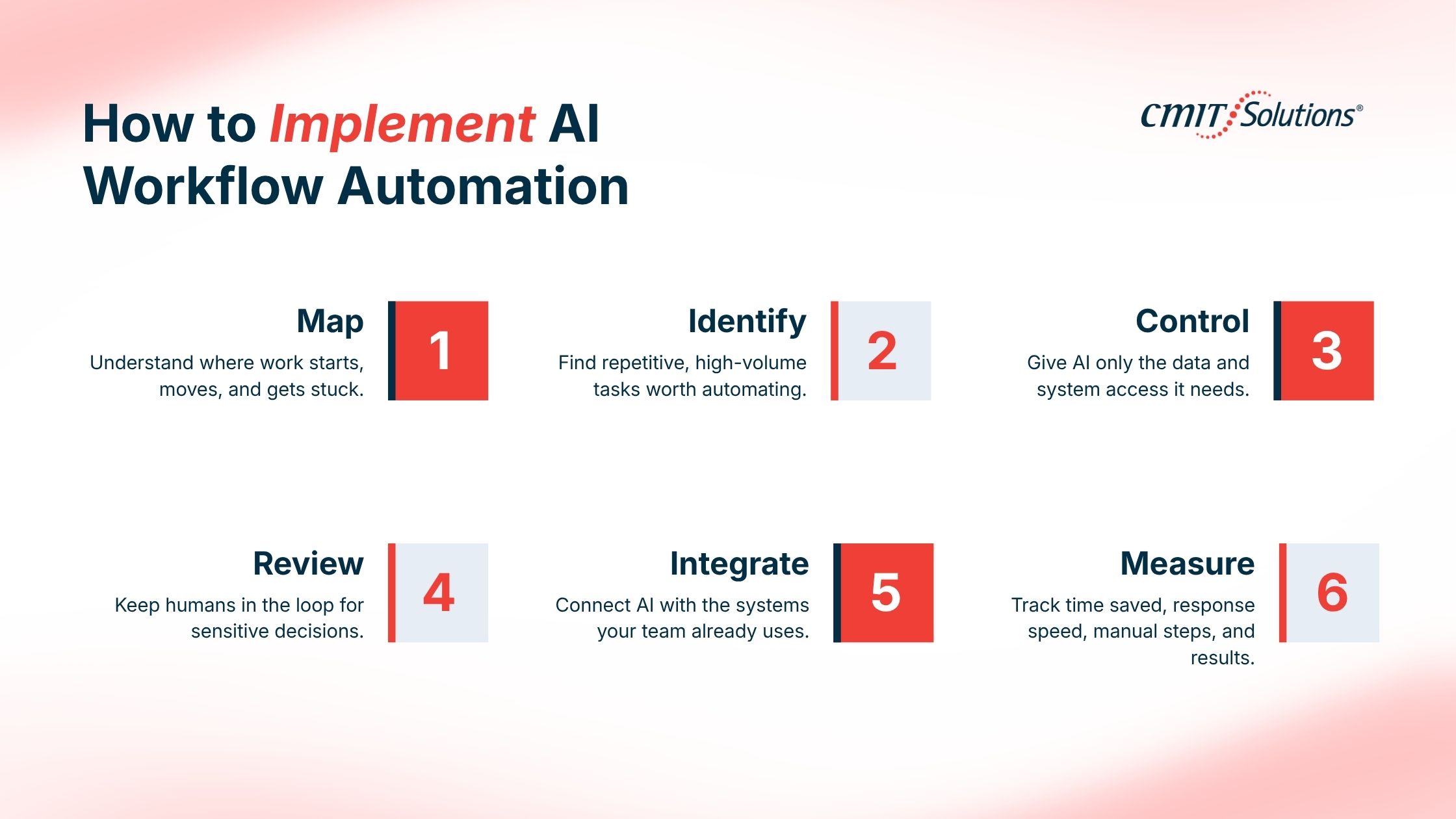
For firms considering AI automation services for property management companies in Orange County, implementation should begin with the workflow rather than the AI tool.
Step 1: Map the Current Workflow
Document what happens today.
Who receives the request? Which system contains the information? What gets copied manually? Where are employees waiting for approvals? Where do requests get lost?
Step 2: Identify the Repetitive Steps
Look for repetitive work such as:
- Reading and categorizing requests
- Copying information between systems
- Sending routine acknowledgments
- Creating tickets
- Scheduling reminders
- Updating records
- Preparing summaries
These are usually stronger automation candidates than complex judgment calls.
Step 3: Determine What AI Actually Needs Access To
Do not connect an AI system to every application simply because integration is technically possible. Use least-privilege access. If a workflow only needs maintenance request information, it should not automatically receive access to unrelated tenant records.
Step 4: Define Human Approval Points
Decide which actions AI can perform automatically and which require review.
A useful model is:
AI reads → AI recommends → Human approves → System acts
As confidence and controls improve, low-risk steps can potentially become more automated.
Step 5: Integrate the Existing Technology Stack
This is where custom AI solutions in Orange County can differ from buying another standalone AI application. The objective should be to connect AI to the systems employees already use instead of forcing employees to manage another isolated platform.
Step 6: Measure the Outcome
Before deployment, establish a baseline.
Measure things such as:
- Average response time
- Time to assign maintenance requests
- Number of manual workflow steps
- Leasing follow-up time
- Requests handled per employee
- Unresolved ticket volume
- Administrative hours spent on recurring tasks
Then compare those metrics after implementation. If an automation does not save time, improve response consistency, reduce manual steps, or create another measurable benefit, it probably needs to be redesigned.
Build an AI Workflow, Not Another Software Silo
Property management firms already have technology. The next phase is making that technology work together. That is why effective AI-powered property management automation in Orange County is less about installing a chatbot and more about designing connected workflows.
- A maintenance request should reach the right person faster
- A leasing inquiry should not disappear into an inbox
- A routine tenant question should not require an employee to type the same response twenty times
- A manager should not spend Friday afternoon manually combining information that already exists across company systems.
The opportunity for AI is in the gaps between those systems.
AI Workflow Automation for Anaheim and Orange County Property Management Firms
CMIT Solutions of Anaheim West helps businesses evaluate, integrate, and manage technology securely, including the infrastructure required to support AI-enabled workflows.
For property management companies, that can include reviewing existing systems, identifying automation opportunities, integrating approved platforms, managing access and security, and helping build workflows around the technology the business already uses. Rather than adopting AI simply because a new tool exists, property management firms can start with a more useful question:
What repetitive process is costing our team the most time today? That is usually where the first automation should begin.
Ready to Find the Right AI Opportunities for Your Business?
Not sure where AI can make the biggest impact without creating new security or integration risks? CMIT Solutions of Anaheim West can help you identify practical automation opportunities, evaluate your existing technology, and build secure AI workflows around the systems your team already uses.
Book a Free AI & IT Assessment and discover where smarter automation can save time, improve efficiency, and support your business.
Frequently Asked Questions
What is AI workflow automation for property management?
AI workflow automation for property management uses artificial intelligence, integrations, and predefined business rules to reduce manual work across processes such as tenant communication, maintenance requests, leasing follow-up, document processing, vendor coordination, and reporting.
What property management tasks can AI actually automate in 2026?
AI can assist with tenant inquiry classification, maintenance request routing, leasing follow-ups, appointment reminders, document extraction, internal summaries, work-order coordination, and reporting. Sensitive housing decisions should generally retain appropriate human and legal oversight.
How much does AI workflow automation cost for a small property management firm?
There is no single standard cost because implementation depends on the number of workflows, existing software, required integrations, data security requirements, and whether custom development is necessary. A focused workflow connected to existing systems can be substantially simpler than a company-wide AI implementation.
Is AI safe to use with tenant data?
It can be used safely when appropriate security, privacy, access, vendor, and governance controls are in place. Property management firms should understand what information an AI provider receives, how that information is stored or processed, who can access it, and whether it may be retained or used beyond the intended workflow.
What are the compliance risks of using AI in property management?
Potential risks include privacy violations, discriminatory outcomes, insufficient transparency, inappropriate use of applicant or tenant information, and automated decisions that conflict with fair housing requirements. AI used for tenant screening or other consequential housing decisions requires particular care.
Do I need a managed IT provider to deploy AI workflow automation?
Not every AI tool requires a managed IT provider. However, workflows that integrate AI with company systems, tenant information, identity platforms, email, document storage, or other business applications can introduce security and integration requirements. Managed IT services for property management can help firms evaluate those dependencies before deployment.
How long does it take to implement AI in a property management company?
Implementation time depends on the workflow and systems involved. A narrow automation using existing integrations may be relatively quick, while custom AI automation involving multiple platforms, permissions, data sources, and approval processes requires more planning, testing, and security review.
Which Orange County IT provider handles AI automation for property management firms?
CMIT Solutions of Anaheim West works with businesses in Anaheim and Orange County on managed IT, technology integration, cybersecurity, and AI-related technology initiatives. Property management firms considering AI automation services in Orange County can begin with an assessment of their existing technology stack and the workflows they want to automate.
