

Supply chains today operate in real time. Orders move from online carts to warehouse floors in seconds. Inventory updates sync across ERP systems instantly. Barcode scanners, RFID readers, tablets, IoT sensors, and automated guided vehicles (AGVs) all depend on uninterrupted connectivity.
In this environment, network support in Anaheim is no longer a background IT function. It is operational infrastructure. Likewise, strategic supply chain wireless networking integration in Orange County has become essential for continuity, accuracy, and scalability.
At CMIT Solutions of Anaheim, we work with organizations that rely on stable wireless performance to keep logistics, warehousing, and distribution moving without disruption. Here is what that really means and why it matters.
The Modern Supply Chain Runs on Wireless Connectivity
Traditional wired networks cannot support the mobility requirements of modern warehouses and distribution centers. Today’s operations depend on:
- Real-time warehouse management systems (WMS)
- Cloud-based enterprise resource planning (ERP)
- Handheld barcode scanners and rugged tablets
- RFID-based tracking systems
- IoT sensors monitoring temperature and equipment
- Automated material handling systems
All of these systems require consistent, low-latency wireless access. Supply chain wireless networking in Anaheim must account for large facilities, metal racks that interfere with signals, high device density, and constant movement of people and equipment. Without proper design and monitoring, connectivity gaps become operational bottlenecks.
What Is Supply Chain Wireless Networking
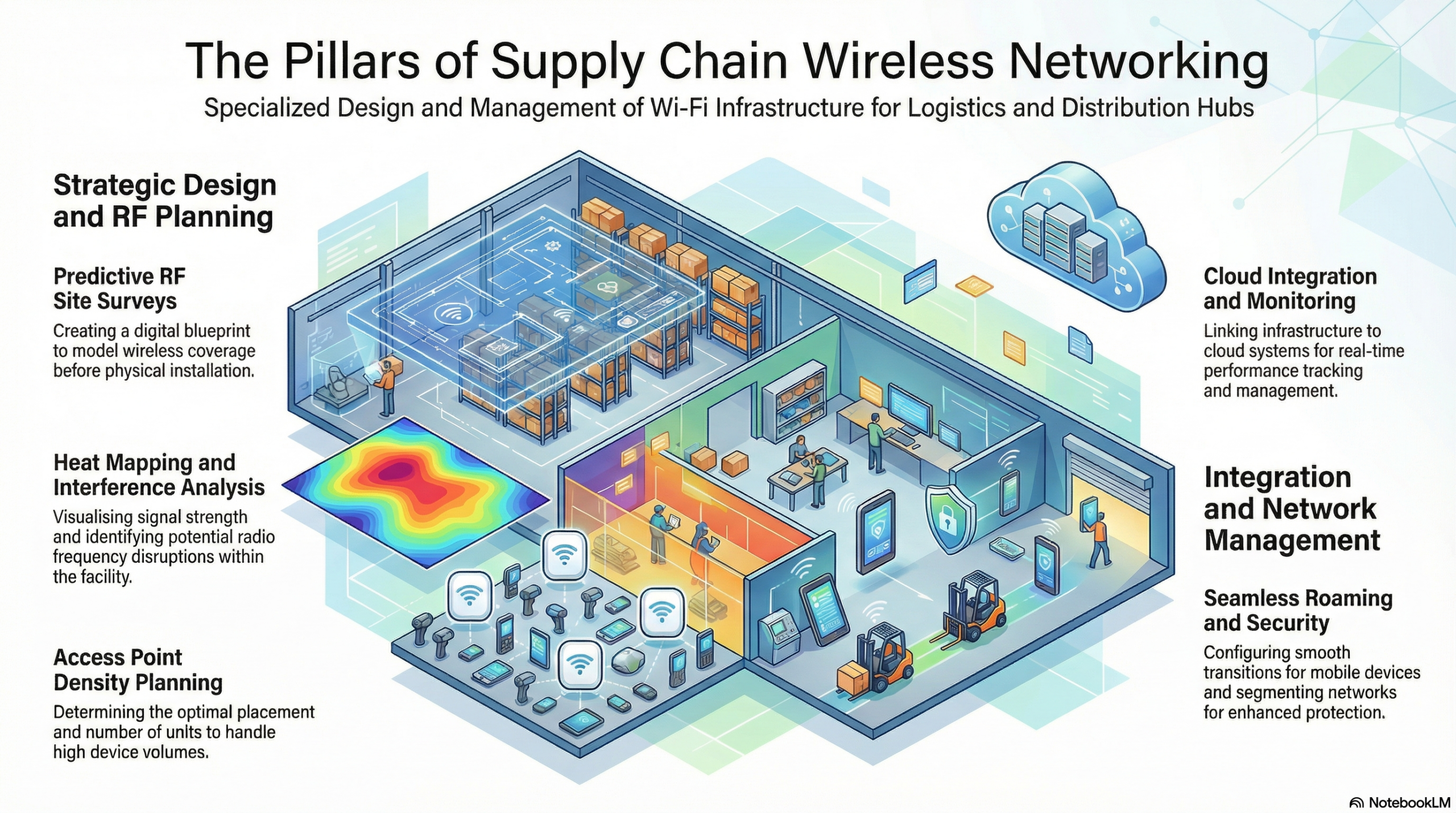
Supply chain wireless networking refers to the design, deployment, and management of enterprise-grade Wi-Fi infrastructure tailored to logistics and distribution environments.
It includes:
- Predictive RF site surveys
- Heat mapping and interfrence analysis
- Access point density planning
- Seamless roaming configuration
- Network segmentation for security
- Integration with cloud systems
- Continuous performance monitoring
Unlike basic office Wi-Fi, supply chain wireless networking solutions must support roaming devices, high throughput, and mission-critical applications without latency spikes.
In high-volume environments across Anaheim and Orange County, even minor signal instability can result in delayed shipments, inaccurate inventory counts, and compliance risks.
Why Reliable Network Support Prevents Supply Chain Downtime
Downtime in a supply chain environment has cascading effects. A few minutes of network failure can impact:
- Picking and packing operations
- Order verification processes
- Shipping documentation
- Real-time inventory synchronization
Professional network support in Anaheim minimizes these risks through proactive management.
Proactive Network Monitoring
Modern network management platforms provide:
- Real-time performance analytics
- Bandwidth utilization tracking
- Device health monitoring
- Automated alerting systems
- Early detection of hardware degradation
Instead of reacting after a failure, issues are identified and resolved before they disrupt operations.
Redundancy and High Availability
Reliable supply chain networks include:
- Dual internet connections
- Redundant firewalls and switches
- Automatic failover configurations
- Backup power protection
These safeguards ensure operations continue even if one component fails.
Security Oversight
Logistics companies are increasingly targeted by ransomware and data breaches. Effective Orange County network management includes:
- Network segmentation using VLANs
- Secure isolation of guest and IoT traffic
- Encrypted communication protocols
- Continuous threat monitoring
- Endpoint protection integration
Security failures can shut down supply chains entirely. Strong support prevents that risk.
Operational Challenges Without Proper Wireless Networking
Organizations operating without optimized supply chain wireless networking setup often experience:
- Wi-Fi dead zones in large warehouse areas
- Frequent scanner disconnects
- Slow synchronization with ERP systems
- Manual data entry workarounds
- Increased picking errors
- Inaccurate stock reporting
- Compliance documentation gaps
Metal shelving, moving forklifts, and high ceilings all interfere with signal propagation. Without professional RF planning, networks become unreliable.
In competitive distribution hubs like Anaheim and Placentia, these inefficiencies translate directly into lost revenue and reduced customer confidence.

How Wireless Networking Improves Real-Time Inventory Tracking
Real-time inventory accuracy is central to operational efficiency. A well-designed supply chain wireless networking integration in Orange County enables:
Seamless Device Roaming
Warehouse workers move continuously. Devices must transition between access points without dropping connections. Optimized roaming protocols ensure uninterrupted scanning and data transmission.
Immediate Data Synchronization
When an item is scanned, inventory records update instantly. This allows:
- Accurate stock levels
- Reduced stockouts
- Automated reordering
- Improved demand forecasting
- Fewer reconciliation discrepancies
Support for IoT and Automation
Modern facilities increasingly deploy:
- Environmental monitoring sensors
- Smart conveyor systems
- Automated guided vehicles
- RFID tracking systems
These systems require stable, low-latency wireless networks to function effectively. Poor connectivity compromises automation performance.
Read More Informational Blog: 6 Common MSP Mistakes That Cost Small Businesses Money in 2026
What Is Involved in Supply Chain Wireless Networking Integration
Integration requires more than installing access points. It involves a structured process.
Comprehensive Site Assessment
Technicians conduct:
- Physical walkthrough
- RF spectrum analysis
- Interference mapping
- Device density evaluation
This ensures coverage planning reflects real operational conditions.
Strategic Infrastructure Design
Design considerations include:
- Access point placement based on predictive modeling
- Channel optimization to reduce interference
- Capacity planning for peak workloads
- VLAN configuration for security segmentation
- Quality of Service settings for traffic prioritization
Secure Configuration and Testing
Security policies are implemented to protect sensitive operational data. Networks are stress-tested to confirm performance under heavy device load.
Ongoing Optimization
As operations grow, networks must scale. Professional supply chain wireless networking solutions in Placentia and Anaheim include:
- Firmware updates
- Capacity adjustments
- Hardware lifecycle planning
- Continuous performance analysis
Integration is not a one-time deployment. It is an ongoing management process.
The Role of Network Monitoring in Supply Chain Continuity
Continuous monitoring is foundational to reliability.
Advanced monitoring tools provide:
- Real-time dashboards of performance metrics
- Automated anomaly detection
- Bandwidth prioritization controls
- Capacity forecasting reports
- Security threat alerts
For example, if peak shipping hours increase device load, monitoring systems identify bandwidth saturation early. This allows proactive scaling before performance degrades.
Without monitoring, network problems surface only after operational disruption occurs. Reliable network support in Anaheim ensures visibility at all times.
Why Local Orange County Expertise Matters
Supply chain environments vary by region. Orange County’s logistics infrastructure is high volume and highly competitive.
Partnering with a local provider like CMIT Solutions of Anaheim offers:
- Rapid on-site response
- Understanding of regional infrastructure requirements
- Familiarity with compliance standards
- Tailored wireless networking strategies for Anaheim and Placentia facilities
Local support reduces downtime response time and ensures solutions are customized to specific operational layouts.
Signs Your Supply Chain Network Needs Improvement
Organizations should evaluate their wireless infrastructure if they experience:
- Frequent device disconnections
- Slower system performance during peak hours
- Coverage inconsistencies
- Rising help desk tickets related to connectivity
- Increased manual reconciliation efforts
- Security alerts or vulnerabilities
These indicators suggest gaps in current supply chain wireless networking setup. Addressing them proactively protects operational continuity.
The Strategic Value of Reliable Network Support
Investing in professional Orange County network management delivers measurable advantages:
- Reduced operational downtime
- Improved inventory accuracy
- Faster order fulfillment
- Stronger cybersecurity posture
- Scalable infrastructure for growth
- Greater customer satisfaction
In today’s fast-moving logistics landscape, stable wireless connectivity is foundational to competitive performance.
Frequently Asked Questions
What is supply chain wireless networking and why is it critical for operations?
It is the design and management of enterprise wireless infrastructure that supports warehouse, logistics, and manufacturing systems. It ensures real-time data exchange and uninterrupted operations.
How does reliable network support prevent supply chain downtime?
Through proactive monitoring, redundancy planning, rapid response, and continuous optimization to detect and resolve issues before disruption occurs.
What challenges do supply chains face without proper wireless networking?
Common issues include signal interference, dropped connections, inaccurate inventory data, operational delays, and increased cybersecurity risks.
How does wireless network setup improve real-time inventory tracking?
By enabling seamless device roaming and instant synchronization with ERP and WMS systems, ensuring inventory data remains accurate and current.
What is involved in supply chain wireless networking integration?
It includes site surveys, infrastructure design, secure configuration, system integration, testing, and ongoing management.
How does network monitoring support supply chain continuity?
Monitoring tools provide real-time visibility, automated alerts, and performance forecasting, ensuring networks remain stable and scalable.
Conclusion
Supply chains cannot afford instability. Reliable network support in Anaheim combined with strategic supply chain wireless networking integration in Orange County ensures operations remain efficient, secure, and resilient.
For organizations operating in Anaheim, Placentia, and throughout Orange County, strong wireless infrastructure is not simply an IT enhancement. It is the backbone of uninterrupted supply chain performance. CMIT Solutions of Anaheim helps businesses design, deploy, and manage resilient wireless networks that keep operations moving without disruption today and as they grow.