Cybersecurity is no longer just an IT concern for businesses in Austin. It has become a critical part of operational stability, regulatory compliance, and long-term business growth.
As cyber threats continue to evolve in 2026, businesses are realizing that isolated security tools and reactive IT strategies are no longer enough. Organizations need a structured approach that helps them identify risks, strengthen defenses, respond to incidents, and maintain business continuity.
That’s why many Austin businesses are turning to the NIST Cybersecurity Framework.
Originally developed by the National Institute of Standards and Technology (NIST), the framework has become one of the most trusted cybersecurity models for organizations of all sizes. From healthcare providers and financial firms to legal practices and growing SMBs, businesses are adopting NIST standards to build stronger, more resilient IT environments.
Why Businesses Need a Structured Cybersecurity Framework
Modern cyber threats are becoming more sophisticated, automated, and difficult to contain.
Businesses today face:
- AI-driven phishing attacks
- Ransomware campaigns
- Cloud security vulnerabilities
- Insider threats
- Compliance risks
- Third-party vendor exposure
Many organizations already have cybersecurity tools in place, but tools alone do not create resilience. Without a clear structure for managing risk, businesses often struggle with inconsistent security policies, fragmented monitoring, and delayed incident response.
A cybersecurity framework helps organizations move from reactive security to proactive risk management.
This is one of the biggest reasons Austin businesses are adopting NIST standards as part of their long-term IT strategy.
Businesses investing in cyber risk management and proactive Austin IT leadership are building stronger security foundations against modern threats.
What Is the NIST Cybersecurity Framework?
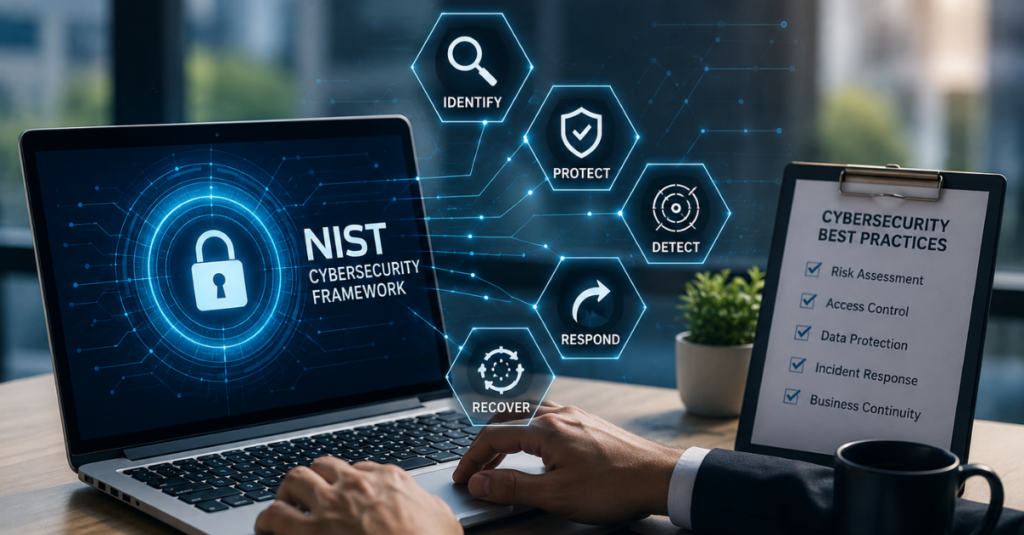
The NIST Cybersecurity Framework (CSF) is a set of guidelines and best practices designed to help organizations improve cybersecurity risk management.
Rather than focusing on one specific technology, NIST provides a structured approach for building and maintaining a strong security posture across the entire business.
The framework is built around five core functions:
- Identify
- Protect
- Detect
- Respond
- Recover
These categories help businesses understand where vulnerabilities exist, how threats can be minimized, and how to maintain continuity during cybersecurity incidents.
One reason the NIST framework has become so widely adopted is its flexibility. It can scale across businesses of different sizes and industries while adapting to changing operational needs.
Organizations improving security maturity and strengthening digital resilience are increasingly aligning operations with NIST standards.
Austin Businesses Are Prioritizing Cyber Resilience
Austin’s business environment continues to grow rapidly, especially in sectors like healthcare, finance, technology, legal services, and construction.
As companies expand operations, adopt cloud platforms, and support hybrid workforces, their attack surfaces also grow larger and more complex.
This rapid digital growth has increased the need for structured cybersecurity planning.
Businesses are now focusing more heavily on:
- Continuous risk assessments
- Security policy standardization
- Endpoint and cloud visibility
- Faster incident response
- Backup and recovery readiness
NIST helps organizations create consistency across these areas while aligning cybersecurity efforts with business goals.
Businesses improving endpoint visibility and scalable cloud operations are creating more resilient IT environments.
Compliance Requirements Are Driving NIST Adoption
For many organizations, cybersecurity is no longer optional from a compliance standpoint.
Industries handling sensitive customer information face increasing pressure to demonstrate stronger security controls and documented cybersecurity practices.
Businesses in healthcare, financial services, and legal sectors are expected to maintain:
- Access controls
- Risk management procedures
- Incident response plans
- Data protection measures
- Continuous monitoring practices
The NIST framework helps organizations strengthen compliance readiness by providing a recognized structure for cybersecurity governance.
Even businesses not directly required to follow NIST are adopting its standards because customers, partners, and insurers increasingly expect stronger cybersecurity maturity.
Organizations focused on compliance readiness and structured security governance are gaining stronger operational stability.
NIST Supports Modern IT Environments
Today’s business IT environments are far more complex than traditional office networks.
Employees work remotely, businesses rely on cloud applications, and organizations operate across multiple devices and platforms simultaneously.
Without centralized cybersecurity management, visibility gaps can quickly emerge.
NIST supports modern IT operations by helping businesses establish:
- Clear access management policies
- Consistent security controls
- Structured vulnerability management
- Ongoing monitoring and response procedures
This becomes especially important for Austin businesses managing hybrid work environments and rapidly expanding digital operations.
Organizations strengthening hybrid security and improving network visibility are reducing operational blind spots.
Incident Response Has Become a Business Priority
One of the most valuable aspects of the NIST framework is its focus on incident response and recovery.
Many organizations invest heavily in prevention but struggle when an actual cybersecurity event occurs.
Modern cyberattacks move quickly, and delayed response can significantly increase operational disruption and financial damage.
NIST encourages businesses to develop clear processes for:
- Identifying cybersecurity incidents
- Containing threats rapidly
- Communicating during disruptions
- Restoring systems safely
- Reviewing incidents to improve future readiness
Businesses with structured response plans often recover faster and reduce the long-term impact of cyber incidents.
Companies investing in incident response and reliable disaster recovery strategies are minimizing downtime after cyber events.

Small and Mid-Sized Businesses Are Embracing NIST
A common misconception is that cybersecurity frameworks are only designed for large enterprises.
In reality, small and midsize businesses are increasingly adopting NIST because they face many of the same threats as larger organizations but often with fewer internal resources.
Cybercriminals frequently target SMBs because they may lack:
- Dedicated security teams
- Formalized security policies
- Continuous monitoring capabilities
- Incident response planning
The NIST framework gives SMBs a practical roadmap for improving cybersecurity maturity step by step without needing enterprise-level infrastructure from the start.
Businesses investing in managed cybersecurity and smarter business protection are creating stronger long-term resilience.
Why Austin Businesses Are Partnering With Managed IT Providers
Implementing cybersecurity frameworks internally can be challenging for businesses already managing daily operations and rapid growth.
This is why many Austin organizations are partnering with managed IT providers for guidance, monitoring, and long-term cybersecurity planning.
Managed IT services help businesses:
- Align with cybersecurity best practices
- Improve risk visibility
- Maintain ongoing monitoring
- Strengthen endpoint and cloud security
- Support compliance readiness
- Reduce operational IT burden
By combining structured frameworks like NIST with proactive IT management, businesses can improve resilience while staying focused on growth.
Organizations adopting strategic IT planning and secure technology procurement are improving operational efficiency while strengthening cybersecurity posture.
How CMIT Solutions of Austin Downtown and West Helps Businesses Strengthen Cybersecurity
CMIT Solutions Austin helps businesses implement stronger cybersecurity strategies through proactive IT management and security solutions aligned with modern best practices.
Their approach supports organizations with:
- Risk assessments and security evaluations
- Endpoint and network protection
- Cloud security management
- Backup and disaster recovery planning
- Compliance-focused IT strategies
- Ongoing monitoring and incident response support
By helping businesses align IT operations with structured cybersecurity frameworks like NIST, CMIT Solutions helps organizations strengthen resilience while reducing operational risk.
Businesses modernizing their operations also benefit from improved workflow productivity and streamlined business communication.
Conclusion: Cybersecurity Requires Structure, Not Just Technology
Cyber threats in 2026 are evolving faster than ever, and businesses can no longer rely on reactive security measures alone.
Building resilience requires more than installing cybersecurity tools. It requires structure, planning, continuous monitoring, and a clear framework for managing risk across the organization.
That’s why more Austin businesses are adopting the NIST Cybersecurity Framework as part of their long-term IT strategy.
Organizations that prioritize cybersecurity maturity today will be better prepared to protect operations, maintain customer trust, and adapt to future threats.
To learn more about evolving cybersecurity risks, explore insights on AI threat defense, autonomous cyber threats, and future-ready security.
If your business is looking to strengthen cybersecurity practices and build a more resilient IT environment, CMIT Solutions of Austin Downtown and West can help. Contact our team today to learn how structured cybersecurity strategies and proactive IT support can help protect your business in 2026 and beyond.