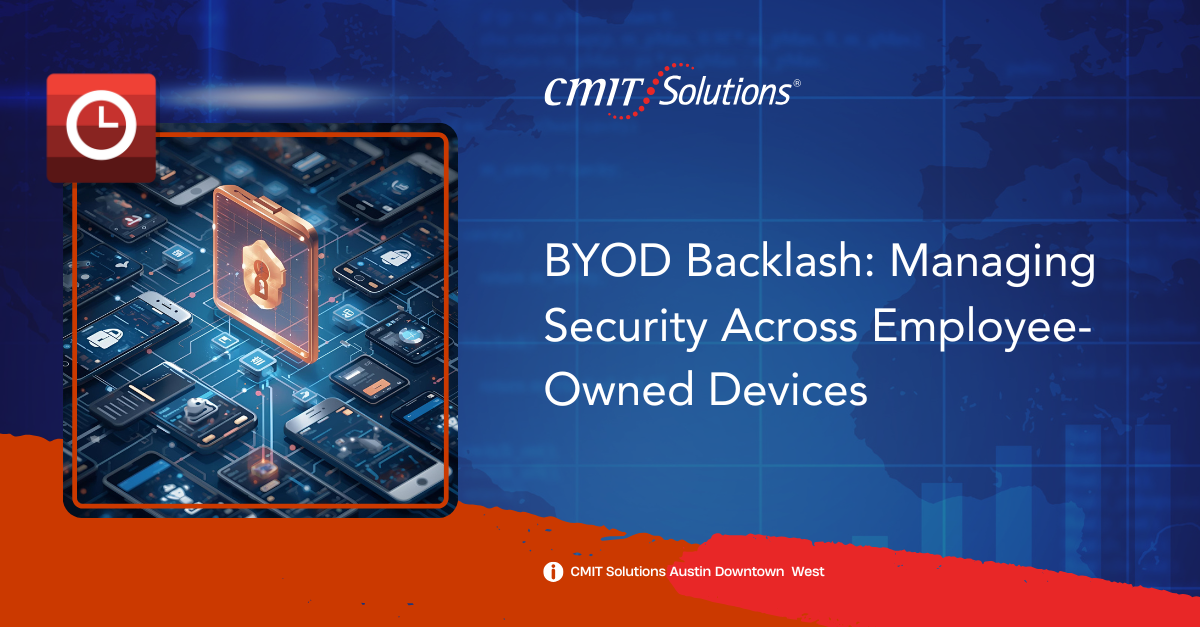
The Bring Your Own Device (BYOD) movement revolutionized modern work culture. By allowing employees to use personal devices for business operations, organizations achieved new levels of flexibility, productivity, and mobility. But with convenience comes risk and today, BYOD has become one of the most significant cybersecurity challenges facing small and midsize businesses (SMBs).
In Austin’s thriving tech scene, where startups and established firms alike embrace remote and hybrid work, personal device use has surged. Yet every smartphone, tablet, and laptop connecting to company networks expands the attack surface for cybercriminals. The result? A growing backlash against BYOD without strong security and compliance controls.
The Rise (and Risks) of BYOD
BYOD policies were initially viewed as a cost-effective way to empower employees. Staff could use familiar devices, reducing hardware expenses while improving accessibility and morale. But as seen with the cost of poor network management, convenience without oversight quickly leads to costly vulnerabilities.
Personal devices blur the boundaries between business and personal use. Without centralized management, it becomes difficult to enforce encryption, monitor app usage, or ensure timely security updates.
In a BYOD environment, risks include:
- Unsecured Wi-Fi connections during remote work
- Unpatched operating systems and apps
- Data leakage through unauthorized cloud apps
- Device theft or loss without remote wipe options
These vulnerabilities make SMBs an attractive target for ransomware, phishing, and insider threats.
Why SMBs Are Most Exposed
Unlike large enterprises, most SMBs don’t have the in-house resources to deploy enterprise-grade mobile device management (MDM) solutions. Cybercriminals know this and exploit it.
Smaller businesses are less likely to require multifactor authentication, enforce data encryption, or segment employee networks. As a result, attackers can infiltrate systems through unsecured devices and escalate privileges silently. This trend mirrors findings from why managed IT services, where expert oversight drastically reduces risk exposure by implementing structured, policy-driven security. BYOD should not mean “bring your own vulnerability.” It must be supported by clear governance and strong technological safeguards.
The Compliance Challenge: BYOD and Data Governance
Compliance frameworks like HIPAA, GDPR, and CCPA place strict controls on how businesses handle data but BYOD complicates enforcement. Personal devices often fall outside corporate IT’s direct control, creating blind spots in audit and access trails.
Firms adhering to IT compliance in Texas principles know that regulators don’t distinguish between “corporate” and “personal” when data breaches occur. If company information is exposed on an employee device, the business is still liable.
Key compliance challenges include:
- Ensuring data encryption across personal devices
- Maintaining separation of personal and corporate data
- Enforcing consistent security patching and updates
- Monitoring file transfers and external sharing
Without proper oversight, BYOD environments can undermine even the most robust compliance programs.
AI and Automation: Smarter BYOD Security
AI-powered security tools are changing how organizations detect and respond to threats. Intelligent systems can analyze device behavior, detect anomalies, and block malicious activity before it spreads.
Businesses adopting boosting cybersecurity with AI solutions gain real-time insights into device behavior automatically identifying compromised endpoints and triggering isolation protocols.
Automation also plays a crucial role in maintaining BYOD hygiene by:
- Automatically enforcing password policies
- Detecting outdated operating systems
- Monitoring data access in real time
- Managing remote device wipe upon termination
When AI-driven systems are integrated with managed IT frameworks, businesses gain continuous, adaptive defense against evolving BYOD threats.
Zero Trust: The Foundation of Modern BYOD Strategy
The traditional “trust but verify” model no longer works in distributed networks. BYOD requires Zero Trust Architecture, a model where no device or user is trusted by default. Companies deploying zero trust maximum security ensure that every access request is authenticated, authorized, and continuously validated.
Zero Trust strategies include:
- Enforcing least-privilege access controls
- Using continuous authentication and behavioral monitoring
- Segmenting networks to isolate endpoints
- Verifying device health before granting access
With Zero Trust, even compromised personal devices can’t easily move laterally through the network significantly reducing the impact of a breach.
Cloud Security in a BYOD World
Cloud adoption and BYOD go hand in hand, but poorly configured cloud services can magnify risk. Employees using personal devices often sync data to unsanctioned storage apps, creating “shadow IT” environments that bypass corporate security.
Organizations investing in cloud innovation in Austin are mitigating this issue by implementing cloud access security brokers (CASBs), enforcing encryption policies, and centralizing data management.
Cloud-native BYOD strategies enable:
- Real-time monitoring of user activity
- Automated compliance reporting
- Unified threat detection across devices
- Centralized identity and access management
When cloud and BYOD security are aligned, businesses can scale securely without compromising agility.
Data Backup and Recovery for BYOD Environments
Ransomware attacks targeting personal devices have surged. Employees’ phones and laptops are often the weakest link in an organization’s defense chain. That’s why forward-thinking SMBs are prioritizing robust data protection through data backup isn’t an optional strategy. Even if a personal device is compromised, having secure, immutable backups ensures critical files remain intact.
Modern BYOD recovery frameworks include:
- Cloud-based automated backups
- Endpoint isolation during incidents
- AI-driven restoration prioritization
- Encrypted synchronization across user accounts
With intelligent backup systems, businesses maintain operational continuity no matter where their data resides.
The Human Factor: Educating Employees on BYOD Security
Technology alone can’t secure a BYOD environment. Employee awareness is essential. Many breaches occur because staff unintentionally expose company data through weak passwords, unsafe downloads, or public Wi-Fi. Businesses adopting digital trust in real estate methodologies know that trust must be earned through consistent behavior and transparency.
To strengthen user accountability, SMBs should:
- Conduct regular cybersecurity training sessions
- Implement mobile usage policies with clear do’s and don’ts
- Require device registration and security approval
- Encourage multi-factor authentication on all platforms
A culture of security awareness turns employees from potential risks into active defenders.
The Role of Managed IT Services in BYOD Governance
Managing BYOD security requires round-the-clock vigilance, something most SMBs can’t maintain internally. This is where managed IT services in Austin become indispensable. Managed IT providers handle every aspect of BYOD governance, including:
- Endpoint monitoring and management
- Network segmentation and access control
- Policy enforcement and compliance tracking
- Incident response and recovery planning
By integrating AI-driven tools and Zero Trust frameworks, managed IT partners ensure that personal devices enhance productivity without compromising business security.

Case Study: Austin SMBs Leading Secure BYOD Adoption
Many local businesses have found success through strategic BYOD policies supported by IT professionals. Tech startups using from startups to scaleups frameworks integrate mobile device management early—ensuring that growth doesn’t come at the expense of compliance.
Healthcare organizations, guided by HIPAA compliance and cyber defense, use encrypted communication channels for patient data. Construction firms employ cybersecurity in construction frameworks to secure blueprints and site access. Each example demonstrates that with the right combination of tools, policy, and training, BYOD can be both efficient and secure.
AI, Analytics, and the Future of BYOD
The next phase of BYOD management will rely heavily on artificial intelligence. Predictive analytics will assess risk levels in real time, while AI algorithms will identify abnormal behaviors and suggest corrective actions automatically.
Organizations following Austin’s AI advantage are already integrating adaptive learning models into their IT ecosystems enabling faster threat detection and smarter access control. As AI evolves, it will merge with hyperautomation and self-healing IT systems empowering SMBs to manage BYOD security at scale with minimal manual intervention.
Conclusion: Balancing Flexibility with Control
BYOD isn’t going away, it’s the new standard for the modern workplace. But without proper security, it can expose businesses to unacceptable risks.
By integrating zero trust maximum security, leveraging cloud innovation in Austin, and partnering with managed IT services in Austin, SMBs can transform BYOD from a liability into a competitive strength. The future of work is mobile and with the right cybersecurity foundation, it can also be secure, compliant, and resilient.