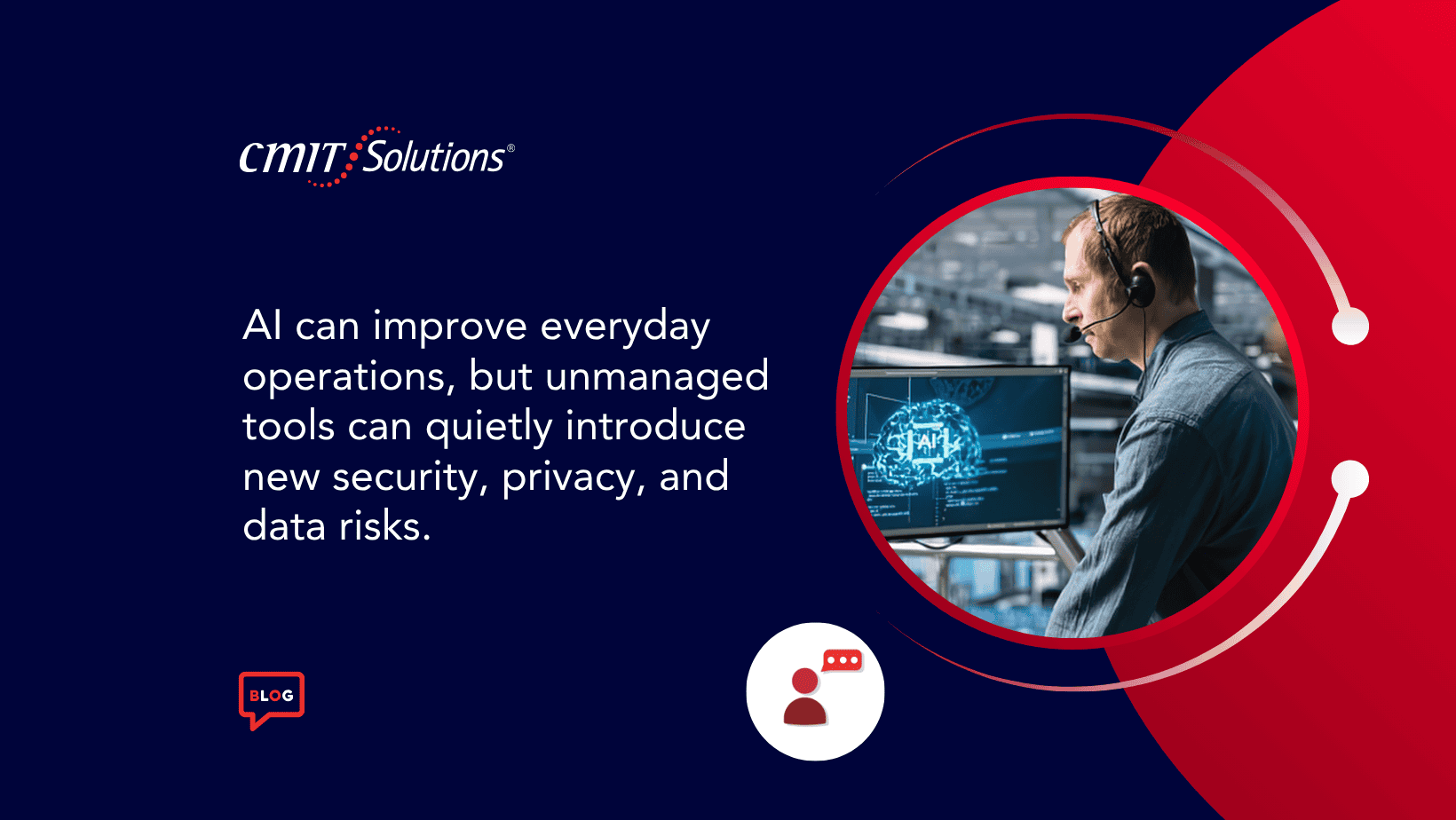
Artificial intelligence has moved well beyond the experimental phase for most businesses. It’s now woven into scheduling tools, customer service chats, marketing platforms, financial reporting, and even the software employees use to draft a simple email. This shift has happened quickly, often faster than the policies and safeguards needed to manage it responsibly.
CMIT Solutions of Austin Downtown West works with businesses across the region navigating this exact tension. AI is delivering real efficiency gains, but many companies are adopting these tools faster than they’re evaluating the risks that come along with them. This article explores how AI is reshaping daily business operations, where the hidden risks tend to show up, and what businesses can do to capture the benefits without exposing themselves unnecessarily.
How AI Has Quietly Become Part of Daily Operations
A few years ago, AI adoption in small and midsize businesses often meant a single chatbot on a website or a basic recommendation engine. Today, AI touches far more of the day-to-day workflow, often without employees even realizing a given tool relies on it.
Common everyday uses now include:
- Drafting and refining emails, proposals, and marketing content
- Summarizing meetings, documents, and long email threads
- Automating scheduling, follow-ups, and routine customer communications
- Powering search and recommendation features across internal software
- Analyzing sales, financial, or operational data to surface trends
- Screening resumes and assisting with early-stage hiring decisions
This kind of adoption is explored in more depth in this look at AI driven productivity tools that many local businesses are already using without a formal rollout plan in place. What often starts as a small productivity experiment quickly expands into something touching nearly every department, frequently without a clear inventory of which tools are actually being used across the organization.
Where the Real Benefits Show Up
Before addressing the risks, it’s worth acknowledging why AI adoption has spread so quickly. The efficiency gains are often immediate and measurable.
Time savings on repetitive tasks. Employees spend far less time on routine writing, data entry, and basic research when AI tools can handle a first draft or initial summary.
Faster customer response times. AI-powered chat and support tools allow businesses to respond to common customer questions instantly, freeing staff to focus on more complex requests.
Better decision-making through data analysis. AI can process far larger volumes of data than a person could manually review, surfacing patterns and trends that might otherwise go unnoticed.
Reduced operational costs. Automating routine processes often reduces the staffing hours needed for tasks that previously required significant manual effort.
Businesses across the area have documented these gains firsthand, a trend covered further in this overview of everyday AI efficiency improvements local companies have realized over the past year. The challenge isn’t whether AI delivers value. It’s making sure that value doesn’t come with unmanaged risk attached.

Where the Hidden Risks Actually Live
Most AI-related risk doesn’t come from the technology failing outright. It comes from how it’s adopted, configured, and integrated into daily workflows without enough oversight.
Data exposure through free or unmanaged tools. Employees experimenting with free AI tools may unknowingly input sensitive customer data, financial figures, or proprietary business information into platforms with unclear data handling policies.
Shadow AI adoption. Just as “shadow IT” once described unapproved software creeping into a business, “shadow AI” now describes employees using unsanctioned AI tools without any visibility from leadership or IT.
Inaccurate or biased outputs. AI tools can produce confidently incorrect information, and decisions based on flawed AI-generated analysis can carry real financial or legal consequences if not properly reviewed.
New attack surfaces for cybercriminals. As AI tools become more embedded in business systems, they also become new targets, and attackers are already exploring ways to manipulate AI-driven processes for their own benefit.
Compliance blind spots. Industries with strict data handling requirements may unknowingly violate regulations if AI tools process regulated data without proper safeguards in place.
Bringing structure to this kind of rapid, informal adoption is exactly what’s covered in this discussion of practical AI integration strategies designed to move businesses from scattered experimentation toward a coordinated approach.
The Shadow AI Problem
Shadow AI deserves particular attention because it’s often invisible until something goes wrong. Employees adopt these tools with good intentions, usually to save time or work more efficiently, but without any centralized visibility into what’s being used or how.
Common shadow AI scenarios include:
- A marketing employee using a free AI writing tool to draft content that includes unreleased product details
- A finance team member uploading spreadsheets containing sensitive figures into an AI tool for quick analysis
- Customer service staff pasting customer messages into a chatbot to draft responses, unintentionally exposing personal data
- Managers using AI resume screening tools without understanding how decisions are being made or whether bias is being introduced
Without a clear policy, businesses often have no idea how many of these tools are actively in use across departments. Establishing visibility starts with understanding how shifting workplace behavior around new technology tends to outpace formal policy updates, leaving gaps that grow larger the longer they go unaddressed.
AI Collaboration Tools and Workplace Productivity
Beyond individual employee use, many businesses are now formally adopting AI-powered collaboration platforms designed to streamline meetings, project management, and internal communication. These tools promise significant productivity gains, but they also centralize large volumes of internal data in a single platform, raising the stakes if that platform isn’t properly secured.
Considerations for adopting these tools responsibly include:
- Reviewing data retention and privacy policies before rolling out a new platform company-wide
- Limiting access to sensitive project details based on role rather than granting broad visibility by default
- Training employees on what information is appropriate to share within AI-assisted collaboration tools
- Establishing a clear process for evaluating new tools before they’re adopted informally by individual teams
A closer look at how these platforms are reshaping daily workflows is available in this discussion of AI collaboration tools now common across growing businesses.
Leadership’s Role in Managing AI Adoption
Successfully integrating AI into daily operations requires more than a technology decision. It requires leadership involvement in setting expectations, defining acceptable use, and modeling responsible adoption across the organization.
Leaders should consider:
- Establishing a clear, written AI use policy that employees actually understand
- Designating someone responsible for evaluating and approving new AI tools before widespread adoption
- Creating a feedback loop so employees can report concerns or unclear situations without hesitation
- Regularly revisiting policies as AI capabilities and associated risks continue to evolve
Guiding teams through this kind of transformation is a leadership challenge in its own right, one explored in more depth in this piece on leading through automation and what it takes to bring a team along rather than leaving policy as an afterthought. Many businesses without dedicated technology leadership are turning to outside expertise for this exact reason, a trend covered in this overview of strategic technology leadership available through fractional or virtual roles.

How AI Is Changing IT Support Itself
It’s not just business operations being reshaped by AI. IT support and service delivery have changed significantly as well, with AI now handling much of the initial triage for common technical issues.
- Automated ticketing systems that categorize and prioritize issues without manual sorting
- AI-assisted troubleshooting that resolves simple problems before they ever reach a technician
- Predictive monitoring that flags potential hardware or system failures before they cause downtime
- Smarter escalation processes that route complex issues to the right specialist faster
This shift is discussed further in this look at automated service desks and how they’re changing what businesses should expect from their technology support experience.
The Cybersecurity Side of AI Adoption
As AI becomes more embedded in business operations, it also becomes more attractive to cybercriminals looking for new ways to exploit these systems. Attackers are increasingly using AI themselves, both to launch more convincing attacks and to identify vulnerabilities in AI-driven business processes.
Key risks include:
- AI systems being manipulated through carefully crafted inputs designed to produce harmful or misleading outputs
- Attackers using AI to identify which businesses have adopted specific tools with known vulnerabilities
- Increasingly convincing phishing and social engineering attempts generated using AI language tools
- Autonomous attack tools capable of scanning for and exploiting weaknesses with minimal human involvement
Understanding this evolving threat landscape is critical, particularly as autonomous threat actors become more capable of operating with limited human oversight. Businesses adopting AI tools without a security review are increasingly exposed to emerging AI cybercrime tactics specifically designed to exploit gaps most companies haven’t yet considered. Manipulative approaches used to gain initial access remain a common thread across these attacks, a pattern covered further in this discussion of manipulative attack tactics increasingly powered by AI.
Why Digital Fragility Is a Growing Concern
As businesses layer more tools, integrations, and AI-driven processes on top of existing systems, overall resilience can quietly weaken even as day-to-day efficiency improves. A single point of failure, whether a critical AI tool going offline or a key integration breaking, can disrupt operations far more broadly than a similar failure would have a few years ago.
This growing interdependence is explored in more detail in this discussion of digital fragility risks that many businesses don’t fully recognize until a disruption actually occurs.
The Gap Between Software Spending and Actual Value
Many businesses adopt new AI-powered software with high expectations, only to find the tool underused, poorly integrated, or ultimately abandoned within a year. This disconnect wastes budget and often leaves security gaps behind, since abandoned tools frequently retain access to business data long after active use has stopped.
- Audit existing software subscriptions regularly to identify underused or forgotten tools
- Remove access and data permissions for any tool no longer in active use
- Evaluate new tools based on actual workflow fit, not just feature lists or marketing claims
- Assign clear ownership for each tool’s ongoing maintenance and review
This disconnect is examined further in this look at software value gaps that many businesses discover only after reviewing their technology spending in detail.
Managing the Data AI Tools Generate and Consume
AI tools don’t just process existing data, they often generate new data in the process, from chat logs to analysis outputs to training data used to improve a given system over time. This adds another layer to an already growing data management challenge.
Businesses should consider:
- Where AI-generated data is stored and how long it’s retained
- Who has access to review or export data created by AI tools
- Whether AI tools are creating duplicate or redundant data across multiple systems
- How this additional data volume affects existing backup and storage capacity
This challenge connects directly to the broader issue of unmanaged data growth that many companies are still working to get ahead of as new tools continue to generate information faster than existing systems were designed to handle.
Blind Spots Leadership Often Misses
AI adoption frequently happens at the team or individual level long before it reaches leadership’s attention, creating blind spots that can persist for months or even years without being addressed.
Common blind spots include:
- Not knowing which departments have adopted AI tools without formal approval
- Assuming existing security policies automatically cover new AI-driven processes
- Underestimating how much sensitive data has already been shared with external AI platforms
- Failing to update employee training to reflect how work is actually being done day to day
These gaps are covered in more depth in this discussion of leadership blind spots that tend to grow wider as remote and hybrid work arrangements add further complexity. Left unaddressed, these gaps often become the kind of overlooked technology gaps that only become obvious once they’ve already slowed down broader business operations.
Building a Structured Approach Instead of Reacting to Problems
Rather than addressing AI-related issues one at a time as they arise, more businesses are shifting toward documented playbooks that establish clear expectations before problems occur. This proactive approach tends to produce far better outcomes than a reactive, tool-by-tool response.
A structured playbook typically includes:
- An approved list of AI tools cleared for business use
- Clear data handling guidelines specific to AI platforms
- A defined process for evaluating and onboarding new tools
- Regular review cycles to reassess existing tools and policies
This shift toward documented planning is covered further in this look at technology playbook approach strategies that help businesses stay ahead of issues rather than constantly responding to them after the fact.
Where Managed IT Support Fits Into Responsible AI Adoption
Capturing the benefits of AI while managing its risks is easier with the right technology partner in place, one capable of evaluating new tools, securing existing systems, and helping leadership make informed decisions.
A well-rounded approach typically includes end to end IT services that account for how AI tools are actually being used across an organization, not just the systems that were part of the original IT setup. Day-to-day questions and issues are handled through everyday technical support that helps employees use new tools correctly rather than working around unclear policies.
Protecting the business as AI adoption grows requires AI aware security measures built to recognize risks specific to these new tools, supported by monitored network performance that can flag unusual activity tied to unauthorized platforms. As more workflows move into AI-integrated software, scalable cloud infrastructure ensures systems can keep pace without sacrificing performance or security.
Data generated and processed by these tools should be protected with dependable data recovery options in place, while businesses in regulated industries need ongoing regulatory alignment to ensure AI adoption doesn’t create unintentional compliance gaps. Teams relying on AI-powered collaboration platforms benefit from integrated team communication tools that keep everyone working from the same secured systems.
Everyday productivity gains depend on properly configured workflow automation tools that integrate safely with existing business software, and any new AI investment benefits from informed technology purchasing decisions made with security and long-term value in mind rather than short-term hype. Ongoing long term IT planning helps businesses prioritize which AI investments actually make sense given their size, industry, and existing infrastructure.
CMIT Solutions of Austin Downtown West helps local businesses adopt AI tools responsibly, capturing real efficiency gains without losing visibility into the risks that tend to hide in the details. Companies looking for a broader overview of what’s available can also explore general Austin business solutions built for companies navigating this exact transition.
Moving Forward with AI Responsibly
AI is not a passing trend businesses can choose to ignore, and it’s not a risk-free upgrade either. The businesses seeing the best long-term outcomes are the ones treating adoption as an ongoing process, one that pairs real efficiency gains with clear policies, visibility, and security built in from the start.
If your business wants to capture the benefits of AI without losing sight of where the risks hide, schedule a consultation to review your current tools and build a plan that fits how your team actually works.
Frequently Asked Questions