In the world of business technology, some revolutions are loud and disruptive, while others quietly reshape the way we work without fanfare. Automation belongs to the second category. From the background tasks that keep networks running to the intelligent workflows that speed up customer service, automation is transforming small and mid-sized businesses (SMBs) in ways many owners don’t even notice until they see the measurable results.
This quiet evolution is no longer optional. As remote work, cybersecurity demands, and cloud adoption accelerate, automation is becoming the backbone of daily IT operations. Understanding how it works, what it impacts, and how to adopt it strategically can give SMBs a powerful competitive edge.
What IT Automation Really Means
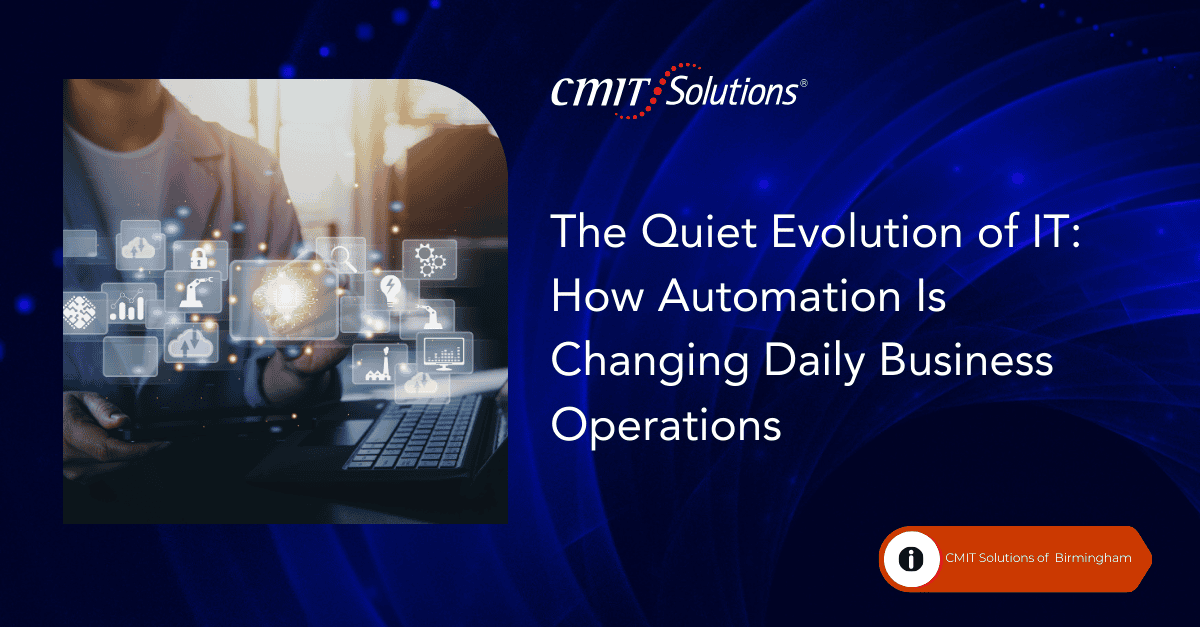
IT automation refers to using software and intelligent tools to perform routine technology tasks without constant human intervention. Instead of manually patching systems or backing up data, businesses rely on automated processes to handle:
- System updates and security patches
- Network monitoring and performance optimization
- Data backups and disaster recovery routines
- Employee onboarding and access management
These processes now run in the background, quietly reducing risk and freeing IT teams to focus on strategic projects. Automation is not about eliminating people it’s about using technology to handle repetitive tasks so humans can focus on higher-value work.

Why Automation Has Become Essential
Several major trends are driving businesses toward automated IT operations:
- Remote and hybrid work: Employees expect secure access to company systems from anywhere, at any time.
- Cloud computing: Data and applications are now spread across multiple platforms that must be updated and secured continuously.
- Escalating cyber threats: Hackers attack around the clock, making manual monitoring impractical.
Companies that embrace proactive IT support find it far easier to handle these demands without overloading internal staff.
Everyday Operations Quietly Transformed
Many businesses already rely on automation even if they don’t call it that. Examples include:
- Customer service chatbots that resolve common inquiries instantly, as highlighted in CMIT’s guide to integrating AI chatbots.
- Automated network management that detects and addresses slowdowns before employees notice, an approach central to next-gen network management.
- Data backups that run on schedule, ensuring business continuity without relying on manual intervention.
These quiet efficiencies reduce downtime, improve customer satisfaction, and allow employees to focus on innovation.
Strengthening Cybersecurity Through Automation
Cybersecurity threats now evolve faster than human teams can react. Automation helps businesses defend against ransomware, phishing, and insider risks by:
- Automatically applying security patches to close vulnerabilities.
- Using AI to detect unusual activity on networks.
- Triggering instant responses to contain potential breaches.
These capabilities are essential for companies adopting a zero trust security model, which assumes that every connection inside or outside the network must be verified.
Reducing Human Error and Compliance Risk
Human error remains one of the leading causes of data breaches and compliance violations. Automation reduces this risk by enforcing consistent policies and generating audit-ready documentation.
For example, automated IT governance tools can ensure encryption, access controls, and retention policies are applied uniformly, simplifying compliance with regulations such as GDPR, HIPAA, and PCI DSS.
Financial Benefits: Lower Costs and Higher ROI
Automation offers clear economic advantages for SMBs:
- Lower maintenance costs through automatic updates and monitoring.
- Reduced downtime that prevents revenue loss.
- Improved resource allocation as IT staff focus on strategic initiatives.
Businesses that adopt smarter tech buying practices can maximize the return on automation investments by selecting scalable tools that grow with their operations.
Supporting Remote and Hybrid Teams
The work-from-anywhere model depends on automation to keep employees productive and secure. Automated systems can:
- Provision new employee accounts in minutes.
- Back up critical data from multiple locations automatically.
- Monitor endpoints for threats in real time.
Companies leveraging hybrid cloud strategies can centralize these processes, ensuring consistent security no matter where employees work.

Preparing IT Staff for a New Role
Far from replacing IT professionals, automation frees them to focus on higher-value activities:
- Designing technology strategies aligned with business goals.
- Exploring AI-driven analytics and predictive maintenance.
- Managing complex cloud environments.
This shift transforms IT from a cost center into a strategic partner for growth.
Overcoming Common Adoption Challenges
Despite its benefits, implementing automation requires careful planning. Common hurdles include:
- Upfront costs for tools and training.
- Integration complexity with legacy systems.
- Change management to ensure employee buy-in.
Partnering with providers that offer tailored IT solutions can help SMBs design automation plans that fit their specific needs and budgets.
Building a Roadmap for Automated IT
A successful automation strategy starts with a clear plan:
- Audit current processes to identify repetitive tasks.
- Set measurable goals for cost savings, productivity, or compliance.
- Invest in scalable infrastructure using future-proof planning strategies.
- Measure and refine to ensure automation delivers consistent value.
Regular reviews prevent “automation sprawl” and ensure that every new tool supports long-term business objectives.
Real-World Results: From Quiet Efficiency to Competitive Advantage
SMBs that embrace automation often report:
- Faster response times for customer inquiries.
- Fewer system outages and quicker disaster recovery, thanks to modern backup strategies.
- Improved employee morale as staff focus on strategic projects instead of repetitive tasks.
These outcomes demonstrate why automation is more than a cost-saving measure—it’s a key driver of innovation and market agility.
Taking the Next Step
Automation is no longer a future concept it’s the quiet engine powering daily business operations today. SMBs that adopt intelligent automation will gain resilience, scalability, and security, while those that delay risk higher costs, slower growth, and greater exposure to cyber threats.
The path forward involves strategic IT consulting to align automation with business goals, proactive support to manage ongoing tasks, and a culture that embraces continuous improvement.
Final Thoughts
Automation’s greatest strength is its subtlety. It doesn’t require dramatic organizational upheaval or complex overhauls. Instead, it quietly integrates into workflows, enhancing productivity, securing data, and freeing human talent for creativity and strategy.
For SMBs willing to invest now, automation delivers more than efficiency—it creates a foundation for future growth in an increasingly digital and competitive marketplace.