
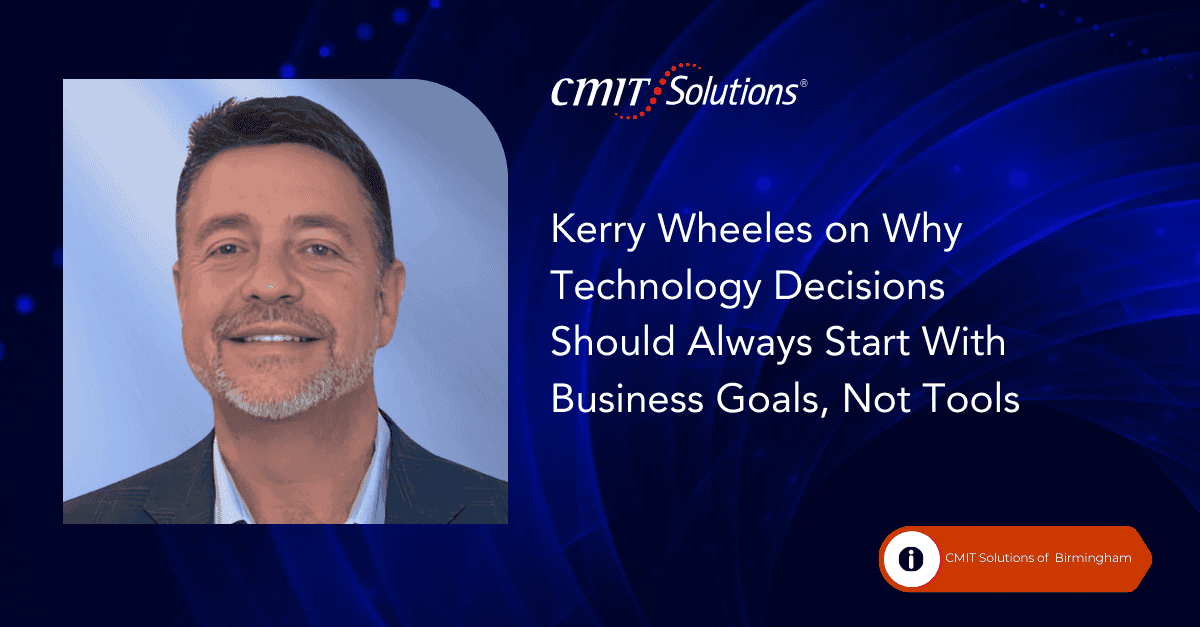
Kerry Wheeles, President of CMIT Solutions of Birmingham, has spent years advising businesses that technology alone does not solve problems—strategy does. In an era where new tools, platforms, and buzzwords appear daily, many organizations fall into the trap of choosing technology first and figuring out the business impact later. Kerry argues that this approach almost always leads to wasted spend, operational friction, and unnecessary risk. Instead, successful organizations reverse the equation: they define business goals first and then select technology that directly supports those outcomes.
The Problem With Tool-First Technology Decisions
Many businesses adopt new tools based on trends, peer recommendations, or vendor promises without clearly defining what problem they are solving. Kerry frequently sees organizations investing in platforms that add complexity without delivering measurable value—a pattern closely tied to unchecked technology sprawl.
- Tools are adopted without clear purpose
- Overlapping platforms increase costs
- Integration challenges emerge
- User adoption remains low
- ROI becomes difficult to measure
Business Goals Create Clarity Before Technology Is Chosen
According to Kerry, defining business objectives upfront creates a filter for every technology decision. Whether the goal is improving productivity, strengthening security, enabling growth, or reducing risk, clarity ensures technology choices align with outcomes rather than features.
- Goals define success criteria
- Priorities become easier to set
- Technology decisions gain context
- Trade-offs are clearer
- Investments stay focused
This approach mirrors strong technology strategy planning used by resilient organizations.

Why Tools Alone Don’t Fix Operational Problems
Kerry emphasizes that tools rarely fix broken processes. Without aligning workflows, responsibilities, and governance, even the best technology fails to deliver results. This is especially common in organizations relying on reactive IT support models.
- Process gaps remain unresolved
- Users create workarounds
- Security controls are bypassed
- Efficiency gains are limited
- Frustration increases
Security Decisions Must Start With Risk, Not Products
In cybersecurity, Kerry warns that buying tools without understanding risk exposure creates a false sense of protection. Effective security begins with understanding data sensitivity, access patterns, and threat exposure—principles reinforced by zero trust strategies.
- Risk defines security priorities
- Controls match actual exposure
- Tools support policy, not replace it
- Visibility improves decision-making
- Protection scales more effectively
Standardization Follows Strategy, Not Convenience
Kerry advises that standardization should be intentional, not accidental. When business goals drive technology selection, standardization becomes a natural outcome that improves reliability and scalability—key benefits discussed in technology standardization models.
- Platforms are chosen deliberately
- Support complexity decreases
- User experience improves
- Security becomes consistent
- Growth is easier to manage
Growth Requires Technology That Scales With the Business
Technology chosen solely for current needs often becomes a constraint during growth. Kerry stresses that forward-looking decisions anticipate expansion, ensuring systems support new users, locations, and services—an approach aligned with future-proofing efforts.
- Systems adapt to growth
- Migrations are minimized
- Performance remains stable
- Costs stay predictable
- Expansion feels controlled
Visibility Enables Smarter Leadership Decisions
When technology aligns with business goals, leadership gains clearer visibility into performance, risk, and efficiency. Kerry notes that this transparency transforms IT from a black box into a strategic asset, reinforcing the importance of IT visibility.
- Metrics align with objectives
- Risks are identified earlier
- Performance gaps are visible
- Decisions are data-driven
- Confidence increases

Proactive IT Depends on Strategic Alignment
Kerry highlights that proactive IT only works when technology decisions support long-term goals. Monitoring, maintenance, and automation become far more effective when built on intentional design—key principles of proactive support.
- Issues are prevented, not chased
- Downtime is reduced
- IT teams focus on strategy
- Users experience fewer disruptions
- Systems remain reliable
Business-First Decisions Simplify Compliance and Governance
When technology aligns with business objectives, compliance becomes easier to manage. Kerry explains that governance frameworks are far more effective when built around how the business operates rather than around disconnected tools—a benefit of compliance automation.
- Policies match workflows
- Controls are consistently applied
- Audits require less effort
- Risk exposure is reduced
- Accountability improves
Kerry Wheeles’ Core Philosophy on Technology Leadership
At its core, Kerry’s philosophy is simple: technology should serve the business, not the other way around. Tools will continue to change, but business goals provide a stable foundation for decision-making—especially as boardroom security becomes a leadership responsibility.
- Goals guide every decision
- Technology remains adaptable
- Risk is managed intentionally
- Investments deliver value
- Growth stays sustainable
Conclusion: Start With the Business, Then Choose the Technology
Kerry Wheeles’ message to business leaders is clear: successful technology decisions don’t begin with tools, features, or vendor pitches—they begin with business goals. By defining outcomes first and selecting technology second, organizations reduce complexity, control risk, and ensure every investment supports growth. In a rapidly evolving digital landscape, this business-first approach is what separates reactive organizations from resilient, future-ready ones.