
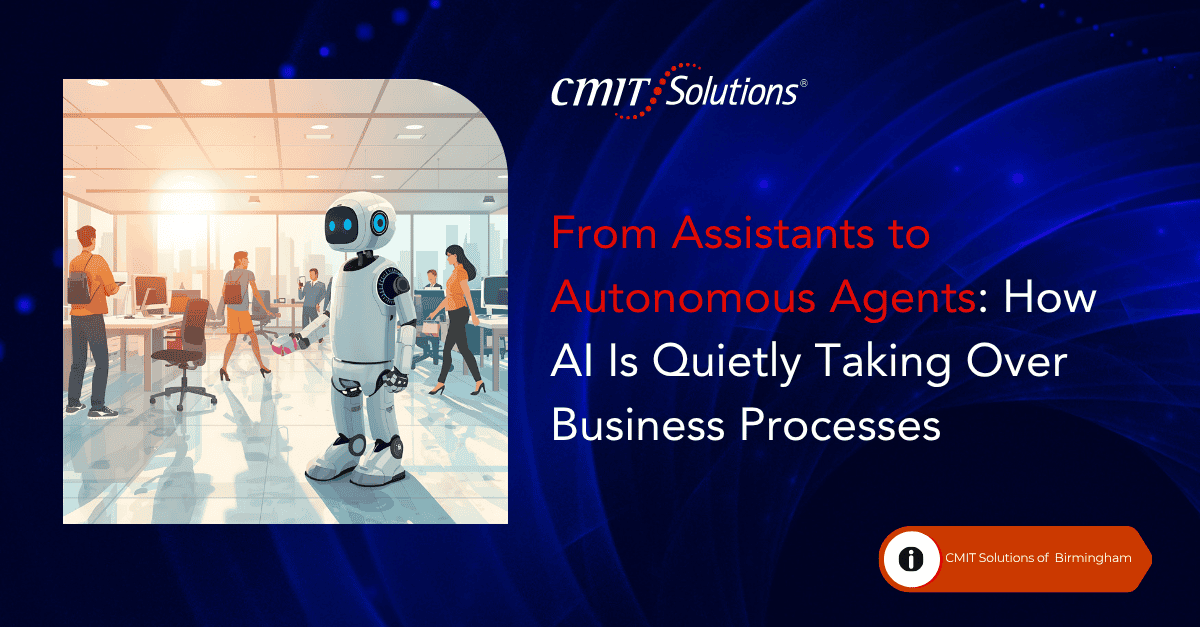
Artificial Intelligence (AI) is no longer just a futuristic concept it is actively transforming the way businesses operate. From automating routine tasks to enabling autonomous decision-making, AI is quietly reshaping workflows, enhancing productivity, and driving innovation across industries.
This blog explores how AI is evolving from simple assistants to fully autonomous agents, the impact on business processes, and strategies for integrating AI effectively.
What Are AI Assistants and Autonomous Agents?
AI assistants, such as chatbots and virtual helpers, perform predefined tasks like scheduling, answering queries, and basic data processing. Autonomous AI agents, however, go a step further—they can analyze data, make decisions, and execute complex business processes without constant human oversight.
Organizations leveraging managed IT services are integrating AI to streamline workflows, improve operational efficiency, and reduce manual errors.
How AI Is Transforming Business Processes
Automating Routine Tasks
AI-powered assistants handle repetitive tasks such as:
- Email triage and responses
- Meeting scheduling and reminders
- Document classification and management
By automating these functions, businesses free employees to focus on strategic initiatives. Integration with cloud services ensures that AI tools can access data securely and efficiently across systems.
Enhancing Decision Making
Autonomous AI agents analyze large datasets to identify trends, risks, and opportunities, enabling data-driven decision-making. Companies using IT guidance can implement AI analytics platforms to optimize operations and strategic planning.
Optimizing Customer Experience
AI agents can engage with customers through chat, email, or voice interactions, providing personalized responses and solutions 24/7. Businesses leveraging IT support can ensure AI systems integrate smoothly with CRM and service platforms.
Streamlining Supply Chain and Operations
Autonomous AI agents monitor inventory, forecast demand, and optimize logistics, reducing waste and improving operational efficiency. Network management ensures data flows seamlessly across supply chain systems, supporting AI-driven insights.
Reducing Human Error
AI minimizes errors in complex workflows, such as financial reporting, compliance checks, and regulatory documentation. Integrating AI with cybersecurity safeguards sensitive information while automating routine validation processes.
Benefits of Adopting Autonomous AI Agents
Increased Productivity
Autonomous agents handle repetitive and time-consuming tasks, allowing employees to focus on creative and strategic work. Combining AI with managed IT services ensures optimized deployment and continuous monitoring.
Cost Efficiency
Automation reduces labor costs and improves resource utilization, generating measurable ROI. Businesses using cloud services can scale AI solutions cost-effectively.
Faster Decision Making
AI analyzes real-time data faster than humans, enabling businesses to act on insights immediately. Leveraging IT guidance ensures alignment between AI-driven recommendations and strategic objectives.
Competitive Advantage
Early adoption of autonomous agents can provide a market edge by improving operational efficiency, customer satisfaction, and innovation velocity.
Improved Compliance
AI ensures adherence to regulations by automatically monitoring processes and generating audit-ready reports, reducing compliance risks. Cybersecurity integration adds an extra layer of protection for sensitive data.
Key Industries Leveraging Autonomous AI Agents
Finance
AI automates fraud detection, credit risk assessment, and financial reporting. Banks and investment firms using IT support integrate AI for faster, more accurate operations.
Healthcare
AI assists in patient data analysis, diagnostics, and personalized treatment recommendations, enhancing care while reducing administrative burdens.
Manufacturing
Autonomous agents manage production lines, inventory, and predictive maintenance, improving efficiency and minimizing downtime. Network management ensures connectivity between IoT devices and AI systems.
Retail and E-commerce
AI powers personalized recommendations, inventory management, and customer support automation, increasing revenue and customer loyalty. Integration with cloud services enables real-time analytics across platforms.
Logistics and Supply Chain
Autonomous AI optimizes routing, monitors shipments, and predicts delays, reducing operational costs and improving delivery performance.
Challenges of AI Adoption
Despite its benefits, businesses must navigate challenges when implementing autonomous agents:
- Integration Complexity: Aligning AI with existing systems can be difficult without expert IT guidance.
- Data Quality Issues: AI depends on accurate, clean data; poor quality leads to unreliable outcomes.
- Cybersecurity Risks: AI systems can become targets; integrating cybersecurity is essential.
- Employee Adaptation: Workforce resistance and skill gaps may hinder AI adoption. Managed IT services can provide training and support.
Strategies for Effective AI Integration
- Start Small, Scale Gradually: Begin with high-impact processes that benefit most from automation.
- Leverage Cloud Platforms: Use cloud services to scale AI workloads without heavy infrastructure costs.
- Implement Continuous Monitoring: Regularly evaluate AI performance and impact on business processes using IT support.
- Invest in Employee Training: Ensure staff can collaborate effectively with AI agents and leverage insights.
- Combine AI with Cybersecurity: Protect autonomous agents from attacks by integrating cybersecurity best practices.
Future Outlook: AI Beyond Automation
The evolution from assistants to autonomous agents signals a broader trend: AI-driven businesses. Future developments include:
- AI systems that predict market trends and adjust strategies autonomously
- Integration with IoT and edge computing for real-time operational control
- Enhanced decision-making with multi-agent AI systems collaborating across departments
- Smarter compliance and reporting through continuous monitoring
Businesses prepared with IT guidance, managed IT services, and network management will gain a competitive advantage in this rapidly evolving landscape.
Conclusion
AI is quietly transforming business processes, evolving from simple assistants to autonomous agents capable of making decisions, executing complex workflows, and driving innovation. Organizations that proactively adopt AI, integrate it with robust cloud services, and combine it with cybersecurity and IT guidance will reap the benefits of increased productivity, cost savings, and strategic agility.
Embracing autonomous AI agents is no longer optional it’s a critical step toward building future-ready, resilient, and innovative business operations.