AI tools are moving fast. Businesses are adopting them to write faster, automate workflows, analyze data, and handle customer interactions. The productivity gains are real, and the pressure to keep up is real too.
But most businesses skip past a critical question: what happens to your data once these tools are in use?
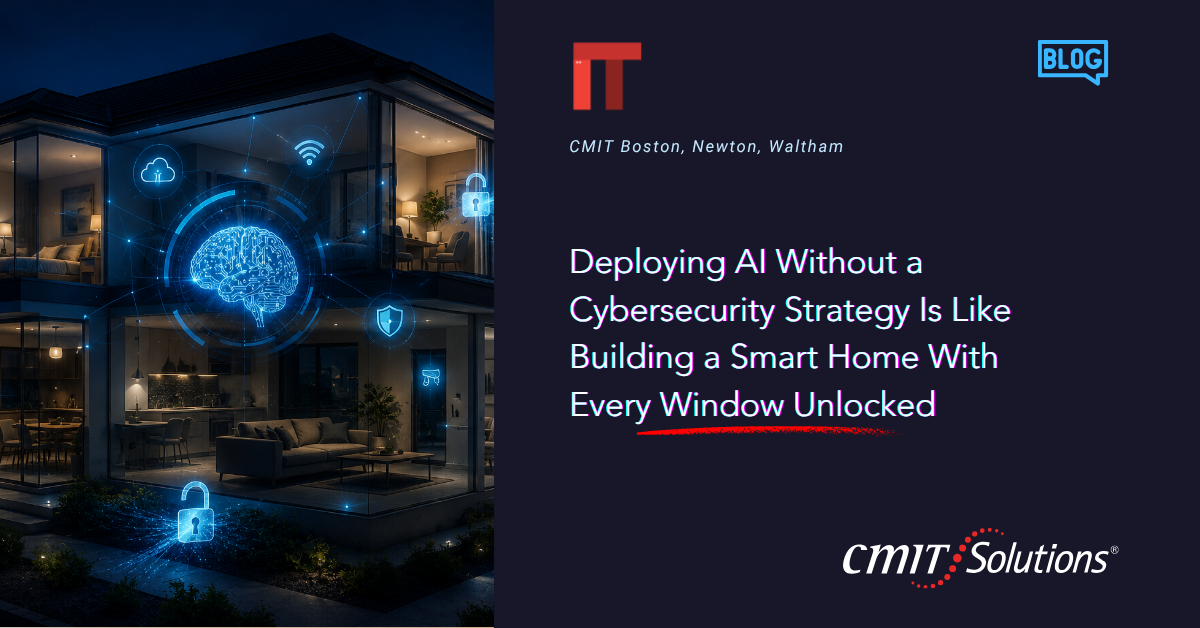
Deploying AI without a security plan in place is not just risky. It is an open invitation for breaches, compliance failures, and disruptions that are far more expensive than any efficiency gain the tool was supposed to deliver. A smart home loaded with connected devices but with every window left unlocked is still a target. Technology does not protect you. The security around it does.
If your team is exploring new tools, an AI readiness assessment is a good place to start, because it tells you where your environment actually stands before you add anything new to it.
This is not a problem unique to large enterprises with dedicated security teams. Small and mid-sized businesses are adopting AI at the same pace as everyone else, often faster, because they feel the productivity pressure more acutely and have fewer people to absorb the extra workload. A five-person marketing agency experimenting with an AI writing assistant faces the same fundamental questions as a two-hundred-person law firm rolling out an AI-powered research tool: where does the data go, who can see it, and what happens if the vendor gets breached. The size of the business changes the scale of the risk, not whether the risk exists.

AI Expands Your Attack Surface Whether You Notice It or Not
Every AI tool your team uses touches data. Customer records fed into a chatbot. Internal documents summarized by a writing assistant. Financial data processed by an automation platform. That data has to go somewhere, and in most cases, businesses have no clear picture of where.
When you add AI tools without evaluating the permissions they require, the vendors behind them, and the connections they make across your environment, you are expanding your attack surface without expanding your defenses. Attackers do not need a dramatic breach to cause damage. They follow the path of least resistance, and an unsecured AI integration is exactly that path.
This is why network management matters more now than it ever did. Knowing what is connected to your environment, and what those connections can reach, is the first line of defense. It is also why more businesses are turning to dedicated AI services to evaluate a tool’s footprint before it ever touches production data, rather than discovering the gaps after something goes wrong.
Think about how many tools your team has adopted in the past year alone. A scheduling assistant here, a transcription tool there, a chatbot plugin for the website, an AI feature quietly turned on inside software you were already using. Each one, on its own, seems small. Together, they form a web of connections that nobody has mapped, and a web nobody has mapped is a web nobody is defending. Attackers count on exactly that kind of accumulated blind spot, because it means more doors to try and fewer people watching any single one of them.
Your Data Is the Liability, Not the Tool
Most conversations about AI focus on output: what the tool produces, how accurate it is, how much time it saves. Very few focus on what the tool ingests to produce that output.
When employees use AI platforms without guidance, they often share more than they should. Proprietary product details, client data, internal pricing, HR records. Once that information leaves your environment, you lose control over how it is stored, used, or protected.
This is not a hypothetical risk. It is a real compliance issue for businesses operating under HIPAA, PCI-DSS, or similar frameworks. An AI tool that seems harmless can introduce compliance and data governance risks that many businesses fail to evaluate before adoption.
For example, a professional services firm might connect an AI assistant to Microsoft 365 to help summarize emails and meetings. Without proper permissions and oversight, that tool could potentially access client communications, financial documents, or confidential business information that should remain protected. Understanding exactly what data an AI tool can access is essential before putting it into daily use, which is why so many firms lean on IT consulting and support before rolling a new integration out company-wide.
The tricky part is that this kind of exposure rarely announces itself. Nobody gets an alert saying “this AI assistant just indexed your entire client contract archive.” The access happens quietly, in the background, as part of the tool doing exactly what it was designed to do. That is precisely why the evaluation has to happen before adoption, not after. Once a tool has already ingested sensitive information, you cannot fully undo that exposure, you can only manage the fallout from it.
Shadow AI Is Already Happening on Your Team
You may not have an official AI policy yet. That does not mean your employees are waiting for one.
Shadow AI, meaning the use of AI tools without IT visibility or approval, is spreading through organizations the same way shadow IT did a decade ago. Employees find tools that make their jobs easier and start using them. They are not trying to create a problem. They just do not know they are creating one.
The answer is not to ban AI. It is to get ahead of it. That means approved platforms, clear usage policies, and ongoing visibility into what tools are touching your data. Without that structure, you are not in control of your own environment. IT guidance from a trusted partner helps you build that structure before the problems surface, not after.
Not all AI tools carry the same level of risk. Enterprise platforms such as Microsoft Copilot include security, compliance, and governance controls designed for business environments. The key is ensuring these tools are configured properly, users have appropriate permissions, and usage aligns with company policies and compliance requirements. This is where productivity applications support and managed IT support make the difference between a tool that strengthens your operation and one that quietly undermines it.
Building an approved app catalogue is one of the simplest ways to bring shadow AI into the light. When employees have a clear, short list of vetted tools they are allowed to use, along with a straightforward way to request evaluation of a new one, most of the guesswork disappears. People are not trying to break the rules. They just need the rules to exist, be reasonable, and be easy to follow. A policy that takes five minutes to understand will get followed. A forty-page document that nobody reads will not.
Integration Without Oversight Creates Hidden Vulnerabilities
AI tools rarely operate in isolation. They connect to your email, your CRM, your file storage, your communication platforms, including unified communications systems many teams rely on daily. Each connection is a potential entry point if it is not properly configured and monitored, and a poorly scoped one can hand a tool far more access than it actually needs.
This is the window-left-open problem in practice. You built something that looks impressive, but without proper cloud services oversight and disciplined IT procurement, the perimeter has gaps that have not been closed, and a vendor with weak security practices can expose your information even if your own defenses are otherwise solid.

What a Secure AI Deployment Actually Looks Like
It starts with an honest inventory. What AI tools are already in use across your organization? What data are they touching? Which ones have been evaluated and which ones have not?
From there, it means putting the right controls in place. Data backup protocols, access restrictions, clear accountability for who owns AI-related decisions, and regular review of what vendors have access to your systems. It also means choosing vetted technology that has been properly evaluated, not just whatever offers a free trial or looks good in a demo.
Before Approving Any AI Tool, Ask:
- What data can this tool access?
- Has the vendor been vetted?
- Does it meet our compliance requirements?
- Are permissions limited to what is necessary?
- Is activity monitored and logged?
- Are employees trained on acceptable AI use?
None of this is overly complicated. But it requires intentional effort, and most businesses are moving too fast on the adoption side to pause and do it properly. That is where working with expert outsourced IT solutions or a dedicated cybersecurity partner makes all the difference. A structured approach through cmit anywhere secure AI support gives your team a clear framework for evaluating tools instead of reacting to problems one at a time.
Building a Policy Your Team Will Actually Follow
Most AI usage policies fail for the same reason most password policies used to fail: they ask people to change behavior without making the right behavior easy. If approving a new AI tool takes six weeks of back and forth, employees will simply stop asking and start using whatever gets the job done. A workable policy needs three things: a fast evaluation process, a short list of pre-approved options, and a clear point of contact when someone wants to try something new.
Training matters just as much as the policy itself. Most data exposure incidents involving AI are not the result of malicious intent. They happen because someone pasted a client contract into a chatbot to get a quick summary, not realizing where that text might end up or how long it might be retained. A short, practical training session, refreshed periodically, closes most of that gap. Pair it with the kind of ongoing IT guidance that keeps policies current as tools and threats evolve, and you have a program that actually holds up over time instead of one that looks good in a binder and gets ignored in practice.
It also helps to treat AI governance as an extension of your existing cybersecurity program rather than a brand-new initiative bolted on beside it. The same principles that govern who can access your file server, your CRM, or your financial systems should govern who can connect an AI tool to any of them. You already have a framework for thinking about access and risk. AI does not need a separate one, it needs to be folded into the one you already have.
The Businesses That Get This Right Do One Thing Differently
They do not treat AI adoption and security as separate conversations. They evaluate AI tools the same way they evaluate any new software: through the lens of data access, vendor trust, user permissions, and compliance requirements.
Before a tool goes live, they know what data it can reach. They know what the vendor’s security posture looks like. They have controls in place to monitor usage. And they have a plan for what happens if something goes wrong.
That kind of structure comes from having managed security services built around proactive oversight, not just reactive fixes. It means your team can use these tools confidently, without creating risk that circles back to hurt the business later. Businesses that pair strong business technology services with clear AI governance consistently outperform the ones treating each new tool as a one-off decision made in isolation, and that same discipline extends to how they plan their overall business technology services roadmap for the years ahead.
Round-the-clock visibility matters here too. Problems with a misconfigured integration rarely wait for business hours, which is one reason so many Boston-area companies now rely on 24/7 IT support services and 24/7 business IT support to catch unusual activity the moment it happens rather than the next morning.
The Cost of Getting This Wrong
A data breach tied to an unsecured AI tool can cost far more than the efficiency gains it was supposed to deliver. There are regulatory fines, customer trust damage, legal exposure, and the operational disruption of cleaning up after the fact.
Beyond the financial hit, there is the reputational cost. Clients and partners want to know their data is handled responsibly. If an AI tool causes a breach, saying you were trying to be more productive is not a defense that holds up.
The smarter path is to build the security foundation before the problem surfaces. Cybersecurity support paired with properly evaluated productivity applications gives your team the upside of AI without the exposure that comes from moving without a plan. Whether your business needs fast IT support after an incident or advanced IT support to prevent one in the first place, the underlying principle is the same: plan for the exposure before it becomes a headline.
Modern cloud technology solutions also play a role here, since much of the risk tied to AI tools comes from how they connect to and move data through cloud environments your team already depends on every day.
Recovery costs deserve a closer look too. If an AI integration mishandles data and triggers a breach, the cleanup rarely stops at the technical fix. Legal counsel needs to review exposure. Affected clients or patients may need to be notified, depending on the regulations that apply to your industry. Cyber insurance carriers will ask detailed questions about what controls were in place before the incident, and gaps in that answer can affect a claim. None of this is quick, and none of it is cheap, which is exactly why the upfront work of vetting a tool costs so much less than untangling the aftermath of skipping it.
Conclusion
The question is not whether your business will use AI. It is whether you will adopt it with the right guardrails in place. At CMIT Solutions of Boston, Newton & Waltham, we help businesses evaluate AI tools, protect sensitive data, and build the security foundation needed to innovate confidently. By combining cybersecurity expertise with strategic IT guidance, we help organizations take advantage of AI without creating unnecessary risk.
The window analogy holds. You can build the smartest, most connected environment imaginable. But if the security foundation is not there, none of the technology inside it is safe. The same is true for your business.
Getting IT support that understands both the opportunity and the risk is how you move forward without leaving yourself exposed. That is what we help businesses do every day.
If your business is adopting AI tools and you are not sure whether your security foundation is keeping up, that is worth a conversation. We help Boston-area businesses take on new technology without taking on unnecessary risk. So instead of reacting to problems after they happen, your business stays protected while it grows.
Call us at (617) 657-1075 or schedule a discovery call to find out where your gaps are and how to close them before they become a problem. You can also reach out anytime through our contact us page to get started.
If you know another business leader navigating AI adoption, send this their way.
Frequently Asked Questions
- Why should businesses evaluate AI tools before deployment?
Evaluating AI tools before deployment helps identify security risks, data privacy concerns, compliance issues, and integration challenges before sensitive business information is exposed. - What types of business data should never be entered into public AI tools?
Businesses should avoid entering confidential client information, financial records, employee data, legal documents, intellectual property, passwords, and other sensitive information into public AI platforms. - How can organizations safely introduce AI into the workplace?
Organizations should create AI usage policies, approve trusted platforms, provide employee training, review security settings, and continuously monitor AI-related activity. - What is AI governance?
AI governance is the framework of policies, security controls, compliance standards, and oversight processes that ensure AI technologies are used responsibly and securely. - Can AI tools create compliance risks?
Yes. AI tools can create compliance challenges if they process regulated information without proper controls or fail to meet industry-specific privacy and security requirements. - How often should AI security policies be reviewed?
AI security policies should be reviewed at least annually and whenever new AI technologies, cybersecurity threats, or regulatory requirements emerge. - What role does employee training play in AI security?
Employee education helps prevent accidental data exposure, encourages responsible AI use, and reduces the risk of security incidents caused by human error. - Can AI applications increase an organization’s attack surface?
Yes. Every AI application connected to business systems introduces new integrations, permissions, and potential entry points that must be properly secured. - Should AI tools have limited user permissions?
Absolutely. AI applications should follow the principle of least privilege by accessing only the information required to perform their intended functions. - Why is vendor evaluation important for AI solutions?
Vendor assessments help organizations understand security practices, data handling procedures, compliance certifications, incident response capabilities, and privacy commitments. - How can businesses identify Shadow AI?
Organizations can identify Shadow AI through software inventories, network monitoring, endpoint management, employee surveys, and regular technology audits. - Does cybersecurity become more important as AI adoption increases?
Yes. As businesses rely more on AI, strong cybersecurity becomes increasingly important to protect sensitive information, monitor activity, and prevent unauthorized access
. - What industries face the greatest AI security challenges?
Healthcare, legal, financial services, education, government, manufacturing, and professional services frequently handle regulated or confidential data requiring enhanced AI governance. - Can managed IT services support secure AI adoption?
Yes. Managed IT providers help businesses evaluate AI platforms, configure security settings, monitor environments, manage access controls, and maintain compliance. - Why is continuous monitoring essential for AI environments?
Continuous monitoring helps detect unusual behavior, unauthorized access, suspicious integrations, and potential threats before they impact business operations. - Should AI security be included in cybersecurity planning?
Yes. AI governance should become part of the organization’s overall cybersecurity strategy rather than being managed as a separate initiative. - What is the biggest misconception about business AI adoption?
Many organizations believe productivity benefits alone justify deployment without first evaluating the associated security, compliance, and privacy risks. - How can businesses reduce AI-related compliance risks?
Businesses should classify sensitive data, restrict AI access, implement governance policies, document AI usage, and conduct regular compliance reviews. - What are the signs that an organization needs an AI security assessment?
Using multiple AI tools, lacking an AI policy, uncertain data access, increasing cloud integrations, or handling regulated information are strong indicators that an assessment is needed. - How can CMIT Solutions of Boston, Newton & Waltham help businesses deploy AI securely?
CMIT Solutions of Boston, Newton & Waltham helps businesses evaluate AI technologies, implement cybersecurity controls, establish AI governance, monitor environments, strengthen compliance, and securely integrate AI into daily operations while protecting sensitive business data.