Data Privacy Week is January 26 – 30, 2026
Data privacy might seem abstract, but it couldn’t be more personal. You generate lots of data every time you access the internet, and sometimes, when you don’t – your home address, health records, and Social Security are all pieces of data. While you can’t control the fact that your data is collected, you can take charge of how and with whom you share data with in many cases.
Your data is worth a lot of money to many different people, businesses, and organizations, but we often don’t value our own data story as much as they do. We can all be more aware of who we share our data with and what we expect in return. Fortunately, there are a few simple, repeatable behaviors you can adopt. It appears people are becoming more aware: a recent McKinsey survey found that 71% of consumers said they would stop doing business with a company if it gave away sensitive data without permission.
There’s an old Silicon Valley adage that if you’re not paying for it, you aren’t the customer, you’re the product. In many cases, this proves true. To be more accurate, your data is the product. Who’s buying? Advertisers, mostly, but also others like software developers. You and your data make up a slice of this multi-billion bonanza.
Here are some tips on how to take charge of your data privacy in 2026!
1. KNOW WHAT YOU CAN’T CONTROL
The truth is, you can’t control who has access to every scrap and byte of your data. The IRS, for example, will find out how much money you make. And many online services require some of your data to function – a maps app cannot suggest directions if it doesn’t know where you are located (at least while you are using it). An image-sharing site needs access to your photos.
Understand that there is a tradeoff between convenience and privacy. To use all the features of your devices, apps, and software, you will often have to share more and more data. By understanding this balance, you can make better informed data decisions.
2. BUILD BETTER PRIVACY HABITS
Apps, websites, devices, and software will often seek out more data than you would think is necessary —why does a Solitaire app need to know your location? Why does a social media app need to know the phone numbers of everyone you know? Here is where you can really take charge of your data.
Fortunately, many web browsers, computers, and devices will ask you if you want to share certain types of data with a new app or website. Strike up a habit of paying attention to these requests and actually thinking about your answers. Here are common types of data you might be asked for:
Your location – In order to provide more relevant results, many apps will ask for you to share your geolocation data with them. On mobile devices, you can often decide if you want an app to only have access to this data while using it. Make sure that you are only sharing this data with apps you trust and that these apps are using your data in a responsible way.
Your contacts – Email apps and video conferencing apps virtually all allow for individuals to automatically sync their existing contacts with their services. Therefore, it is important that you share this data only with trusted sources as not only is contact data yours, but it is your friend’s and family’s as well.
Your photos and camera – Social apps universally ask for access to an individual’s photo library and related camera data — which obviously contains troves of private information. Be sure only the most trusted sources have access to this information.
Data about your behavior and use of a service – Many apps and websites track how you interact with their platforms, including what you click, how long you spend on certain pages, searches you perform, and features you use most. This data is often used to personalize experiences, improve products, or deliver targeted advertising. While behavioral data may seem less sensitive, over time it can create a detailed profile of your habits and preferences—so it’s important to review these permissions and limit tracking whenever possible.
At this point, think about what you want to share. If an app or software program refuses to function unless you share certain data that you don’t think it needs (like the Solitaire app demanding your location), find another app. Generally, you might feel more secure erring on always limiting how much data you share when asked.
3. CHECK YOUR PRIVACY SETTINGS
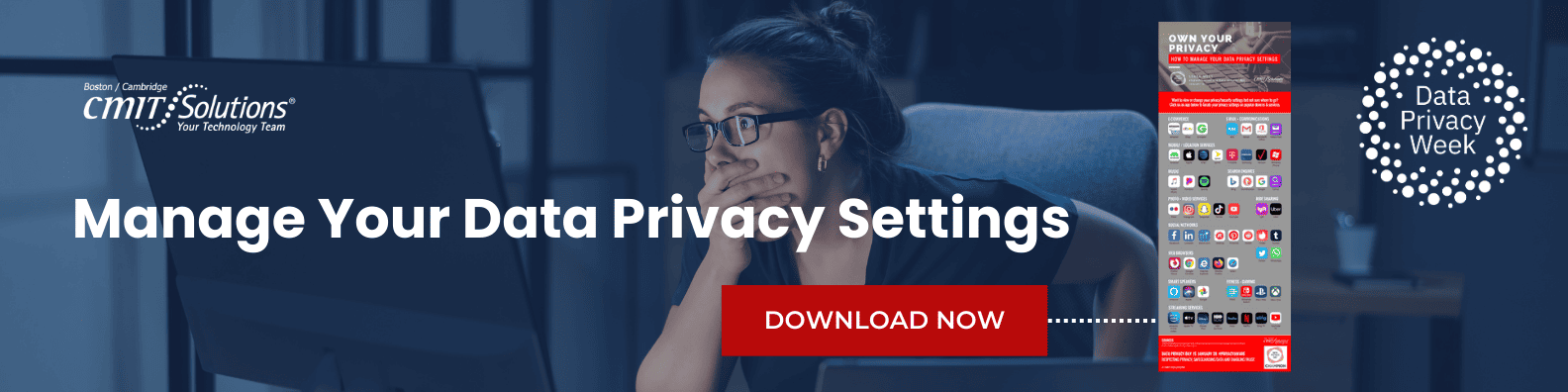
Even if an app or software program never asks you for data, you should assume it is still collecting it. Routinely (every month or so) Manage Your Privacy Settings and ensure everything fits within your comfort level. You can access app and software permissions through your device’s general settings. Remember, apps will often ask for you to give them access permissions at all times, but you usually only need to give them permissions for while you are using the app. Here are some default settings you should usually turn off, unless you need it for the app to function and you trust the app.
📷 Camera — off
🎤 Microphone — off
📍 Location — off
👥 Sync contacts — off
4. DELETE APPS YOU DON’T USE
Every 3 months or so, go through your devices and think about each app you have downloaded — we call this an “app audit.” You might think that the real estate on your phone is pretty limitless, but an app audit isn’t just about decluttering. Many apps will collect and share your device-use data even when you don’t use them; you’re basically giving away your data, and you don’t even like the app! Why should that food delivery app you used once a year ago get access to all your precious data?
If you haven’t used the app in months, delete it from your device. Don’t be afraid to be ruthless, you can always download the app again!
BE PROACTIVE ABOUT PRIVACY
Regularly reviewing and updating your data privacy settings is one of the simplest yet most effective ways to protect your information. Limit permissions to only what’s necessary, remove access from apps you no longer use, enable multi-factor authentication where available, and stay alert to platform policy changes. With studies showing that nearly 8 in 10 consumers are concerned about how companies use their data, proactive privacy management isn’t optional—it’s an ongoing habit that helps you maintain control, reduce risk, and safeguard what matters most.
Written by: Chris Zambuto | Chief Information Security Officer @CMITBostonCambridge