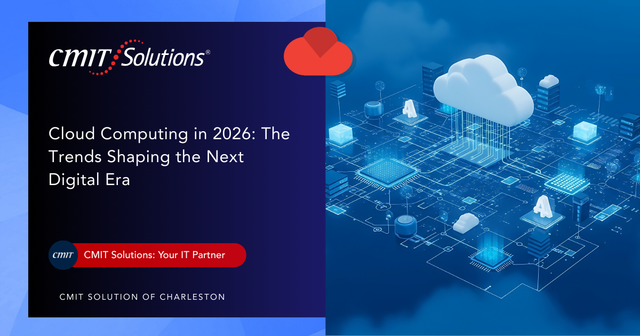
Cloud computing has evolved far beyond simple infrastructure hosting. As businesses enter 2026, the cloud is no longer just a platform it is the foundation for digital strategy, resilience, innovation, and competitive advantage. Organizations that once viewed cloud adoption as an IT initiative now recognize it as a core business enabler that touches every department, workflow, and customer interaction.
The next digital era is defined by intelligent systems, hybrid architectures, heightened security demands, and the need for continuous scalability. Cloud computing sits at the center of this transformation, enabling businesses to respond faster, operate smarter, and grow more securely in an increasingly complex digital landscape.
At CMIT Solutions of Charleston, we work with organizations that want cloud strategies built for long-term success not short-term convenience. Understanding where cloud computing is headed in 2026 helps business leaders make smarter technology decisions today
Cloud as the Strategic Foundation for Digital Transformation
By 2026, cloud computing has become the default foundation for digital transformation initiatives. Rather than modernizing individual systems in isolation, organizations are using cloud platforms to redesign how they operate, collaborate, and deliver value.
Cloud-first thinking enables businesses to innovate faster, integrate new technologies seamlessly, and scale operations without the limitations of traditional infrastructure. The cloud now supports everything from core business applications to advanced analytics and automation especially as the market aligns with the biggest tech trends.
This strategic shift positions the cloud as the foundation for transformation by enabling:
- Faster deployment of digital services and applications
- Greater flexibility to adapt to market changes
- Reduced dependence on legacy infrastructure
- Alignment between IT capabilities and business strategy
Hybrid and Multi-Cloud Architectures Becoming the Norm
The cloud landscape in 2026 is no longer defined by a single platform. Organizations are increasingly adopting hybrid and multi-cloud strategies to balance performance, security, compliance, and cost considerations.
Rather than placing all workloads in one environment, businesses are distributing applications across public cloud, private cloud, and on-premises systems. This approach offers resilience, flexibility, and greater control over sensitive data, while supporting smooth cloud migration.
Hybrid and multi-cloud adoption continues to grow because it allows organizations to:
- Optimize workloads based on performance and security needs
- Avoid vendor lock-in
- Support regulatory and data residency requirements
- Improve business continuity and disaster recovery
Cloud Security Shifting Toward Built-In and Continuous Protection
As cloud adoption accelerates, security is no longer an add-on it is embedded into cloud architecture itself. In 2026, cloud security focuses on continuous monitoring, identity-centric controls, and automated threat response.
Organizations are moving away from perimeter-based defenses toward security models that assume constant connectivity and potential exposure. This shift ensures that data, users, and applications remain protected regardless of location, especially as threats evolve and drive the need for defending against AI-powered cyber threats.
Modern cloud security strategies emphasize:
- Identity and access management as the primary control layer
- Continuous monitoring and real-time threat detection
- Integrated security policies across cloud environments
- Reduced reliance on manual security processes

Cloud-Driven Scalability Supporting Business Growth
One of the most powerful advantages of cloud computing in 2026 is its ability to support growth without disruption. Businesses can scale infrastructure, applications, and services dynamically based on demand.
This elasticity allows organizations to expand into new markets, support seasonal workloads, or launch new digital initiatives without large upfront investments or infrastructure delays an advantage that pairs well with custom IT packages when scaling operations.
Cloud scalability enables growth by providing:
- On-demand resource provisioning
- Faster time-to-market for new services
- Infrastructure that grows with business needs
- Reduced capital expenditure and operational risk
Intelligent Automation and AI Embedded in Cloud Platforms
Cloud platforms are increasingly becoming intelligent ecosystems. In 2026, automation and AI are deeply embedded into cloud services, helping organizations optimize performance, reduce costs, and improve decision-making.
Rather than managing infrastructure manually, businesses rely on cloud-native intelligence to monitor usage patterns, predict issues, and automate routine operations an approach aligned with practical AI integration.
AI-powered cloud environments support smarter operations through:
- Automated resource optimization
- Predictive maintenance and performance monitoring
- Intelligent workload management
- Reduced administrative overhead for IT teams
Cloud Enabling a Borderless and Distributed Workforce
The future of work continues to evolve, and cloud computing plays a central role in enabling secure, productive, and flexible work environments. In 2026, cloud platforms support seamless collaboration across locations, devices, and time zones.
Employees access applications and data securely from anywhere, while organizations maintain control, visibility, and compliance especially as IT leaders build strategies around remote teams and remote work collaboration.
Cloud-powered work environments benefit organizations by enabling:
- Secure remote and hybrid work models
- Consistent user experiences across devices
- Centralized management of applications and access
- Improved collaboration and productivity
Cloud Resilience and Business Continuity as Core Requirements
Downtime is no longer acceptable in a digital-first economy. Cloud computing in 2026 emphasizes resilience, redundancy, and rapid recovery as built-in capabilities rather than afterthoughts.
Organizations are designing cloud environments that can withstand disruptions, cyber incidents, and infrastructure failures without impacting operations. This is increasingly critical as leaders recognize the real cost of downtime and prioritize preventing costly downtime.
Cloud resilience strengthens business continuity by providing:
- Built-in redundancy across environments
- Faster recovery from outages and incidents
- Improved disaster recovery planning
- Reduced operational downtime
Cost Optimization Through Smarter Cloud Management
As cloud usage matures, cost management becomes a strategic focus. In 2026, organizations are leveraging advanced monitoring and governance tools to ensure cloud investments deliver measurable value.
Rather than uncontrolled spending, businesses are aligning cloud usage with business priorities and performance metrics, using models reinforced by CFOs and tech strategy.
Effective cloud cost management is achieved through:
- Visibility into usage and spending patterns
- Automated scaling to prevent overprovisioning
- Governance policies that align IT and finance
- Continuous optimization of cloud resources

Industry-Specific Cloud Solutions Gaining Momentum
Cloud computing in 2026 is increasingly tailored to industry needs. Organizations are adopting cloud solutions designed specifically for their operational, regulatory, and security requirements.
This industry-focused approach accelerates adoption while reducing complexity and risk, particularly when guided by leading with trust.
Industry-aligned cloud solutions offer advantages such as:
- Preconfigured compliance and security controls
- Faster implementation of business-critical systems
- Better alignment with industry workflows
- Reduced customization and integration challenges
Cloud Strategy Becoming a Long-Term Business Partnership
In the next digital era, cloud success depends not just on technology but on strategic guidance. Organizations are shifting away from transactional cloud adoption toward long-term cloud partnerships that evolve with their business.
A well-defined cloud strategy ensures technology investments support growth, security, and innovation over time while reinforcing governance requirements outlined in compliance made simple and cybersecurity compliance.
A strategic cloud approach helps organizations:
- Align cloud initiatives with business goals
- Adapt to emerging technologies and risks
- Maintain governance and security at scale
- Build a future-ready IT foundation
Conclusion: Preparing for the Cloud-Driven Digital Era
Cloud computing in 2026 is no longer about where systems are hosted it is about how businesses operate, innovate, and compete. The cloud has become the engine driving digital transformation, scalability, resilience, and intelligent decision-making.
For organizations looking to thrive in the next digital era, a thoughtful, well-managed cloud strategy is essential. Success depends on aligning cloud capabilities with business objectives, security requirements, and long-term growth plans.
At CMIT Solutions of Charleston, we help businesses navigate the evolving cloud landscape with clarity and confidence. Whether you are refining your existing cloud environment or building a future-ready strategy from the ground up, our team is here to help you turn cloud computing into a true business advantage.
The next digital era is already here your cloud strategy should be ready for it. Connect with CMIT Solutions of Charleston to get started.