
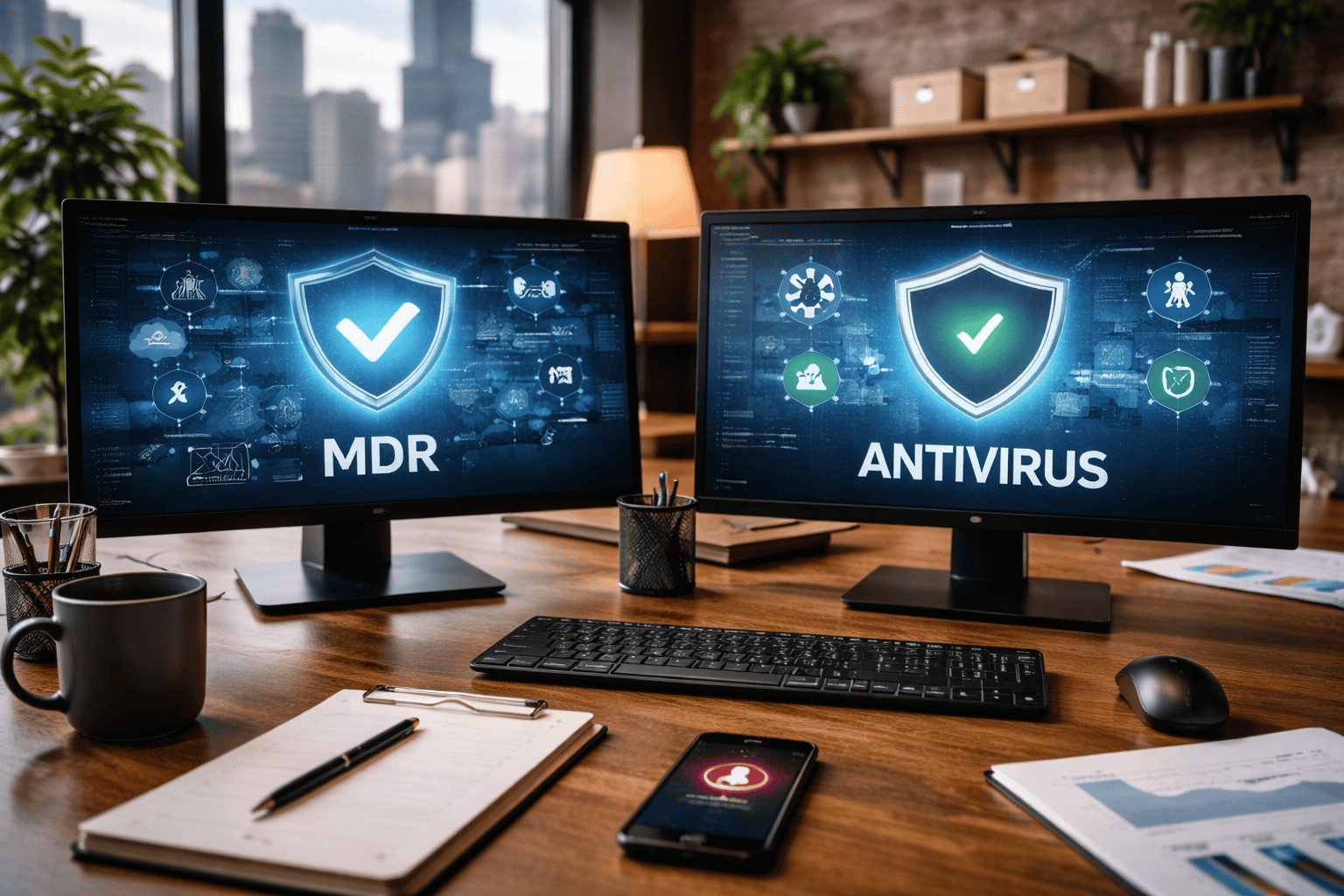
If you have antivirus software running on your business computers, you’re doing something right. Antivirus catches a meaningful category of threats known malware, recognized virus signatures, flagged files that match patterns from previous attacks.
The problem is the word “known.”
The threats that cause the most damage to small and mid-sized businesses today aren’t the ones antivirus recognizes. They’re the ones that have been specifically designed to avoid it. And by the time a traditional antivirus tool flags a problem, the damage is often already done.
How Antivirus Works and Where It Stops
Antivirus software operates primarily on signatures. When a new piece of malware is identified by the security research community, its characteristics get added to a database. Your antivirus software checks files and activity against that database and blocks what it recognizes.
This is genuinely useful, for threats that have already been catalogued. But modern cyberattacks are engineered to circumvent signature-based detection. Ransomware strains are modified slightly to avoid matching known patterns. Attackers use legitimate system tools to move through a network without triggering traditional alerts. Phishing campaigns deliver credentials-stealing code that doesn’t look like malware at all because it piggybacks on trusted applications.
The result is a detection gap, a window between when an attacker enters your environment and when (or whether) your existing tools catch them. Research consistently shows that the average dwell time for an attacker in a compromised environment is measured in weeks, not hours. Antivirus doesn’t close that gap. Managed Detection and Response does.
What MDR Actually Does
Managed Detection and Response is an active, continuous security function not a tool that runs in the background and occasionally flags something.
Here’s what distinguishes it in practice:
Behavioral monitoring, not just signature matching. MDR looks at what’s happening in your environment how users are logging in, what files are being accessed, what processes are running, how data is moving and identifies anomalies that indicate a threat even when no known signature matches. An employee account suddenly accessing large volumes of files at 2 a.m. from an unfamiliar location is a behavioral signal. Antivirus misses it. MDR catches it.
24/7 active monitoring. Attacks don’t follow business hours. MDR provides continuous visibility into your environment, with analysts and automated systems watching for indicators of compromise around the clock. A threat that surfaces on a Saturday night doesn’t wait until Monday to be contained.
Rapid containment and response. When MDR identifies a confirmed threat, the response is immediate isolating affected systems, blocking malicious activity, and beginning the remediation process before the incident compounds. This is the difference between a contained incident and a full breach.
Threat hunting. Rather than waiting for an alert, MDR includes proactive hunting actively looking for signs of compromise that haven’t triggered an alert yet. This closes the dwell time gap by finding attackers who are already in the environment before they’ve reached their objective.
The Gap That Matters Most: Pre-Breach vs. Post-Breach
The most important distinction between antivirus and MDR isn’t technical, it’s temporal.
Antivirus is largely reactive. It identifies and blocks threats at the point of contact, or after infection is already underway. By the time a ransomware attack has triggered an antivirus alert, files are often already encrypted. By the time a credential theft is discovered, the attacker may have been inside the environment for weeks.
MDR is designed to interrupt an attack in progress before the attacker reaches their objective. The earlier in the attack chain a threat is detected, the lower the cost of the incident. A contained intrusion looks very different from a full breach in remediation cost, in data exposure, in regulatory implications, and in client and reputational impact.
For Chicago financial services firms and law firms, where a breach carries regulatory reporting obligations and direct client trust consequences, the pre-breach vs. post-breach distinction is not theoretical. It’s the difference between a security incident your clients never hear about and one that requires a disclosure letter.
Why Most SMBs Don’t Have MDR and Why That’s Changing
Until recently, MDR was priced and structured for enterprise organizations. The monitoring infrastructure, the analyst capacity, and the response capabilities were out of reach for most small and mid-sized businesses.
That’s changed. Managed IT providers now offer MDR as part of a broader security stack delivering enterprise-grade detection and response capability at a cost and complexity level accessible to SMBs. For Chicago businesses that aren’t running a security operations center internally (which is nearly all of them), this is how the detection gap gets closed.
The question is no longer whether SMBs can afford MDR. It’s whether they can afford the alternative.
CMIT Solutions Chicago: Active Monitoring, Real-Time Response
Jeremy Treister and the CMIT Solutions Chicago team provide managed detection and response as part of a comprehensive cybersecurity stack built for small and mid-sized businesses. That means continuous monitoring of your environment, behavioral threat detection, rapid incident containment, and proactive threat hunting without the overhead of building those capabilities in-house.
In 17+ years serving 200+ Chicago businesses, we have maintained a zero client data breaches record. That outcome doesn’t happen by accident. It happens because our clients have active security not just antivirus running in the background.
If your current security posture starts and ends with antivirus, it’s time to have a different conversation.
Talk to CMIT Solutions Chicago about managed detection and response →
CMIT Solutions Chicago provides managed detection and response, cybersecurity services, and managed IT to businesses across Chicago. Serving financial services companies, law firms, and SMBs since 2008.