
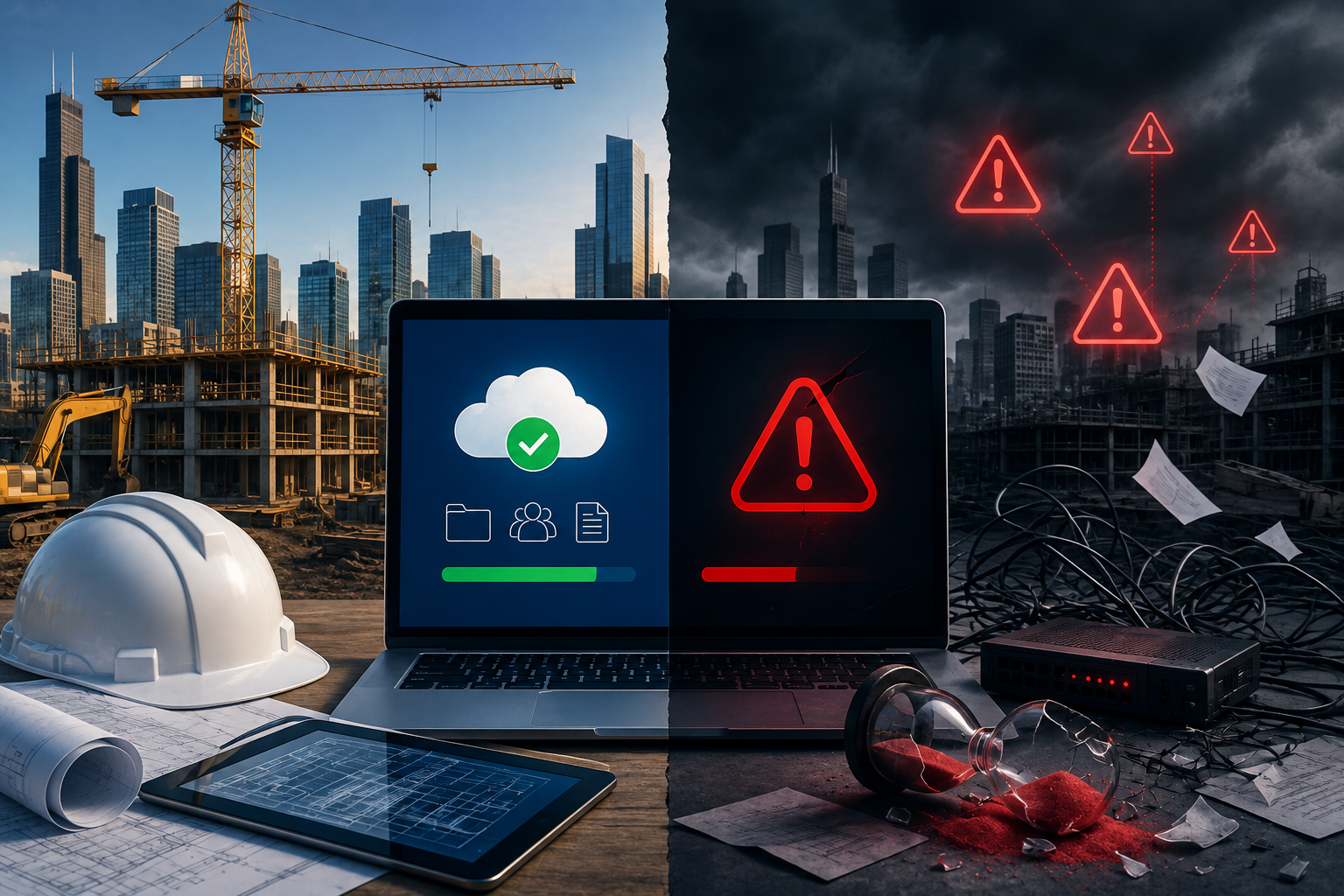
It’s 7:15 AM on a commercial construction project in downtown Chicago. Crews are arriving on-site, subcontractors are checking schedules, and the project manager is preparing for the day’s coordination meeting. Before any physical work begins, the team needs access to project management software, updated blueprints, vendor documentation, permits, schedules, and communication platforms.
Then a problem appears.
The project management system begins timing out. Updated drawings won’t load. Field supervisors cannot access revised specifications. Subcontractors are waiting for approvals that can’t be retrieved from the cloud platform. The accounting department is unable to process purchase orders because the shared system is running slowly.
Within an hour, multiple teams are affected.
The issue may ultimately be traced to a server problem, a networking issue, or a software integration failure. The root cause almost doesn’t matter. What matters is that construction activity slows down while employees wait for technology to catch up.
Unlike many industries where technology problems create inconvenience, construction firms often experience direct operational consequences. Delayed information leads to delayed decisions. Delayed decisions lead to project slowdowns. Project slowdowns eventually affect timelines, budgets, client satisfaction, and profitability.
For many Chicago construction companies, technology has become just as critical as equipment, materials, and labor. Yet many firms continue relying on reactive IT support models that were designed for a very different business environment.
Why Construction Companies Depend on Technology More Than Ever
Construction has undergone a significant digital transformation over the past decade. What was once a paper-driven industry now depends heavily on cloud platforms, mobile applications, project management software, digital documentation systems, and real-time collaboration tools.
Today’s construction firms manage complex ecosystems of technology. Teams rely on platforms like Procore, Autodesk Construction Cloud, Buildertrend, Microsoft 365, accounting software, document management systems, vendor portals, and communication tools to keep projects moving forward.
These systems connect field teams, project managers, subcontractors, suppliers, and executives across multiple locations simultaneously.
The challenge is that technology adoption has often outpaced technology management.
Many construction companies have invested heavily in software solutions designed to improve efficiency, but they have not invested equally in the infrastructure, monitoring, security, and support required to keep those systems running reliably. As a result, technology that was intended to streamline operations can sometimes become a source of frustration and disruption.
When project schedules are measured in days and contract obligations are measured in dollars, even small technology issues can create outsized consequences.
The Technology Challenges Unique to Construction Firms
Construction companies face operational realities that differ significantly from traditional office-based organizations.
Most businesses operate from a centralized location with relatively stable technology requirements. Construction companies operate across multiple job sites, temporary offices, warehouses, and field environments. Employees are constantly moving between locations, often relying on mobile devices, wireless connectivity, and cloud applications to stay productive.
This creates unique support challenges.
Internet connectivity at a job site may be inconsistent. Devices are exposed to harsh environments. New projects require temporary infrastructure deployments. Employees frequently need access to critical information from locations where traditional office support is unavailable.
At the same time, construction firms generate enormous volumes of documentation. Blueprints, permits, contracts, inspection reports, safety records, change orders, vendor agreements, and financial documents must remain organized, accessible, and secure throughout the life of a project.
Without proper technology management, these complexities quickly become operational bottlenecks.
Many firms discover that technology issues aren’t slowing down individual employees—they’re slowing down entire projects.
Document Management Problems Cost More Than Most Firms Realize
One of the most common challenges we see in construction environments is poor document management.
Construction projects involve constant updates. Drawings change. Specifications evolve. Permits are revised. Clients request modifications. Vendors submit new documentation. Every project generates hundreds or even thousands of files that need to remain accessible and current.
When document management systems are poorly organized, teams often waste valuable time searching for information, verifying file versions, or attempting to determine which documents are actually current.
The risks extend beyond productivity.
Using an outdated drawing or specification can lead to costly rework, project delays, material waste, and disputes between stakeholders. A simple file management issue can quickly evolve into a budget issue.
Effective IT support is not simply about storing files. It is about ensuring that critical project information remains available, organized, protected, and accessible to the right people at the right time.
Cybersecurity Has Become a Construction Industry Issue
Many construction companies still assume cybercriminals primarily target large corporations, financial institutions, or healthcare organizations.
That assumption is increasingly dangerous.
Construction firms have become attractive targets because they handle significant financial transactions, maintain relationships with numerous vendors and subcontractors, and often operate under strict project deadlines that create urgency.
Cybercriminals understand that a ransomware attack or business email compromise incident can disrupt active projects and create immediate pressure to resolve the situation quickly.
We regularly see construction firms facing threats such as phishing attacks, fraudulent payment requests, vendor impersonation schemes, ransomware attempts, and credential theft campaigns.
The problem is often compounded by inconsistent security practices.
Employees may access systems from personal devices. Password policies may be weak. Multi-factor authentication may not be fully implemented. Critical systems may not be monitored continuously.
A single compromised account can create financial, operational, and reputational damage that extends far beyond the IT department.
Cybersecurity is no longer a technical issue reserved for large enterprises. It has become a business risk that construction firms of all sizes must actively manage.
Why Vendor Management Creates Ongoing Frustration
Most construction companies work with a surprisingly large number of technology vendors.
There may be separate providers for internet connectivity, telecommunications, project management software, cloud storage, accounting platforms, security systems, hardware procurement, managed services, and specialized construction applications.
Each vendor has its own support process, service agreements, escalation procedures, and technical requirements.
When something breaks, accountability often becomes unclear.
A software vendor may blame the network provider. The network provider may point to cloud infrastructure. Another vendor may suggest the issue originates with a third-party integration.
Meanwhile, project teams continue waiting for a resolution.
Without centralized vendor management, construction companies often spend valuable management time coordinating vendors rather than focusing on projects and clients.
An effective IT partner serves as a single point of accountability, managing vendor relationships and ensuring problems are resolved quickly regardless of where they originate.
Why Reactive IT Support Costs More Than Most Firms Realize
Many construction companies continue to rely on a traditional break-fix model for technology support because it appears less expensive on the surface. Rather than paying for ongoing IT management, the company simply contacts a technician when a problem occurs. While this approach may seem cost-effective initially, it often ignores the much larger operational costs associated with downtime, project delays, and productivity loss.
The fundamental weakness of reactive IT support is that it only addresses issues after they have already affected the business. Servers rarely fail without warning. Network equipment typically shows signs of degradation before outages occur. Backup systems can experience failures long before anyone attempts a recovery. Security vulnerabilities often exist for months before being exploited. Without proactive monitoring and maintenance, these issues remain invisible until they create a direct operational impact.
For construction firms, the consequences can be significant because technology disruptions rarely affect a single employee. A network issue can prevent field teams from accessing project data. A cloud outage can delay approvals. A server problem can impact accounting, procurement, project management, and communications simultaneously. The cost of these disruptions extends well beyond the expense of repairing the underlying technical issue.
This is why many successful construction companies eventually move away from reactive support models and toward proactive IT management strategies designed to identify and resolve problems before they affect operations.
What Effective IT Support Looks Like for Construction Firms
Effective IT support for a construction company goes far beyond troubleshooting laptops and resetting passwords.
A modern support strategy includes continuous monitoring of infrastructure, proactive maintenance of critical systems, cybersecurity management, backup oversight, cloud platform support, vendor coordination, and strategic planning.
The goal is not simply fixing technology when it breaks. The goal is preventing technology from becoming a business problem in the first place.
For construction firms, this means ensuring project management platforms remain available, field teams stay connected, documents remain accessible, security risks are minimized, and vendors are coordinated efficiently.
Technology should support project delivery, not complicate it.
The best IT environments are often the ones employees barely notice because systems work reliably, support is responsive, and problems are addressed before they create disruption.
Why Chicago Construction Firms Choose CMIT Solutions Chicago
CMIT Solutions Chicago has supported Chicago businesses since 2008, helping organizations build technology environments that improve productivity, security, and operational reliability.
We understand the unique challenges construction companies face, including distributed workforces, multiple job sites, complex vendor ecosystems, cybersecurity risks, and the need for uninterrupted access to project information.
Our managed IT services provide proactive monitoring, cybersecurity protection, cloud support, help desk services, vendor management, and strategic technology planning designed specifically to reduce downtime and support business growth.
Construction projects already involve enough uncertainty. Your technology infrastructure shouldn’t be one of them.
Talk to CMIT Solutions Chicago about IT support for your construction company →
CMIT Solutions Chicago provides managed IT services, cybersecurity, cloud solutions, help desk support, vendor management, and technology consulting for businesses throughout the Chicago area. Serving Chicago organizations since 2008.