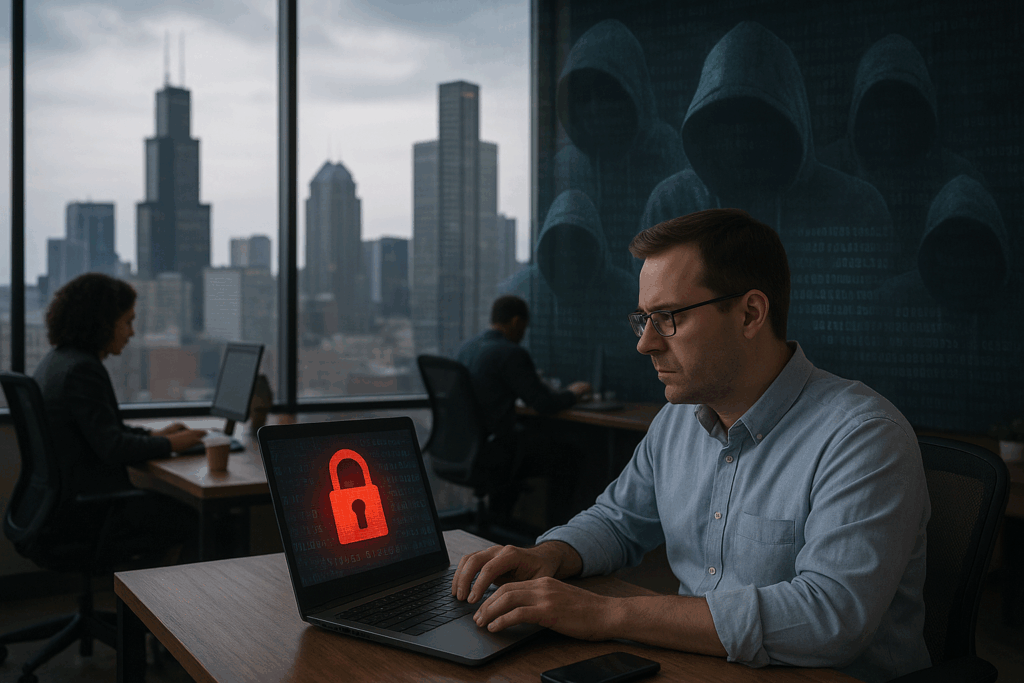

It’s the middle of tax season.
A senior accountant at a Chicago CPA firm is finalizing multiple client filings due later that day when the firm’s accounting software suddenly slows to a crawl. Staff members begin experiencing login issues. Shared files stop syncing properly. Client records take minutes to load instead of seconds. Within a short period of time, what started as a minor inconvenience becomes an office-wide productivity problem.
The firm’s IT provider is called, but support isn’t immediately available. Hours pass before meaningful troubleshooting begins. By the end of the day, deadlines have been pushed, staff members are working overtime, and several hours of billable work have effectively disappeared.
Situations like this are more common than many accounting firms would like to admit. The problem isn’t always the software, the server, or the network. More often than not, the real issue is relying on a reactive IT support model that only becomes involved after something has already failed.
As accounting firms continue to handle increasing volumes of sensitive financial data while managing strict deadlines and growing cybersecurity risks, many Chicago firms are discovering that traditional break-fix IT support is no longer enough.
Why Accounting Firms Face Unique Technology Challenges
Accounting firms operate under pressures that many other businesses simply do not face. Unlike organizations that can absorb occasional downtime without major consequences, accounting firms often work against immovable deadlines tied to tax filings, audits, payroll processing, financial reporting, and regulatory requirements.
At the same time, accounting professionals manage some of the most sensitive information a business can possess. Tax returns, banking information, payroll records, Social Security numbers, financial statements, and confidential client communications move through firm systems every day. A technology disruption doesn’t just create inconvenience—it can delay critical client work, create compliance concerns, and damage client trust.
The increasing adoption of cloud applications, remote work arrangements, and digital collaboration platforms has created additional complexity. While these tools improve flexibility and productivity, they also introduce new cybersecurity risks that require ongoing management and oversight.
For modern accounting firms, technology has become a core operational function rather than a simple business utility. When systems fail, the impact is felt immediately across the entire organization.
The Hidden Costs of Reactive IT Support
Many accounting firms still rely on break-fix IT support because it appears cost-effective on the surface. The arrangement seems simple: when something breaks, call a technician and pay for the repair.
The challenge is that break-fix support creates incentives that are fundamentally misaligned with business goals. The provider becomes involved only after an issue has already disrupted operations. By that point, productivity losses, employee frustration, missed deadlines, and client service delays have already occurred.
The true cost of reactive IT support extends far beyond the invoice for the repair itself. Every hour spent waiting for an issue to be resolved represents lost productivity. Every server failure creates operational disruption. Every missed software update increases security exposure. Every technology emergency forces staff to focus on troubleshooting instead of serving clients.
Many firms don’t realize how much downtime is costing them because those costs are spread across multiple employees, projects, and departments. Over the course of a year, however, even small recurring technology issues can translate into dozens or hundreds of lost billable hours.
The Four Technology Problems We See Most Often in Chicago Accounting Firms
Accounting Software Performance Issues
Applications such as QuickBooks, Thomson Reuters products, Drake Tax, CCH, and various document management platforms form the operational backbone of most accounting firms. When these systems become slow or unstable, productivity suffers immediately.
In many cases, the software itself isn’t the root cause. Aging infrastructure, insufficient server resources, poorly configured cloud environments, network bottlenecks, and outdated hardware often create performance issues that are mistakenly blamed on the application.
Without proactive monitoring and maintenance, these problems tend to worsen over time until they begin affecting day-to-day operations.
Cybersecurity Risks Targeting Financial Data
Cybercriminals increasingly target accounting firms because of the valuable financial information they store. A successful attack can expose sensitive client records, banking information, payroll data, and tax documentation.
Phishing attacks, ransomware incidents, business email compromise, and credential theft remain among the most common threats facing accounting professionals today. Many firms still rely on basic security controls that were adequate years ago but are no longer sufficient against modern attack methods.
Protecting financial data requires a layered cybersecurity strategy that includes endpoint protection, multi-factor authentication, email security, user training, vulnerability management, and continuous monitoring.
Remote Work and Cloud Management Challenges
Hybrid and remote work have become permanent realities for many accounting firms. While these arrangements offer flexibility, they also create new support and security challenges.
Employees need reliable access to firm resources regardless of location. Cloud applications must perform consistently. Security policies must be enforced across both office and remote environments. Device management becomes more complex as employees work from multiple locations.
Without proper oversight, firms often experience connectivity issues, inconsistent user experiences, and increased security exposure that negatively impacts productivity.
Lack of Strategic Technology Planning
One of the most common challenges we encounter is the absence of a long-term technology strategy. Many firms make technology decisions only when forced to by a problem.
Servers are replaced after they fail. Security tools are purchased after a cyber incident. Infrastructure upgrades occur only when systems become unusable.
This reactive approach leads to unpredictable costs and unnecessary business risk. Firms that consistently perform well typically follow a structured technology roadmap that aligns IT investments with business objectives and future growth plans.
What Managed IT Support Looks Like for an Accounting Firm
Managed IT services take a fundamentally different approach to technology management. Instead of waiting for problems to occur, managed IT focuses on preventing them.
For accounting firms, this means continuous monitoring of critical systems, proactive maintenance, regular security updates, help desk support, backup management, disaster recovery planning, and ongoing cybersecurity oversight.
Rather than responding to emergencies after productivity has already been impacted, managed IT providers identify potential issues early and resolve them before they become business disruptions.
This approach creates a more stable technology environment, improves employee productivity, reduces security risks, and helps firms plan technology investments more effectively.
Most importantly, it allows accountants to focus on serving clients rather than dealing with technology problems.
Why Chicago Accounting Firms Choose CMIT Solutions Chicago
For more than 17 years, CMIT Solutions Chicago has helped professional services firms build secure, reliable, and scalable technology environments. We understand the operational pressures accounting firms face, the software platforms they depend on, and the security requirements associated with managing sensitive financial data.
Our team provides proactive IT support, cybersecurity services, cloud solutions, Microsoft 365 management, help desk support, vendor coordination, and strategic technology planning designed specifically for businesses that cannot afford unexpected downtime.
We believe technology should support growth, not create obstacles. When managed correctly, IT becomes a competitive advantage rather than a recurring source of frustration.
If your accounting firm is still relying on reactive support and technology issues are disrupting productivity, it may be time for a different approach.
Talk to CMIT Solutions Chicago about IT support for your accounting firm →
CMIT Solutions Chicago provides managed IT services, cybersecurity, cloud solutions, Microsoft 365 management, compliance support, and proactive help desk services to businesses across Chicago. Serving accounting firms, law firms, financial services organizations, manufacturers, and professional services companies since 2008.