
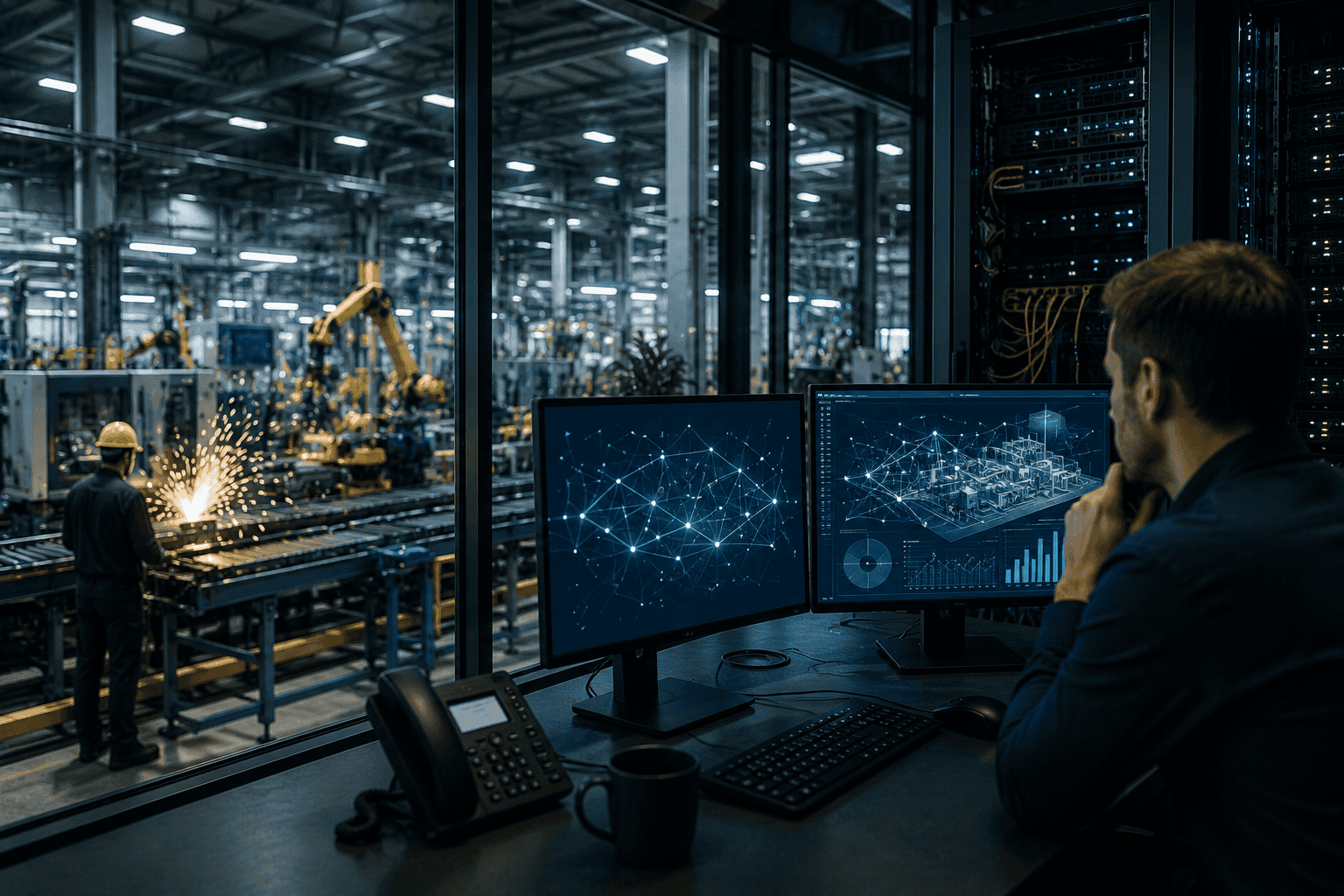
It’s 2:07 PM on a Tuesday.
Production is moving normally at a Chicago manufacturing facility when the ERP system suddenly becomes unavailable. Order entry stops. Inventory visibility disappears. Production supervisors begin tracking work manually using spreadsheets and paper notes while employees wait for updates from management.
At first, everyone assumes the outage will be brief. Fifteen minutes turns into thirty. Thirty minutes becomes two hours. By the end of the shift, production targets have been missed, shipments have been delayed, and managers are scrambling to explain the disruption to customers.
The server failure that caused the outage didn’t happen suddenly. Warning signs had been present for days. Storage utilization had been increasing. Performance alerts had been triggered. Backup jobs had started running longer than usual. The problem wasn’t that the failure occurred. The problem was that nobody was actively monitoring the environment closely enough to identify and address the issue before it impacted production.
For many manufacturers across Chicago, this remains the reality of reactive IT support. Technology problems are discovered only after they begin affecting operations. By that point, the financial impact is already growing.
As manufacturing environments become increasingly dependent on technology, more organizations are realizing that waiting for systems to fail is no longer a sustainable strategy.
Why Manufacturing Technology Requires a Different Approach
Manufacturing businesses rely on technology differently than most professional service organizations.
For a law firm, technology downtime may delay communication or document access. For a manufacturer, downtime can halt production entirely.
Modern manufacturing environments depend on a complex network of interconnected systems. ERP platforms manage orders and inventory. Production scheduling software coordinates workflows. Warehouse management systems track materials and shipments. Industrial devices communicate with business applications. Vendors, suppliers, and logistics partners often integrate directly into operational systems.
When one component experiences a failure, the impact frequently extends across multiple departments.
Technology has become deeply embedded in operational processes. As a result, IT failures are no longer simply technology problems—they are production problems.
This shift requires a more proactive and operationally focused approach to IT management.
The Real Cost of Manufacturing Downtime
Many manufacturing leaders underestimate the true cost of technology disruptions because they focus only on immediate repair expenses.
The actual impact is significantly larger.
When production systems become unavailable, employees may be unable to process orders, update inventory records, generate shipping documentation, or access production schedules. Supervisors spend time coordinating manual workarounds. Customer service teams struggle to provide accurate updates. Shipping deadlines become harder to meet.
These disruptions create direct financial costs through lost productivity, overtime expenses, delayed shipments, and reduced operational efficiency.
There are also indirect costs that are more difficult to measure but equally significant. Customer satisfaction declines when orders are delayed. Employee frustration increases when systems are unreliable. Business leaders lose confidence in technology initiatives when recurring issues continue to interrupt operations.
For manufacturers operating on tight production schedules, even a few hours of downtime can create consequences that last for days.
Four Technology Risks We Commonly See in Manufacturing Environments
ERP System Reliability Issues
The ERP system serves as the operational backbone of most manufacturing businesses. It connects purchasing, inventory, production, accounting, and customer management functions into a single platform.
When ERP systems become unavailable, operations quickly slow down or stop entirely.
Many organizations continue running ERP environments on aging infrastructure that receives minimal proactive maintenance. Performance issues often develop gradually before eventually becoming major disruptions.
Continuous monitoring and capacity planning help identify these issues early, reducing the likelihood of unexpected outages.
Network Infrastructure Failures
Manufacturing operations depend heavily on stable network connectivity.
Wireless devices, production systems, scanners, workstations, cloud applications, and industrial equipment all rely on network infrastructure functioning properly. A failed switch, misconfigured firewall, or connectivity issue can affect large portions of the business almost instantly.
Unfortunately, many manufacturing facilities still operate with limited network visibility and minimal redundancy.
Without proactive monitoring, network problems are often discovered by employees long before they are identified by IT.
Cybersecurity Threats Targeting Manufacturers
Manufacturing organizations have become increasingly attractive targets for cybercriminals.
Attackers understand that operational downtime creates urgency. When production stops, organizations face immediate pressure to restore operations as quickly as possible.
Ransomware attacks, phishing campaigns, credential theft, and supply chain compromises continue to affect manufacturers across the country.
Many manufacturing environments also contain older systems and industrial devices that were never designed to withstand modern cybersecurity threats.
Protecting these environments requires a combination of security monitoring, endpoint protection, network segmentation, access controls, employee training, and incident response planning.
Vendor and System Integration Challenges
Manufacturers often work with numerous technology vendors simultaneously.
ERP providers, logistics platforms, inventory management systems, production software vendors, telecommunications providers, cloud vendors, and equipment manufacturers all play important roles within the technology ecosystem.
When integrations fail or vendor issues arise, organizations frequently struggle to determine ownership of the problem. Valuable time is lost while vendors shift responsibility back and forth.
A coordinated IT strategy helps ensure these relationships are managed effectively and issues are resolved quickly.
What Proactive IT Support Looks Like for Manufacturers
Proactive IT support focuses on identifying and resolving issues before they affect operations.
For manufacturers, this includes continuous monitoring of servers, storage systems, network infrastructure, ERP environments, and production-critical applications. Performance anomalies, hardware failures, security threats, and capacity concerns can be identified early and addressed before they disrupt production.
Proactive support also includes structured patch management, backup verification, cybersecurity monitoring, vendor coordination, disaster recovery planning, and strategic technology reviews.
Rather than reacting to emergencies, organizations gain visibility into their technology environment and can make informed decisions about maintenance, upgrades, and future investments.
This approach reduces downtime, improves operational reliability, and creates a more predictable technology environment for both leadership and production teams.
Why Chicago Manufacturers Choose CMIT Solutions Chicago
For more than 17 years, CMIT Solutions Chicago has helped businesses across Chicago build technology environments that support operational growth and long-term stability.
We understand that manufacturers face unique technology challenges that extend beyond traditional office IT. Production systems, operational technology, ERP platforms, cybersecurity risks, and vendor complexity all require specialized attention.
Our team provides proactive monitoring, managed IT services, cybersecurity protection, help desk support, cloud solutions, vendor management, and strategic technology planning designed to keep operations running efficiently.
Technology should help manufacturing organizations increase productivity, improve visibility, and support growth—not become a source of operational disruption.
If your manufacturing business is still relying on reactive IT support and discovering problems only after production is affected, it may be time to adopt a more proactive approach.
Talk to CMIT Solutions Chicago about IT support for your manufacturing business →
CMIT Solutions Chicago provides managed IT services, cybersecurity, cloud solutions, Microsoft 365 management, help desk services, and strategic technology support to businesses across Chicago. Serving manufacturers, accounting firms, law firms, financial services organizations, and professional services companies since 2008.