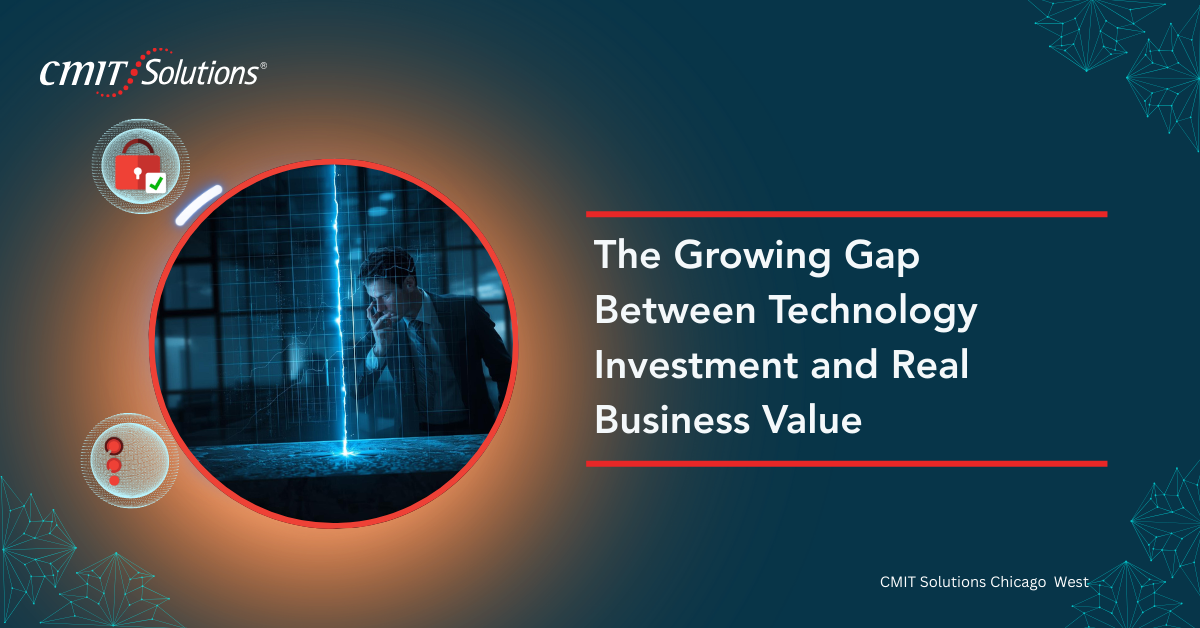
Technology spending among small and mid-sized businesses continues to rise, yet many leaders struggle to see a clear return on those investments. New tools are adopted, platforms are upgraded, and systems are expanded yet productivity gains, operational improvements, and measurable business outcomes often fall short of expectations. This disconnect has created a growing gap between technology investment and real business value.
At CMIT Solutions of Western Suburbs, we work with organizations that are asking an important question: Why are we investing more in technology but seeing less impact? The answer is rarely about technology itself. More often, it’s about strategy, alignment, and execution. Understanding why this gap exists is the first step toward closing it.
Technology Spending Has Outpaced Strategic Planning
Many businesses invest in technology reactively, purchasing tools to address immediate needs rather than following a long-term plan. Over time, these decisions accumulate, creating a technology environment that is complex, fragmented, and difficult to manage. Without a strategic framework, even well-intentioned investments fail to deliver meaningful value.
Technology should support business objectives, not operate independently of them. When strategy is absent, spending increases while outcomes stagnate.
To understand how this imbalance develops, consider how unplanned investments typically result in:
- Disconnected systems that don’t align with workflows
- Overlapping tools with redundant functionality
- Increased operational complexity
- Limited visibility into overall technology performance through proactive IT monitoring
- Difficulty measuring return on investment
Tools Are Purchased Without Clear Business Outcomes
One of the most common reasons technology fails to deliver value is the absence of clearly defined outcomes. Businesses often invest in tools based on features, trends, or perceived necessity rather than specific business goals. As a result, adoption is inconsistent and value remains unclear.
When technology is implemented without a clear purpose, it becomes difficult to evaluate success or justify ongoing investment.
This lack of outcome-driven planning leads to challenges such as:
- Low adoption across teams
- Unclear ownership and accountability
- Difficulty measuring impact on productivity
- Misalignment between technology and business priorities
- Wasted time and resources
Fragmented Technology Environments Dilute Value
As organizations grow, they often accumulate multiple platforms that serve similar purposes. While each tool may provide some benefit, fragmentation prevents technology from working as a unified system. The value of individual investments is diluted when systems don’t integrate or support each other.
Fragmentation increases overhead and reduces efficiency, making it harder to realize the full potential of any single investment.
Fragmented environments reduce business value by creating:
- Data silos that limit insight
- Inconsistent user experiences
- Increased administrative effort
- Higher support and maintenance costs
- Reduced operational efficiency
User Adoption Is Often Overlooked
Even the most advanced technology delivers no value if employees don’t use it effectively. Many organizations underestimate the importance of training, change management, and ongoing support. Without these elements, adoption remains low and potential benefits go unrealized.
Technology must fit naturally into daily workflows to deliver value. When tools are difficult to use or poorly introduced, employees revert to old habits.
Poor adoption typically results from:
- Lack of user training and guidance
- Overly complex tools
- Inadequate communication around purpose
- Resistance to change
- Limited ongoing support

Technology Is Treated as an Expense, Not an Enabler
When technology is viewed solely as a cost center, investment decisions focus on short-term savings rather than long-term value. This mindset often leads to underinvestment in planning, optimization, and integration key components of value realization.
Treating technology as a strategic enabler shifts the focus from cost reduction to business outcomes such as growth, efficiency, and resilience.
A cost-focused mindset contributes to:
- Short-term decision-making
- Deferred upgrades and improvements
- Increased long-term risk
- Missed opportunities for innovation
- Reduced competitive advantage
Security and Risk Management Are Not Aligned With Value
Security investments are often made reactively, driven by fear rather than strategy. While protection is essential, security must be aligned with business operations to deliver value. Overly restrictive controls slow productivity, while insufficient protection exposes the business to disruption.
Strategic security balances protection with usability, enabling the business to operate confidently and efficiently.
Misaligned security efforts lead to:
- Productivity loss due to unnecessary restrictions
- Increased exposure from unmanaged risks
- Difficulty supporting remote and hybrid work without cloud security essentials
- Reactive incident response
- Inconsistent security practices
Leadership Lacks Visibility Into Technology Performance
Many business leaders struggle to understand how technology investments are performing because reporting and visibility are limited. Without clear metrics, it becomes difficult to assess whether technology is delivering value or simply consuming resources.
Improved visibility allows leadership to make informed decisions, adjust strategy, and ensure alignment between technology and business goals.
Limited visibility results in:
- Difficulty evaluating return on investment
- Delayed identification of issues
- Poor prioritization of initiatives
- Reduced accountability
- Strategic misalignment

Growth Outpaces Technology Optimization
As businesses grow, technology environments often expand without sufficient optimization. Systems that worked at a smaller scale may struggle to support increased demand, leading to performance issues and inefficiencies.
Growth should be supported by intentional optimization, ensuring technology evolves alongside the business rather than becoming a bottleneck.
When optimization is neglected, organizations experience:
- Performance degradation
- Increased downtime
- Higher support demands
- Difficulty scaling operations with cloud services
- Reduced employee satisfaction
The Absence of Ongoing Technology Review
Technology value is not static. Systems that once delivered strong returns may become less effective as business needs change. Without regular review and adjustment, investments lose relevance and impact.
Continuous evaluation ensures technology remains aligned with business goals and continues to deliver value over time.
A lack of ongoing review leads to:
- Outdated tools remaining in use
- Missed opportunities for improvement
- Increased technical debt
- Reduced flexibility
- Gradual erosion of value
The Role of Strategic IT Guidance in Closing the Gap
Closing the gap between technology investment and business value requires more than better tools; it requires strategic guidance. Businesses benefit from partners who understand both technology and business operations and can help align investments with outcomes.
At CMIT Solutions of Western Suburbs, we help organizations move beyond reactive spending toward intentional, value-driven technology strategies. Our focus is on ensuring every investment supports real business goals.
Strategic IT guidance helps organizations achieve:
- Clear alignment between technology and objectives
- Improved return on technology investments supported by the true ROI
- Simplified and integrated environments
- Better visibility and control
- Sustainable, long-term value with managed IT services
Conclusion: Turning Technology Investment Into Measurable Business Impact
The growing gap between technology investment and real business value is not caused by a lack of tools, it is caused by a lack of alignment. When technology decisions are driven by strategy, supported by adoption, and continuously evaluated, value follows naturally.
For SMBs, closing this gap is essential to remaining competitive and resilient. By treating technology as a strategic asset rather than a collection of tools, organizations can unlock meaningful outcomes. CMIT Solutions of Western Suburbs partners with businesses to bridge this gap, transforming technology investments into real, measurable business value.