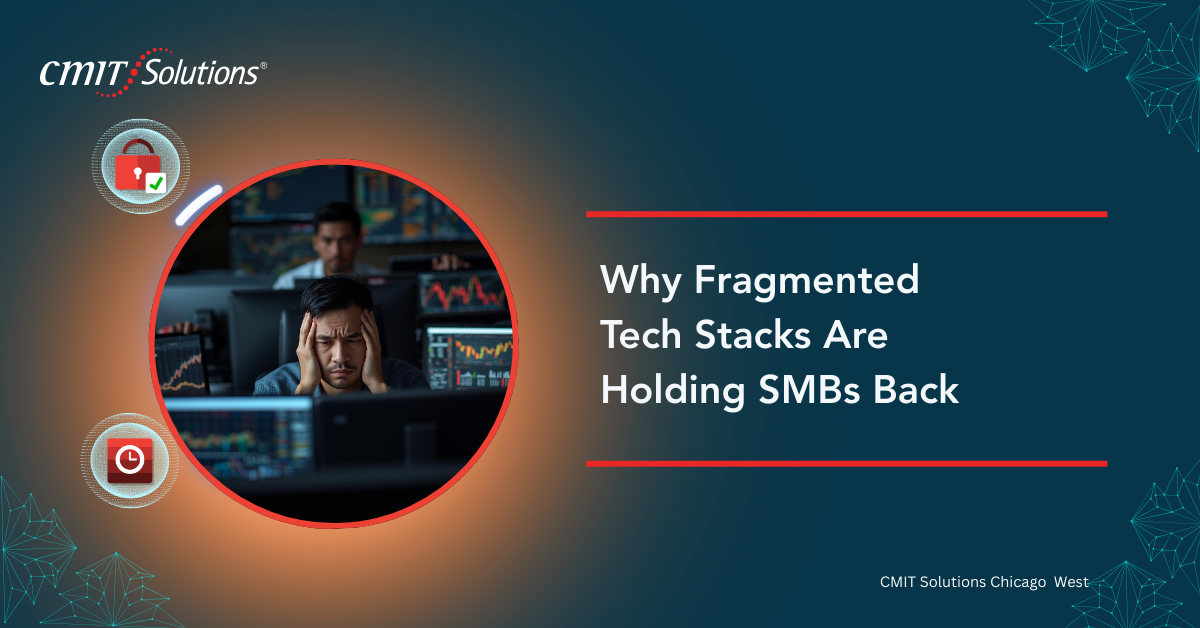
Technology is meant to simplify operations, improve productivity, and support growth. Yet for many small and mid-sized businesses, technology has become a source of frustration rather than an advantage. Over time, SMBs often adopt tools and platforms in response to immediate needs adding new software for collaboration, security, accounting, or customer management without considering how these systems fit together. The result is a fragmented tech stack made up of disconnected solutions that fail to operate as a cohesive whole.
At CMIT Solutions of Western Suburbs, we regularly work with organizations struggling under the weight of fragmented technology environments. While each individual tool may serve a purpose, the lack of integration creates inefficiencies, risks, and missed opportunities. Understanding how fragmented tech stacks hold SMBs back is the first step toward building a more streamlined and strategic IT foundation supported by managed IT services.
What a Fragmented Tech Stack Really Looks Like in SMBs
A fragmented tech stack is not always obvious at first glance. Many SMBs assume that if their tools are functioning individually, their overall technology environment is healthy. In reality, fragmentation occurs when systems are implemented without a unifying strategy, leading to silos of information, inconsistent workflows, and duplicated effort.
This fragmentation often develops gradually as businesses grow, add staff, and adopt new tools to solve specific problems. Without centralized oversight, technology decisions become reactive, and integration is treated as an afterthought rather than a priority often resulting in IT chaos.
To recognize a fragmented tech stack, SMB leaders should look for these common indicators:
- Multiple tools performing overlapping functions
- Systems that require manual data entry between platforms
- Lack of visibility across departments and workflows
- Inconsistent user experiences for employees
- Difficulty generating accurate, unified reports
Productivity Suffers When Systems Don’t Work Together
One of the most immediate impacts of a fragmented tech stack is reduced productivity. Employees are forced to navigate multiple platforms, remember different login credentials, and manually transfer information between systems. This constant context switching slows work, increases frustration, and raises the likelihood of errors.
Instead of focusing on their core responsibilities, employees spend valuable time compensating for technology gaps. Over time, these inefficiencies accumulate and quietly erode operational performance across the organization.
Fragmented systems reduce productivity by creating challenges such as:
- Manual duplication of tasks and data
- Disconnected workflows that interrupt momentum
- Increased training time for new hires
- Confusion over which system holds accurate information
- Frustration that lowers employee engagement
Fragmentation Creates Hidden Security Gaps
Security becomes significantly more difficult to manage when technology environments are fragmented. Each system introduces its own access controls, configurations, and update requirements. Without centralized oversight, vulnerabilities can go unnoticed, leaving gaps that attackers may exploit.
Fragmentation also complicates incident response. When systems are not integrated, detecting and responding to security events becomes slower and less effective. This delay increases the potential impact of breaches and disruptions, especially as threats evolve with the cybersecurity forecast.
A fragmented tech stack weakens security by introducing:
- Inconsistent access controls across platforms
- Unpatched systems due to lack of visibility tied to patch risks
- Limited ability to monitor activity centrally using XDR
- Increased risk from unmanaged third-party tools and the digital supply chain
- Slower response to security incidents amplified by silent breaches
Data Silos Prevent Informed Decision-Making
Data is one of the most valuable assets for any business, but fragmented systems often trap data in isolated silos. When information is scattered across multiple platforms that do not communicate, leaders lack a clear and accurate picture of business performance.
This lack of visibility forces decision-makers to rely on incomplete or outdated information. Strategic planning becomes more difficult, and opportunities for improvement are often missed simply because insights are hidden across disconnected systems.
Data silos caused by fragmented tech stacks lead to:
- Inconsistent or conflicting reports
- Limited insight into operational performance
- Delayed access to critical information
- Reduced confidence in data-driven decisions
- Missed opportunities for optimization and growth

IT Costs Increase Without Delivering Proportional Value
Fragmented tech stacks often appear cost-effective at first, especially when individual tools are purchased to address immediate needs. Over time, however, the cumulative cost of maintaining multiple platforms, licenses, and support contracts adds up quickly.
In addition to direct costs, fragmentation introduces hidden expenses related to inefficiency, downtime, and administrative overhead. Without a strategic approach, SMBs may spend more on technology while seeing diminishing returns often benefiting from smart IT spending instead.
The financial impact of fragmented systems includes:
- Redundant software licenses and subscriptions
- Higher support and maintenance costs
- Increased downtime and productivity loss that proactive monitoring can reduce
- Greater reliance on manual processes
- Difficulty forecasting and controlling IT spending
Scaling the Business Becomes More Complex Than Necessary
As SMBs grow, their technology environment must scale to support additional users, locations, and services. Fragmented tech stacks make scaling far more complex than it needs to be. Each new addition requires custom integrations, additional training, and increased oversight.
Instead of enabling growth, technology becomes a constraint. Businesses may delay expansion or struggle to onboard new employees efficiently due to the limitations of their existing systems.
Fragmentation limits scalability by creating challenges such as:
- Difficulty adding new users across multiple platforms
- Inconsistent experiences for growing teams
- Increased complexity when expanding operations
- Limited flexibility to adopt new capabilities supported by cloud services
- Higher risk of system failures as complexity grows
User Experience Suffers Across the Organization
A cohesive user experience is essential for employee adoption and satisfaction. Fragmented tech stacks deliver the opposite disjointed interfaces, inconsistent workflows, and varying performance levels. This inconsistency makes it harder for employees to work efficiently and confidently.
When users struggle with technology, adoption declines, workarounds increase, and frustration grows. Over time, this impacts morale and can even contribute to higher turnover.
Fragmented environments negatively affect user experience through:
- Multiple logins and authentication methods
- Inconsistent interfaces and navigation
- Varying performance and reliability
- Confusion about system ownership and support
- Reduced confidence in technology tools
Compliance and Governance Become Harder to Maintain
Maintaining compliance and governance standards requires consistency, documentation, and visibility. Fragmented tech stacks make it difficult to enforce policies uniformly or track compliance-related activities across systems.
When audits or assessments occur, businesses may struggle to produce accurate documentation or demonstrate consistent controls. This not only increases risk but also places additional strain on internal teams.
Compliance challenges linked to fragmented systems include:
- Inconsistent policy enforcement
- Limited audit visibility and reporting
- Difficulty managing access and permissions
- Increased risk of non-compliance outlined in compliance challenges
- Reactive rather than proactive governance addressed by cloud-era compliance

Leadership Loses Strategic Control Over Technology
When technology decisions are made in isolation, leadership loses the ability to guide IT strategically. Fragmented tech stacks often reflect years of uncoordinated decisions rather than a cohesive vision. As a result, IT becomes a collection of tools rather than a strategic asset.
Without centralized oversight, leaders struggle to align technology investments with business goals. This disconnect limits the organization’s ability to innovate and respond effectively to change especially when leaders need to rethink IT strategy.
A lack of strategic control over technology leads to:
- Misaligned technology investments
- Difficulty prioritizing IT initiatives
- Limited visibility into risks and opportunities
- Reduced return on technology spending measured through managed IT ROI
- Slower response to business needs
The Role of Strategic IT Consolidation
Addressing fragmentation requires more than replacing tools it requires a strategic approach to consolidation and integration. Strategic IT consolidation focuses on aligning systems around business objectives, reducing redundancy, and improving visibility and control.
At CMIT Solutions of Western Suburbs, we help SMBs assess their technology environments, identify inefficiencies, and build streamlined, integrated solutions that support long-term success. The goal is not fewer tools for the sake of simplicity, but the right tools working together effectively.
Strategic consolidation delivers meaningful benefits, including:
- Improved efficiency and productivity
- Stronger security and governance supported by cyber resilience
- Better data visibility and decision-making
- Reduced IT costs and complexity
- Technology that supports sustainable growth through strategic partnerships
Conclusion: Turning Technology Into a Competitive Advantage
Fragmented tech stacks quietly hold SMBs back by creating inefficiencies, risks, and missed opportunities. While each tool may serve a purpose on its own, the lack of integration prevents technology from delivering its full value. Over time, this fragmentation becomes a barrier to productivity, security, and growth.
By taking a strategic approach to technology consolidation and integration, SMBs can transform their IT environments into powerful enablers of success. CMIT Solutions of Western Suburbs partners with businesses to simplify complexity, align technology with goals, and build cohesive systems that drive long-term performance.