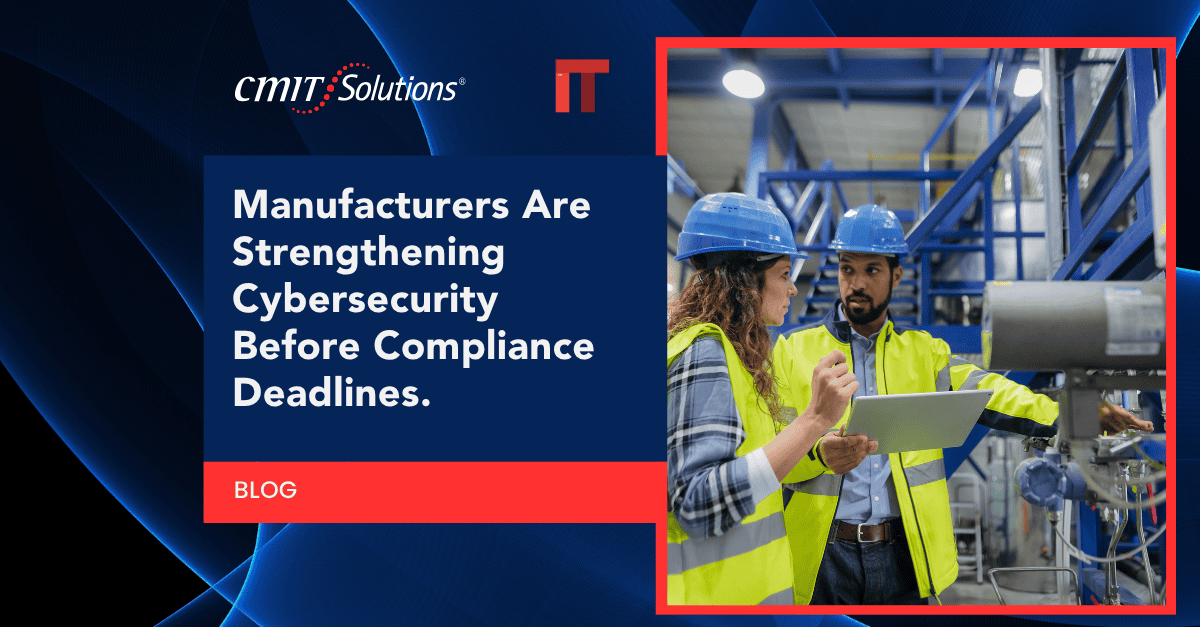
Cincinnati’s manufacturing sector has always been built on precision. Machines run on schedules, supply chains move on tight margins, and quality standards leave little room for error. That same precision is now being demanded of something manufacturers used to treat as an afterthought: cybersecurity.
Audits used to be about safety records, quality certifications, and financial statements. Today, a growing share of audits, whether they come from insurance carriers, prime contractors, government agencies, or industry certification bodies, include a hard look at how a manufacturer protects its data, its network, and its operational technology. Failing that portion of an audit can mean lost contracts, higher premiums, or delayed certifications.
That is why more manufacturers across the region are getting ahead of the problem instead of scrambling to fix it after an auditor flags a gap. CMIT Solutions of Cincinnati East has seen this shift firsthand, working with local plants, machine shops, and industrial suppliers who want their technology environment to hold up under scrutiny long before an assessment date is even scheduled.
This article looks at why audits are getting tougher, what manufacturers are doing to prepare, and where smart technology investments are making the biggest difference.
The Changing Face of Manufacturing Audits
Manufacturing audits are no longer limited to ISO quality checks. Depending on the industry a manufacturer serves, they may now face:
- Cybersecurity Maturity Model Certification (CMMC) requirements for defense contractors
- Cyber insurance underwriting reviews before a policy is issued or renewed
- Customer-driven security questionnaires from prime contractors and OEMs
- Data privacy and handling reviews tied to state and federal regulations
- Financial audits that increasingly include IT controls testing
Each of these has its own checklist, but they share common ground. Auditors want proof that a company knows where its data lives, who can access it, how it is backed up, and what happens if a system is compromised. Manufacturers that cannot answer those questions with documentation, not just verbal assurance, tend to struggle.
Why Manufacturing Is a Bigger Target Than Ever
Manufacturing has moved up the list of the most targeted industries for cyberattacks, and there are a few clear reasons why:
- Legacy equipment and control systems that were never designed with internet connectivity in mind
- Valuable intellectual property, including proprietary designs and processes
- Tight production schedules that make companies more likely to pay a ransom to resume operations quickly
- Deep integration with suppliers and customers, making a single breach a potential entry point into multiple companies
Attackers know that a halted production line costs money every hour it sits idle. That pressure is exactly what ransomware groups rely on, a pattern explored in a related piece on <cite index=”8-1″>ransomware trends showing that most victims would pay again if attacked a second time</cite> through this ransomware payment risks discussion.
What Auditors Are Actually Looking For
Understanding the audit process helps explain why manufacturers are shifting their IT budgets toward prevention rather than reaction. A typical cybersecurity-focused audit review will examine:
Access controls
- Who has administrative rights to systems and machines
- Whether former employees still have active credentials
- Multi-factor authentication on critical systems
Data handling and storage
- Where sensitive data is stored, including customer designs and financial records
- Whether data is encrypted at rest and in transit
- Retention policies and disposal procedures
Incident response readiness
- Whether a written incident response plan exists
- How quickly a breach would be detected
- Backup and recovery testing history
Network segmentation
- Whether production floor equipment is isolated from office networks
- Firewall configurations and monitoring
- Remote access controls for vendors and technicians
Employee training records
- Documentation of security awareness training
- Phishing simulation results
- Policy acknowledgment records
Manufacturers who treat these as ongoing operational practices, rather than a scramble before an audit date, consistently score better and spend less time in remediation.
The Real Cost of Falling Short
A failed or flagged audit rarely stops at a bad score. The downstream effects can include:
- Increased cyber insurance premiums or denied coverage
- Loss of eligibility for defense or government contracts
- Damaged relationships with prime contractors who require security attestations
- Mandatory remediation timelines that pull staff away from production
- Reputational damage if a breach becomes public
Insurance carriers in particular have tightened their underwriting standards. A few years ago, a basic questionnaire was often enough to secure a policy. Now, carriers frequently require proof of multi-factor authentication, endpoint detection tools, and documented backup procedures before they will even quote a premium.

Where Manufacturers Are Investing First
Local plant managers and operations leaders working with CMIT Solutions of Cincinnati East tend to prioritize a handful of areas when preparing for an audit.
Managed IT Oversight
Rather than relying on a single in-house IT generalist, more manufacturers are turning to structured managed IT solutions that provide ongoing monitoring, patching, and documentation. This shift matters because auditors want to see consistency over time, not a one-time cleanup effort.
Network Segmentation and Monitoring
Separating production equipment from administrative networks is one of the most common audit findings. Manufacturers are investing in network monitoring tools that flag unusual traffic patterns before they become a full incident.
Backup and Disaster Recovery
An untested backup is barely better than no backup at all. Companies are building out a proper data backup strategy that includes offsite copies, regular restoration testing, and clear recovery time objectives.
Formal Compliance Programs
Rather than treating compliance as a checklist exercise, manufacturers are building repeatable compliance management services into their operations, so documentation is always current instead of recreated from scratch each audit cycle.
Cloud Migration With Security Built In
Moving files and applications to properly configured secure cloud solutions gives manufacturers better visibility and control than aging on-premise servers, while also simplifying disaster recovery.
The Human Element Auditors Care About
Technology alone does not satisfy an audit. Auditors increasingly ask about people and processes just as much as hardware and software.
- Are employees trained to recognize phishing attempts?
- Does the company have a policy for reporting suspicious emails or texts?
- Is there a documented process for onboarding and offboarding staff access?
Phishing remains one of the most common ways attackers get a foothold inside a manufacturing network. Newer tactics have made this harder to catch, as covered in a discussion of QR code scams that bypass traditional email filters entirely.
Manufacturers are also rethinking how internal teams like finance and accounting are trained, since those departments are frequently the first target in a social engineering attempt. A closer look at why finance teams face outsized risk is available in the piece on the hacker target list that attackers consistently return to.
Zero Trust: A Framework Gaining Traction on the Plant Floor
Zero trust security has moved from a buzzword in large enterprises to a practical framework for mid-sized manufacturers. The core idea is simple: no device or user is automatically trusted, even if it is already inside the network.
For manufacturers, this often means:
- Verifying identity at every access point, not just at login
- Limiting machine-to-machine communication to only what is necessary
- Continuously monitoring for unusual behavior rather than relying on a single perimeter firewall
A deeper explanation of how this model works and why adoption is accelerating can be found in the article on the zero trust model and its growing role across industries.
Passwords Are Losing Ground
Weak or reused passwords remain a leading cause of breaches, and auditors know it. Many manufacturers are now evaluating passwordless options such as biometric authentication and hardware security keys.
A recent breakdown of where authentication technology is heading, covered in the piece on passwordless authentication trends, highlights why this shift matters for companies preparing for stricter access control reviews.
AI Is Already Inside the Plant, Whether IT Knows It or Not
Employees across departments, from scheduling to quality control, are experimenting with AI tools to speed up their work. Auditors are starting to ask pointed questions about this, particularly around data leakage.
- Is company data being pasted into public AI chat tools?
- Are AI-generated documents being reviewed before they leave the building?
- Is there a policy governing which tools employees can use?
These questions are explored further in the article on employee AI usage and the risks it introduces when left unmanaged.
Manufacturers looking to get ahead of this trend rather than react to it are increasingly using an AI readiness check to understand where AI tools are already in use and what guardrails need to be built around them.
Lessons From Other Regulated Industries
Manufacturing is not the only sector facing tighter scrutiny. Legal practices and engineering firms have dealt with similar pressure for years, and the lessons translate well.
- Law firms have had to prove client data confidentiality for decades, a topic covered in the article on law firm security standards.
- Engineering firms rely on high-performance systems that also need to be secure, discussed in the piece on engineering IT infrastructure requirements.
Manufacturers can borrow from both playbooks: build systems that perform well under heavy production demands while still meeting strict data protection standards.
Ransomware Remains the Number One Fear
Ransomware continues to top the list of concerns for manufacturers, and for good reason. A halted production line is expensive, and attackers know it.
Key facts manufacturers should keep in mind:
- Ransomware attacks often start with a single compromised credential or phishing email
- Recovery time without a tested backup plan can stretch into weeks
- Paying a ransom does not guarantee full data recovery
- Repeat attacks are common once a company is identified as willing to pay
A detailed look at how ransomware continues to disrupt operations and what companies can do differently is available in the article on ransomware attack prevention strategies for growing businesses.

Building an Audit-Ready IT Environment: A Practical Checklist
Manufacturers preparing for their next audit can use the following as a starting framework.
Documentation
- Written security policies covering access, data handling, and incident response
- Records of security awareness training completion
- Network diagrams showing segmentation between IT and OT systems
Technical Controls
- Multi-factor authentication across all critical systems
- Endpoint detection and response tools on every device
- Encrypted backups tested on a regular schedule
- Firewall and intrusion detection logs retained for review
Operational Practices
- Scheduled vulnerability scans and patch management
- Vendor and third-party access reviews
- Defined roles and responsibilities for incident response
Manufacturers unsure of where they currently stand can start with a free IT assessment to identify gaps before an external auditor does it for them.
Why Local Support Matters
National providers often apply a one-size-fits-all approach that does not account for the specific mix of legacy machinery and modern IT systems found in many Cincinnati plants. Working with a local partner allows for faster response times and a better understanding of regional compliance expectations.
CMIT Solutions of Cincinnati East works directly with manufacturers to build technology environments that hold up to scrutiny, from the shop floor to the front office. This includes everything from responsive IT support for day-to-day issues to long-term strategic IT guidance for companies planning multi-year growth.
Supporting Systems That Often Get Overlooked
Audits do not stop at cybersecurity controls. Related systems can also come under review, including:
- Communication platforms: Manufacturers relying on outdated phone systems are shifting to unified communication systems that offer better logging and access control.
- Productivity software: Ensuring licensed, updated, and properly configured business productivity tools reduces vulnerabilities tied to outdated software versions.
- Hardware procurement: Buying equipment without a security review can introduce risk. Structured IT procurement services help ensure new devices meet company standards before they are deployed.
Measuring Return on a Cybersecurity Investment
Manufacturers often ask how to justify the cost of these upgrades to leadership or ownership. A few ways to frame the conversation:
- Compare the cost of prevention against the average cost of a single ransomware incident, which frequently runs into six figures once downtime, recovery, and reputational damage are factored in
- Factor in reduced insurance premiums that often follow demonstrated security improvements
- Consider contract eligibility, since many prime contractors now require proof of a security program before awarding work
- Account for reduced downtime from proactive monitoring versus reactive firefighting
Tools like an IT cost calculator can help leadership see the numbers side by side before committing budget.
What Sets a Strong IT Partner Apart
Not every technology provider understands the specific pressures manufacturers face during an audit cycle. When evaluating a partner, manufacturers should look for:
- A track record with similar industrial or manufacturing clients, reflected in real client success stories
- Transparent packages that scale with company size, rather than forcing a large enterprise solution onto a smaller operation
- Ongoing education, including educational IT webinars and resources that keep internal teams informed
- Verified credentials and industry certifications partners that back up their claims
CMIT Solutions of Cincinnati East has built its reputation on being that kind of partner for manufacturers across the region, offering both the technical depth and the local presence that larger national firms often cannot match. More on the company’s approach and background can be found on the local IT experts page, along with a broader look at trusted technology partner credentials.
Manufacturers looking for additional guidance can also explore a library of helpful IT resources covering topics ranging from compliance basics to emerging threats.
Final Thoughts
Cybersecurity audits are not going away, and for Cincinnati manufacturers, they are only becoming more detailed. Waiting until an audit notice arrives is a difficult and expensive way to discover gaps in a company’s security posture. The manufacturers who fare best are the ones treating cybersecurity as an ongoing operational discipline, not a once-a-year fire drill.
Investing early in the right systems, documentation, and training pays off well beyond passing a single audit. It builds a foundation of trust with customers, insurers, and regulators that becomes a competitive advantage rather than a compliance burden.
If your company is preparing for an upcoming audit or simply wants a clearer picture of where things stand today, it may be time to talk with a team that understands both manufacturing operations and the technology behind them. Schedule a consultation to get a clear, practical plan built around your plant’s specific needs.
Frequently Asked Questions