
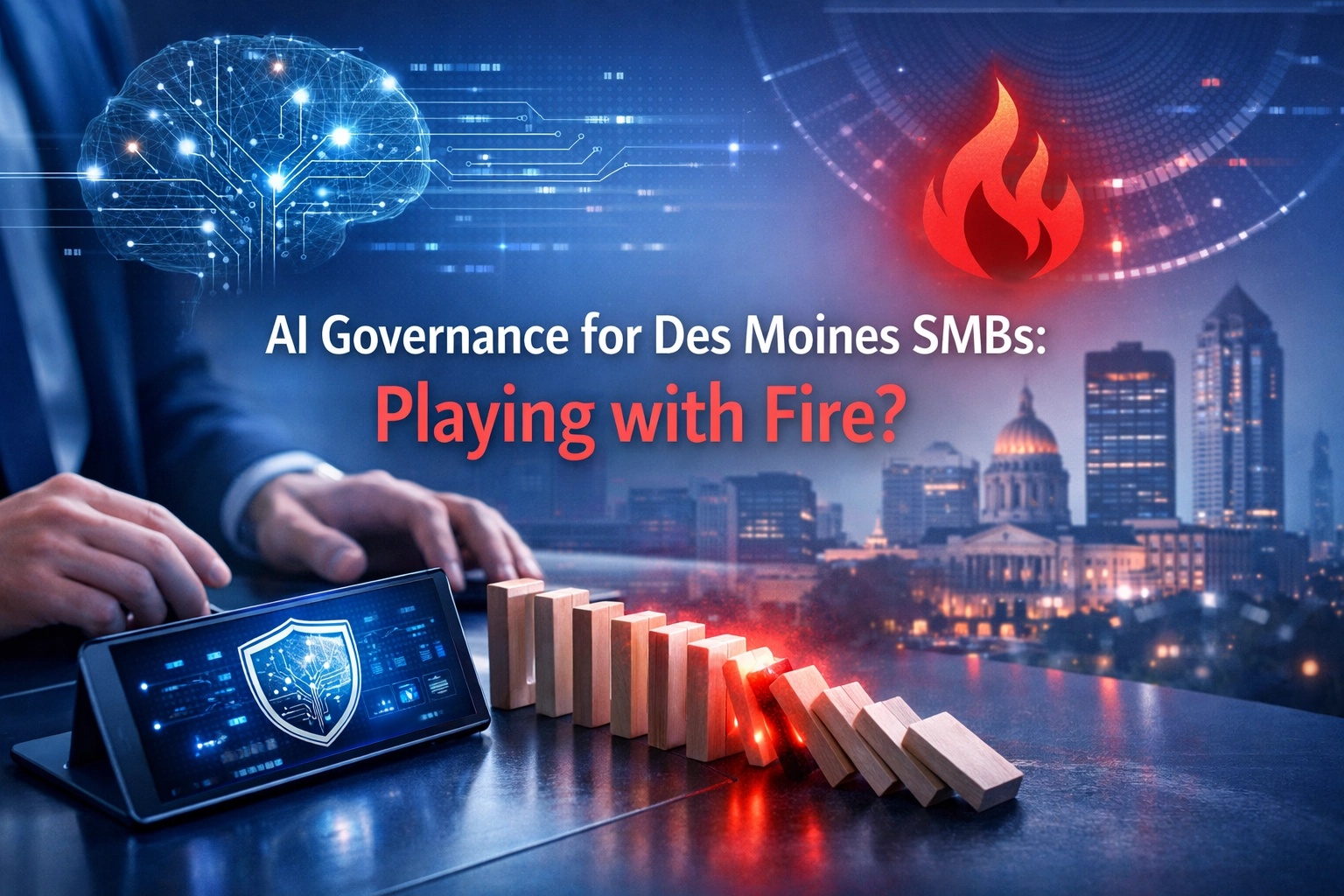
Most Des Moines business owners assume that because their team is “just using ChatGPT to draft emails,” there is no significant risk to the company. The reality is that without a formal AI governance policy, your proprietary data is likely being fed into public AI models every day, creating liabilities you cannot see and risks you cannot yet quantify.
Using artificial intelligence without guardrails is not just an IT issue; it is a fundamental business risk. When employees use unmanaged AI tools, they often bypass traditional security controls, leading to “Shadow AI.” This creates a environment where sensitive information: from client lists to financial projections: can be leaked into the public domain. For small and mid-sized businesses (SMBs) in Des Moines and Overland Park, the lack of oversight is a gamble that could result in regulatory fines, lost intellectual property, and denied cyber insurance claims.
The Hidden Risks of Unmanaged AI Adoption
The primary risk of unmanaged AI is the loss of data sovereignty. Public AI platforms generally use the data provided in prompts to train future iterations of their models. If an employee at a Des Moines accounting firm pastes a client’s tax data into a public AI to summarize a complex document, that data is effectively gone. It is no longer under the firm’s control and could potentially be surfaced to other users of the AI platform in the future.
This loss of control directly conflicts with standard compliance requirements. For businesses in the healthcare, legal, or financial sectors, this constitutes a data breach. Regulatory bodies do not distinguish between data leaked via a hacker and data “voluntarily” provided to an AI by an untrained employee. In both cases, the business is held accountable for the failure to protect sensitive information.
Furthermore, AI tools can produce “hallucinations”: confidently stated but entirely false information. If a construction firm in Overland Park uses an AI to calculate load-bearing requirements or bid estimates without a human-in-the-loop verification process, the resulting errors can lead to physical safety risks or devastating financial losses. Governance ensures that AI is used as a tool for efficiency, not as a replacement for professional judgment.
Why the Danger Is Increasing Today
The threat landscape is evolving rapidly as we approach high-pressure events like the 2026 World Cup. During periods of intense public interest and high-volume digital activity, employees are often distracted or looking for ways to speed up their tasks so they can participate in the festivities. This “speed at any cost” mentality is exactly when mistakes happen.
Cybercriminals are also using AI to enhance their attacks. AI-driven phishing and Business Email Compromise (BEC) are becoming more sophisticated, localized, and harder to detect. If your employees are already comfortable using unmanaged AI tools, they may be more susceptible to AI-generated scams that mimic the tone and style of internal communications.
Moreover, the insurance market is reacting to these developments. Cyber insurance carriers in Iowa and Kansas are tightening their requirements. In 2026, it is no longer enough to have a firewall and a password policy. Carriers are beginning to ask specific questions about AI governance. If a breach occurs and it is discovered that the business had no policy regarding the use of AI, the carrier may have grounds to deny the claim, citing a failure to maintain reasonable security standards.
The Role of a vCISO in AI Strategy
For most SMBs, hiring a full-time Chief Information Security Officer (CISO) is financially out of reach. However, the need for executive-level security leadership has never been higher. This is where a virtual CISO (vCISO) becomes a critical asset. A vCISO provides the strategic oversight needed to implement AI governance without the overhead of a six-figure executive salary.
A vCISO looks at AI through the lens of risk management and operational maturity. They don’t just tell you which tools to use; they help you build the framework that defines how they are used. This includes aligning AI adoption with your existing business goals and ensuring that every technological shift is backed by a policy that protects the company’s valuation and reputation.

Practical Guidance for AI Governance
Governance does not have to be a bottleneck for innovation. When implemented correctly, it provides the “lanes” that allow your team to move faster with confidence. Business leaders should focus on the following high-level actions to secure their operations:
- Establish a Clear AI Acceptable Use Policy (AUP): Define which AI tools are permitted and which are strictly prohibited. Explicitly state that sensitive company, client, or employee data must never be entered into public, non-enterprise AI models.
- Conduct a “Shadow AI” Audit: Identify which AI tools are currently being used by your staff. You cannot manage what you do not see. This inventory is the first step in regaining control over your data footprint.
- Implement Data Masking and Anonymization: If AI must be used for analysis, ensure that any personally identifiable information (PII) or protected health information (PHI) is removed or masked before the data is uploaded.
- Adopt Enterprise-Grade AI Solutions: Unlike consumer versions, enterprise AI platforms often offer “opt-out” clauses for data training. These tools provide the same efficiency gains while keeping your data within your secure perimeter.
- Mandate Human-in-the-Loop Verification: Establish a rule that no AI-generated output: whether it is code, a legal brief, or a financial summary: can be sent to a client or used for a critical business decision without being reviewed and signed off by a qualified human staff member.
- Update Employee Training: Security awareness training must now include AI-specific modules. Employees need to understand the risks of prompt injection and how to spot AI-generated deepfakes or phishing attempts.
Following these steps leads to measurable outcomes:
- Reduced risk of data leakage
- Maintained compliance with state and federal regulations
- Improved readiness for cyber insurance renewals
- Clear accountability for AI-driven decisions
Protecting the Core of Your Business
For industries like healthcare and finance in Des Moines, the stakes of AI governance are even higher. In healthcare, a single patient record leaked via an AI prompt can trigger a HIPAA violation and significant fines. In the financial sector, AI misuse can run afoul of the FTC Safeguards Rule, leading to audits and loss of consumer trust.
AI should be viewed as an enhancement to your people and your existing processes, not a replacement for them. The goal of governance is to ensure that as your business grows and adopts new technology, you are not inadvertently creating backdoors for data loss or cyberattacks. Whether you are managing property in Overland Park or running a logistics firm in Des Moines, your technology must serve your business goals while staying within your risk tolerance.
Moving From Uncertainty to Oversight
The transition from “playing with fire” to utilizing a controlled, powerful tool requires a shift in mindset. It requires moving from a reactive stance: waiting for something to go wrong: to a proactive stance where governance is a standard operating consideration. This is the difference between a business that is vulnerable to the next big shift in technology and one that is built to last.
Managed IT and cybersecurity are no longer just about fixing broken computers. They are about compliance, risk interpretation, and strategic guidance. By implementing structured oversight today, you protect your firm’s future and ensure that you remain an attractive candidate for cyber insurance coverage in an increasingly complex market.
Secure Your AI Future
If you are concerned about how AI is being used in your office, or if you need to build a governance framework that satisfies your insurance carrier and protects your data, start with a conversation. We help Des Moines and Overland Park businesses navigate these risks without slowing down their growth.
Contact Edgar Ortiz today to discuss how a vCISO-led approach can secure your business.
Edgar Ortiz
CEO, CMIT Solutions of Des Moines and Overland Park
Schedule a Consultation