
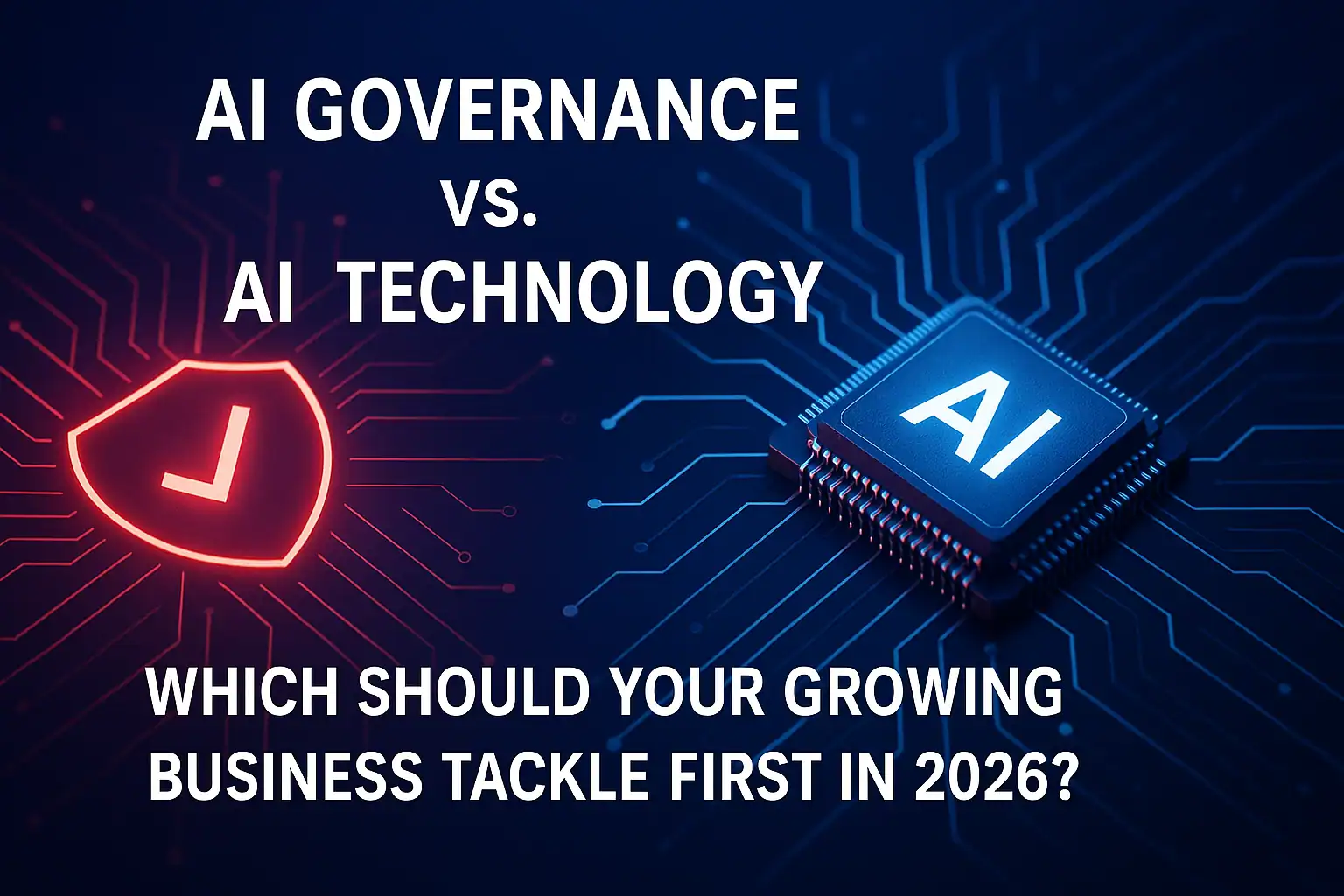
Most business leaders in West Des Moines approach AI adoption like they’re shopping at Jordan Creek Mall. They walk straight to the shiny technology displays: ChatGPT integrations, automated workflows, AI-powered analytics: without stopping to read the fine print.
This is where smart executives get it wrong.
You’re asking the wrong question. It’s not whether to choose AI governance or AI technology first. It’s understanding that governance isn’t a checkbox you handle later. It’s the foundation that determines whether your AI investments create value or create liability.
The Reality Check Every CEO Needs

Your AI strategy has a blind spot the size of Principal Park.
Right now, businesses across Des Moines are deploying AI tools faster than they can control them. They’re connecting AI agents to customer databases, financial records, and operational systems without establishing who’s accountable when something goes wrong.
The risk isn’t theoretical. When an AI agent accesses the wrong client data, recommends a compliance violation, or generates content that exposes your firm to liability, you’re responsible. Not your IT vendor. Not the AI company. You.
This is business risk disguised as technology adoption.
What AI Governance Actually Means
AI governance is not about slowing down innovation. It’s about controlling which data your AI systems can access, which decisions they can make, and how they operate within your business boundaries.
Think of it this way:
• Technology = The AI tools that automate tasks and generate insights
• Governance = The guardrails that ensure those tools work safely within your business rules
Financial advisors understand this instinctively. You wouldn’t give a new analyst access to every client account on day one. You’d establish clear boundaries, approval processes, and oversight requirements.
AI governance applies the same logic to automated systems.
Why 2026 Changes Everything
The AI landscape shifted dramatically in late 2025. What used to be simple tools are now autonomous agents that can take actions, make decisions, and interact with other systems without human intervention.
This creates new categories of business risk:
Unauthorized Actions
AI agents can now execute tasks beyond their intended scope. Without governance frameworks, you have no visibility into what they’re actually doing.
Data Exposure
Modern AI systems can access and analyze vast amounts of business data. Without proper controls, sensitive information becomes vulnerable to unauthorized use or exposure.
Compliance Violations
AI-generated recommendations or decisions can inadvertently violate industry regulations. In financial services, this creates direct liability.
Reputation Risk
AI systems can generate content, communications, or recommendations that don’t align with your business standards or client expectations.
The businesses getting this right in 2026 aren’t the ones with the most advanced AI. They’re the ones with the clearest governance frameworks.
The Overland Park Advantage
Organizations with existing compliance structures: particularly in financial services: have a significant advantage. They already understand the value of controls, oversight, and documented processes.
This regulatory mindset translates directly to AI governance:
• Clear policies on acceptable risk levels and oversight requirements
• Defined accountability for AI-driven decisions and outcomes
• Regular auditing of AI system behavior and performance
• Documented approval processes for new AI implementations
Businesses without this foundation are operating AI systems without a safety net.
What Governance-First Implementation Looks Like

1️⃣ Start With Data Controls
Define which business data AI systems can access and under what conditions. This isn’t about restricting access: it’s about ensuring appropriate access.
2️⃣ Establish Decision Boundaries
Clearly define what decisions AI systems can make autonomously versus what requires human approval. Document these boundaries and enforce them technically.
3️⃣ Implement Monitoring Systems
Deploy tools that provide visibility into AI system behavior. You need to know what your AI is doing, not just what it’s supposed to do.
4️⃣ Create Accountability Frameworks
Assign specific individuals responsibility for AI system oversight, performance, and compliance. Make this as clear as any other business process.
5️⃣ Plan for Incident Response
Develop procedures for when AI systems behave unexpectedly or create unintended outcomes. This is risk management, not technical troubleshooting.
The Integration Reality
The most successful businesses in 2026 don’t treat governance and technology as separate initiatives. They embed governance into their AI implementations from the beginning.
This means:
• Selecting AI tools that support governance requirements, not retrofitting governance onto existing tools
• Training teams on governance principles alongside AI capabilities
• Building oversight into workflows, not adding it as an afterthought
• Making AI governance an executive responsibility, not just an IT concern
Common Implementation Mistakes
Mistake #1: Governance as Compliance Theater
Treating governance as a checkbox exercise rather than operational necessity. Real governance changes how you implement and manage AI systems.
Mistake #2: Technology-First Mindset
Deploying AI tools and figuring out governance later. This creates technical debt and operational risk that becomes harder to address over time.
Mistake #3: Delegating Executive Responsibility
Assuming someone else will handle the governance details. AI governance is strategic decision-making, not technical implementation.
Why This Matters for Des Moines Businesses

Local businesses have a practical advantage in 2026. You understand the value of measured, disciplined growth. You don’t chase every trend, but you don’t ignore competitive advantages either.
AI governance aligns with this mindset. It’s about gaining the benefits of AI technology while maintaining control over business risk. It’s about moving fast but not breaking things that matter.
The financial advisory firms, accounting practices, and SMBs getting this right are the ones treating AI as an operational enhancement with proper oversight, not a technology experiment.
What This Means for Your Business
You don’t need to become an AI governance expert overnight. You need to understand that AI governance is a business strategy issue, not a technical implementation detail.
Start by asking the right questions:
• What business data should AI systems be able to access?
• What decisions can AI systems make without human oversight?
• Who’s accountable when AI systems create unintended outcomes?
• How will you monitor AI system behavior and performance?
• What happens when AI recommendations conflict with business judgment?
These aren’t technical questions. They’re business strategy questions that require executive input and oversight.
Moving Forward in 2026
The businesses that will win with AI in 2026 are those that understand the relationship between governance and technology. They’re not choosing one over the other: they’re implementing both as integrated components of their AI strategy.
This is where having experienced partners matters. Organizations like CMIT Solutions understand that AI implementation is as much about business risk management as it is about technology deployment. They help businesses build AI capabilities within proper governance frameworks, not as separate initiatives.
The goal isn’t to slow down AI adoption. It’s to ensure that your AI investments create sustainable business value while maintaining the control and oversight that responsible leadership requires.
If this sounds like the kind of disciplined approach your business needs for AI implementation, it’s worth starting the conversation before AI governance becomes urgent rather than strategic.