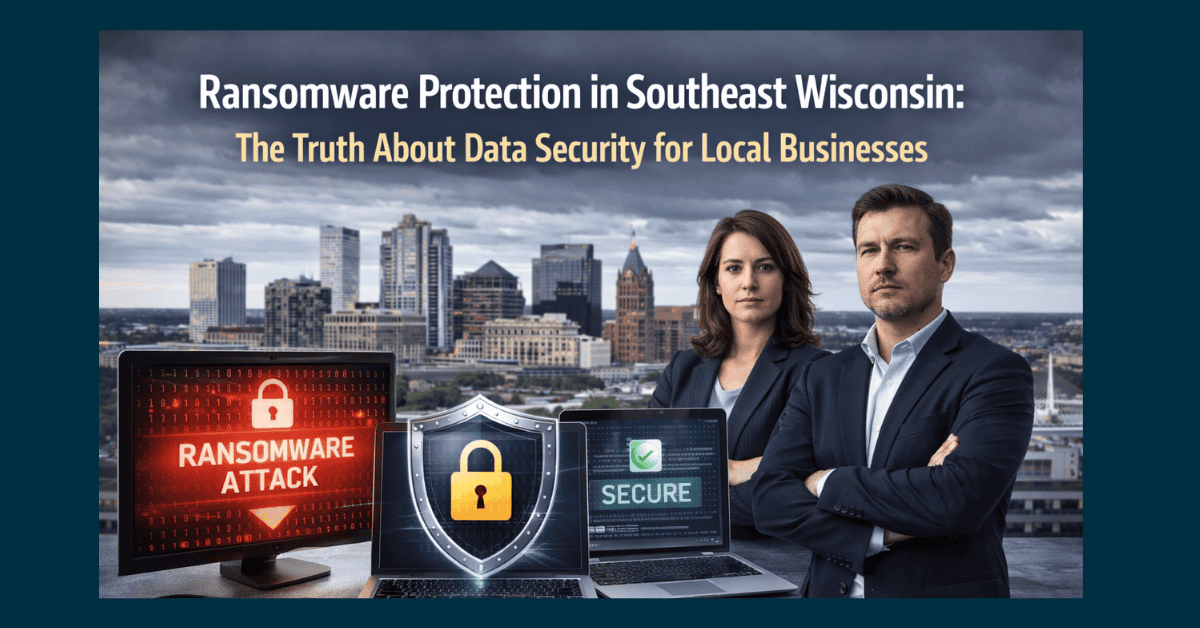
Many business owners believe their data is safe. They have antivirus software. They use passwords. They back up files occasionally. But across Southeast Wisconsin, ransomware attacks are proving that basic protections are no longer enough.
From Kenosha, Racine, Burlington, Lake Geneva, Milwaukee, and surrounding areas, small and mid-sized businesses are facing increasingly sophisticated cyber threats. Ransomware does not just target large corporations. In fact, attackers often focus on smaller organizations because they assume defenses are weaker.
The truth is simple. Without structured ransomware protection in Southeast Wisconsin, your data may be more vulnerable than you think.
Why Ransomware Is Rising in Southeast Wisconsin
Ransomware is a type of malicious software that locks your files and demands payment to restore access. It spreads through phishing emails, compromised websites, and unsecured remote connections.
Local industries are especially exposed:
- Manufacturing firms rely on connected production systems and supply chains.
- Healthcare providers manage sensitive patient records protected under HIPAA.
- Financial firms handle confidential financial data.
- Professional services companies store legal and client documentation.
Southeast Wisconsin has a strong manufacturing and healthcare presence. These sectors are attractive targets because downtime can be costly. Attackers know that businesses may feel pressured to pay quickly to restore operations.
The Real Impact of a Ransomware Attack
Many companies underestimate the damage ransomware can cause.
The immediate impact often includes:
- Locked files and inaccessible systems
- Production shutdowns
- Missed customer deadlines
- Interrupted billing and payroll
However, the hidden costs are often greater. These can include legal expenses, compliance penalties, forensic investigations, and loss of client trust.
For example, a healthcare provider in Kenosha, Racine, Walworth, Milwaukee, Waukesha and other Southeast Wisconsin counties experiencing ransomware may face HIPAA investigations. A manufacturer in the region could miss contract deadlines. A financial firm may need to notify clients of potential exposure.
Ransomware is not just an IT issue. It is a business crisis.

Common Myths About Data Safety
Many businesses across Southeast Wisconsin rely on outdated assumptions about cybersecurity.
Myth 1: We are too small to be targeted.
Small businesses are frequently targeted because they often lack advanced security controls.
Myth 2: Antivirus software is enough.
Traditional antivirus tools do not stop modern ransomware strains.
Myth 3: Backups solve everything.
Backups must be secure, encrypted, and tested regularly. Otherwise, they may fail when needed most.
Understanding these myths is the first step toward stronger protection.
How Ransomware Spreads
Ransomware often begins with a simple action.
An employee clicks a phishing email. A weak password is compromised. An unpatched system is exploited. Once inside, ransomware spreads quickly across networks.
Remote work has increased exposure. Businesses across Kenosha, Racine, Burlington, Lake Geneva, Milwaukee, and surrounding areas using cloud systems and remote access tools must ensure those environments are secure.
Without continuous monitoring, ransomware can remain undetected until it activates.
How Ransomware Protection in Southeast Wisconsin Works
Effective protection requires multiple layers.
Professional ransomware protection typically includes:
- Continuous network monitoring
- Advanced endpoint detection and response
- Secure email filtering
- Multi-factor authentication
- Automated patch management
- Encrypted and isolated backups
- Disaster recovery planning
Monitoring tools detect unusual behavior before encryption spreads. Patch management closes security gaps. Multi-factor authentication prevents unauthorized access.
Secure backups ensure that if an attack occurs, data can be restored without paying ransom.
For businesses across Kenosha, Racine, Burlington, Lake Geneva, Milwaukee, and surrounding areas, this proactive approach reduces risk significantly.
Compliance Risks for Local Industries
Compliance requirements add urgency to ransomware protection.
Healthcare organizations must follow HIPAA guidelines. Financial institutions must protect regulated financial data. Manufacturers working with federal contracts may need to meet CMMC cybersecurity standards.
A ransomware attack that exposes sensitive data can trigger audits and penalties.
Strong IT management ensures:
- Secure storage of confidential information
- Controlled access permissions
- Documented security policies
- Tested recovery procedures
Security and compliance must work together.
The Role of Employee Awareness
Human error remains one of the leading causes of ransomware incidents.
Security awareness training helps employees:
- Recognize phishing attempts
- Avoid suspicious downloads
- Use strong password practices
- Report unusual system behavior quickly
Businesses across Kenosha, Racine, Walworth, Milwaukee, Waukesha and other Southeast Wisconsin counties that combine employee education with technical safeguards build stronger defense systems.
Technology alone is not enough.

Moving From Reactive to Proactive Protection
Many companies operate reactively. They respond only after an issue appears.
Proactive managed IT services integrate ransomware protection into daily operations. Systems are monitored continuously. Updates are applied consistently. Security tools are reviewed and adjusted as threats evolve.
This shift is critical for businesses across Kenosha, Racine, Burlington, Lake Geneva, Milwaukee, and surrounding areas. Instead of hoping nothing happens, organizations take control of their risk environment.
Reliable ransomware protection improves uptime, stability, and long-term resilience.
Warning Signs Your Business May Be Vulnerable
Some red flags indicate higher risk:
- Infrequent security updates
- No formal backup testing process
- Shared passwords among employees
- Limited network monitoring
- No documented disaster recovery plan
If these conditions exist, your business may be more exposed than expected.
Addressing these gaps before an incident occurs is far less disruptive than managing a breach.
Conclusion
Ransomware is not a distant threat. It is a real and growing risk for businesses throughout Southeast Wisconsin. Manufacturing firms, healthcare providers, financial services companies, and professional organizations all depend on secure systems to operate effectively.
Believing your data is safe without structured protection can be costly. Strong ransomware protection requires proactive monitoring, layered security, secure backups, and employee awareness.
If you want to reduce risk and protect your operations, contact CMIT Solutions of Southeast Wisconsin today to strengthen your ransomware defense and safeguard your business.