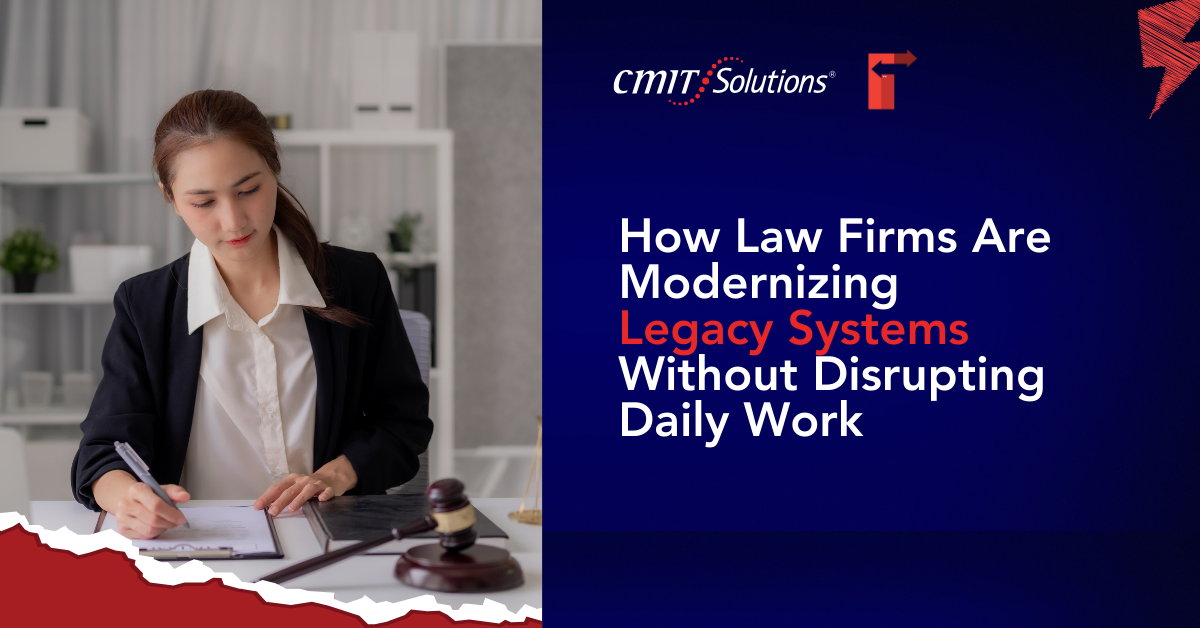
Law firms operate in an environment where precision, confidentiality, and continuity are non-negotiable. Many firms still rely on legacy systems that have supported daily operations for years, yet those systems often struggle to keep pace with modern security requirements, remote work expectations, and evolving client demands. Modernization is necessary but disruption is not an option.
At CMIT Solutions of Long Beach, we work with law firms that want to upgrade technology without interrupting billable hours, client communication, or case workflows. Successful modernization focuses on thoughtful planning, phased execution, and aligning technology upgrades with how legal teams actually work.
Understanding the Risks Hidden in Legacy Legal Systems
Legacy systems often continue to function well enough to support daily operations, which can mask underlying risks. Outdated software, unsupported operating systems, and aging infrastructure may expose law firms to security vulnerabilities, compliance challenges, and performance limitations that grow more severe over time, especially as cyber threats intensify.
Modernization begins with recognizing that stability does not always equal safety. While systems may appear reliable, they often lack the resilience and security controls required in today’s legal environment.
Before initiating any upgrades, firms must acknowledge key risks associated with legacy systems:
- Unsupported software and operating systems
- Increased exposure to cybersecurity threats
- Limited compatibility with modern legal applications
- Performance bottlenecks that slow workflows
- Difficulty meeting evolving compliance expectations
Prioritizing Business Continuity During Technology Upgrades
For law firms, downtime directly impacts productivity, client service, and revenue. Modernization efforts must be designed around maintaining continuous access to case files, legal research tools, and communication systems.
Rather than replacing everything at once, successful firms adopt a phased approach that allows systems to be updated incrementally while daily operations continue uninterrupted, supported by proactive support.
To ensure continuity, modernization strategies should focus on:
- Scheduling upgrades outside peak work hours
- Implementing parallel systems during transitions
- Maintaining access to critical legal applications
- Communicating changes clearly to staff
- Testing systems thoroughly before full deployment
Moving Legal Applications to Secure, Scalable Platforms
Many law firms rely on practice management, document management, and billing systems that were designed for on-premise environments. As firms grow and adopt flexible work models, these systems can become difficult to maintain and scale.
Modernizing legal applications often involves transitioning to secure, cloud-enabled platforms that preserve familiar workflows while improving accessibility and reliability through managed cloud.
When modernizing applications, firms should consider:
- Preserving existing workflows and data structures
- Ensuring secure access for remote attorneys and staff
- Improving system performance and responsiveness
- Supporting integration with modern legal tools
- Reducing reliance on aging on-premise infrastructure

Enhancing Data Security Without Changing How Attorneys Work
Law firms handle highly sensitive information, making security enhancements a critical part of modernization. However, security improvements must not interfere with attorneys’ ability to access documents, collaborate, or communicate with clients efficiently.
Modern security solutions are designed to operate in the background, strengthening protection without introducing unnecessary friction, including AI security options.
To enhance security without disruption, firms should focus on:
- Identity-based access controls aligned with roles
- Multi-factor authentication with minimal user impact
- Encryption of data at rest and in transit
- Continuous monitoring for suspicious activity using MDR EDR
- Centralized security management across systems
Modernizing Infrastructure Through Hybrid IT Models
Many law firms adopt hybrid IT environments that combine on-premise systems with cloud services. This approach allows firms to modernize gradually while maintaining control over critical systems and data.
Hybrid models provide flexibility and resilience, enabling firms to upgrade infrastructure without a full system overhaul.
When implementing a hybrid IT strategy, firms should prioritize:
- Seamless integration between on-premise and cloud systems
- Secure connectivity between environments
- Scalability to support firm growth
- Simplified management and maintenance
- Improved disaster recovery capabilities through cloud backups
Improving Collaboration and Mobility for Legal Teams
Modern legal work requires collaboration across offices, courtrooms, and remote locations. Legacy systems often limit mobility, forcing attorneys to rely on VPNs or restricted access methods that slow productivity.
Modernization efforts increasingly focus on enabling secure, seamless collaboration while preserving confidentiality and control through unified communications.
To improve collaboration and mobility, firms should consider:
- Secure cloud-based document access
- Real-time collaboration tools for case files
- Secure communication platforms for client interactions
- Device flexibility without compromising security
- Centralized management of collaboration tools
Protecting Client Confidentiality During System Transitions
Client confidentiality is paramount in the legal industry, and modernization efforts must ensure that sensitive information remains protected throughout system transitions. Data migration, system integration, and infrastructure changes all introduce potential risk if not managed carefully.
A structured approach to data protection ensures that confidentiality is maintained at every stage of modernization and helps reduce the likelihood of incidents like data breaches.
To protect client data during transitions, firms should focus on:
- Secure data migration processes
- Access controls during system changes
- Verification of data integrity post-migration
- Encryption throughout the transition process
- Detailed documentation of data handling procedures
Reducing Operational Complexity With Centralized Management
Legacy environments often grow organically, resulting in fragmented systems that require constant manual oversight. Modernization provides an opportunity to simplify IT operations through centralized management and automation.
Reducing complexity improves reliability and frees staff to focus on legal work rather than technology issues.
To streamline operations, modernization efforts should include:
- Centralized monitoring and management tools
- Automated updates and patch management
- Unified identity and access management
- Standardized configurations across systems
- Reduced reliance on manual IT processes

Supporting Compliance Without Increasing Administrative Burden
Law firms must comply with professional standards, client requirements, and regulatory expectations related to data protection and record retention. Modern systems can support compliance more effectively than legacy platforms without increasing administrative workload.
Modernization enables compliance to be embedded into systems and workflows rather than handled manually, strengthening audit readiness.
To support compliance efficiently, firms should focus on:
- Automated audit logging and reporting
- Policy-based access enforcement
- Secure data retention and disposal practices
- Consistent compliance controls across platforms
- Simplified documentation and audit readiness
Partnering With Experts to Ensure a Smooth Modernization Process
Technology modernization in a legal environment requires specialized expertise. Partnering with an experienced IT provider ensures that upgrades align with legal workflows, security requirements, and business goals.
At CMIT Solutions of Long Beach, we help law firms modernize at a pace that protects productivity while strengthening security and performance through managed services.
A successful partnership supports modernization by providing:
- Strategic planning aligned with firm operations
- Proactive risk management during transitions
- Ongoing support and optimization
- Clear communication and change management
- Long-term scalability and resilience
Final Thoughts: Modernization Without Disruption Is Achievable
Modernizing legacy systems does not have to disrupt daily work for law firms. With careful planning, phased implementation, and a focus on how legal professionals operate, firms can upgrade technology while maintaining productivity and client service.
At CMIT Solutions of Long Beach, we specialize in helping law firms evolve their IT environments without compromising confidentiality, efficiency, or continuity. By modernizing thoughtfully, law firms can build a secure, flexible technology foundation that supports both current needs and future growth through cybersecurity support.