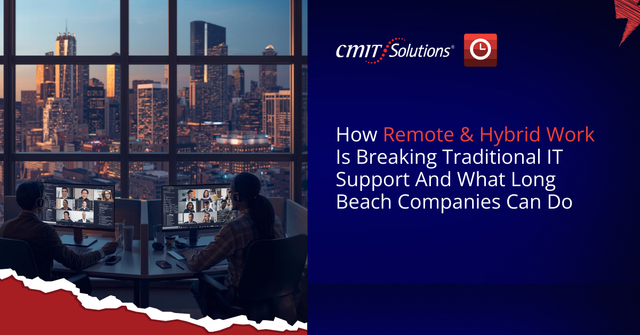
Remote and hybrid work have reshaped how businesses operate, collaborate, and scale. What began as a flexible alternative has become a permanent model for many organizations. Yet while work itself has evolved, the IT support structures behind it often have not.
For many Long Beach businesses, traditional IT support models are being quietly stretched beyond their limits. Issues are no longer confined to a single office, devices operate far outside controlled networks, and problems rarely present themselves in predictable ways. The result is an increasing gap between how technology is supported and how it is actually used.
Traditional IT support was designed for centralized environments
Historically, IT support was built around physical offices. Systems, users, and infrastructure existed in one location, making oversight and troubleshooting relatively straightforward.
This model relied on:
- On-site servers and networks
- Company-managed desktops and laptops
- Perimeter-based security controls
- In-person support for technical issues
When employees worked from the same location, IT teams had visibility and control. Remote and hybrid work removed both.
Distributed work dissolves the boundaries IT once relied on
In a remote or hybrid environment, the workplace is no longer a fixed space. Employees connect from home networks, shared workspaces, and public internet connections, each with different security and performance characteristics.
This shift introduces challenges that traditional IT support struggles to address:
- Limited visibility into device health and usage
- Inconsistent network security conditions
- Increased reliance on remote troubleshooting
- Greater difficulty enforcing standards across systems
Without centralized oversight, IT support becomes fragmented, reactive, and increasingly inefficient. Organizations that want consistent performance across locations typically need stronger endpoint oversight and network stability practices tied to modern network management principles.
Security models tied to physical locations no longer apply
Traditional IT security focused on protecting what was inside the office and blocking what was outside. Firewalls and network controls formed a clear boundary between trusted and untrusted activity.
Remote work removes that boundary. Users, not locations, become the new security perimeter.
This creates new risks:
- Credentials are accessed from unmanaged networks
- Devices operate outside traditional monitoring tools
- Cloud applications become primary business systems
- Data flows between platforms with limited oversight
As this shift accelerates, more organizations are moving away from perimeter-only assumptions and adopting Zero Trust approaches that focus on identity, verification, and least-privilege access.

Support delays escalate faster in remote work environments
In-office support allowed IT teams to resolve issues quickly through direct access. Remote environments add layers of complexity that slow resolution.
Common challenges include:
- Limited ability to diagnose problems without physical access
- Dependence on user availability for troubleshooting
- Delayed response times for distributed employees
- Greater disruption from otherwise minor technical issues
In many cases, the problem is not the complexity of the fix, but the friction involved in getting the right access, logs, and context remotely. This is why remote-first organizations often reassess their tooling and processes for IT support to reduce troubleshooting time and standardize resolution paths.
Device management becomes a persistent challenge
Remote and hybrid work increase both the number and diversity of devices accessing business systems. Laptops, mobile devices, and personal computers may all be used for work, often across multiple locations.
Without modern management practices:
- Updates and patches are applied inconsistently
- Security configurations vary widely
- Lost or stolen devices create ongoing risk
- Compliance requirements become harder to enforce
A major pressure point is operating system lifecycle planning. As older platforms reach support deadlines, unmanaged endpoints become harder to secure and more costly to maintain especially during the Windows 10 end of life transition period.
Cloud reliance increases complexity, not simplicity
Cloud platforms are central to remote work, supporting communication, collaboration, and data storage. While these tools improve accessibility, they also shift responsibility rather than eliminate it.
IT support must now account for:
- User access and permission management
- Data governance across platforms
- Integration between cloud services
- Performance issues outside the office network
Cloud adoption works best when it is treated as an operating environment, not a collection of tools. For many Long Beach teams, the challenge is not getting into the cloud, but managing it consistently through scalable cloud services practices that keep permissions, data controls, and configuration standards aligned.
Reactive IT support struggles to keep pace
Break-fix support models respond to problems after they occur. In remote environments, this approach often leads to repeated disruptions rather than long-term stability.
Reactive support results in:
- Recurring issues with unresolved root causes
- Increased security exposure
- Limited insight into systemic weaknesses
- Difficulty planning for future growth
This gap becomes more visible as threats evolve. Remote work expands the attack surface, and attackers increasingly use stealth, automation, and targeted intrusion methods. Many businesses now reassess whether their defenses are keeping pace with AI-driven threats that are designed to bypass traditional detection.

What effective IT support looks like in a hybrid workplace
Supporting modern work environments requires a shift from location-based assumptions to system-wide visibility and proactive oversight.
Effective IT support typically focuses on:
- Continuous monitoring of systems and devices
- Centralized visibility across users and endpoints
- Identity-focused security controls
- Consistent update and patch management
- Clear policies for remote access and data use
In practice, this means standardizing how endpoints are managed, how access is granted, and how issues are detected before they become disruptions. It also requires security controls that follow users and data, rather than relying on office boundaries. Many organizations formalize these measures under a unified cybersecurity strategy that supports distributed work without adding operational drag.
Why this shift matters for Long Beach businesses
Long Beach companies operate in competitive, fast-moving markets. Technology downtime, security incidents, and inconsistent support directly affect productivity and trust.
As remote and hybrid work continue to shape daily operations, IT support has to evolve alongside them. Businesses that fail to adapt often experience growing inefficiencies and unmanaged risk, even when their technology investments appear sound.
This evolution is less about adopting a single tool and more about building an operating model that can support employees wherever they work. That typically involves clearer standards, better visibility, and more deliberate decision-making especially around lifecycle planning, access controls, and how support is delivered.
Conclusion
Remote and hybrid work are no longer emerging trends they are now embedded in how businesses operate. As this shift continues, the limitations of traditional, office-centric IT support become increasingly clear. Systems designed for centralized environments struggle to provide visibility, consistency, and security across distributed teams, leaving gaps that can affect productivity, reliability, and risk management.
Addressing these challenges requires a more deliberate approach to IT support one that aligns with how employees actually work today and ensures technology remains a stable foundation rather than a recurring obstacle.
If you’re unsure whether your current IT support model is equipped to handle a remote or hybrid workforce, contact us.