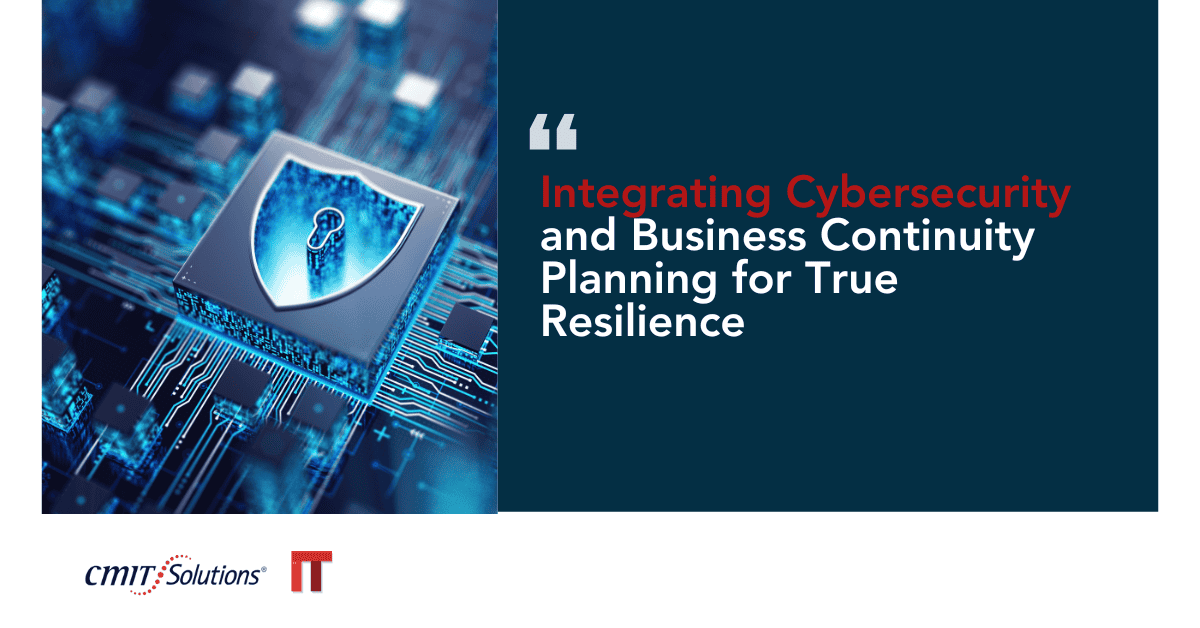
In today’s digital world, cyber threats and business disruptions are no longer isolated risks they are interconnected realities. A single cyberattack can trigger operational downtime, financial loss, and reputational damage that ripple across every department. That’s why true resilience demands the seamless integration of cybersecurity and business continuity planning (BCP).
At CMIT Solutions of Long Beach, we help businesses build this vital bridge ensuring that their security strategies not only prevent attacks but also keep operations running when the unexpected happens.
What Is Business Continuity Planning?
Business continuity planning defines how your organization continues operating after disruptive events such as cyber incidents, natural disasters, or infrastructure failures. It ensures that essential processes, data, and communication channels remain functional even during crises.
Core elements of BCP include:
- Identifying critical business functions
- Establishing data recovery objectives (RTOs and RPOs)
- Developing alternate communication and access channels
- Conducting regular continuity testing
This proactive mindset echoes CMIT’s focus on proactive IT, where preparation and prevention form the foundation for lasting operational success.

The Link Between Cybersecurity and Continuity
Cybersecurity and business continuity are often treated separately, yet they depend on each other. Without strong cybersecurity, continuity plans are meaningless and without continuity, cybersecurity incidents can bring business to a halt.
Together, they create:
- A unified risk management strategy
- Rapid detection and recovery mechanisms
- Reduced downtime from cyber incidents
- Long-term business confidence
CMIT’s insights on ransomware resilience demonstrate that a coordinated defense-and-recovery framework ensures that businesses can bounce back quickly from data encryption or breach events.
Cyber Risks That Threaten Business Continuity
Every organization faces risks that can disrupt operations. However, cybersecurity incidents are now among the top causes of business downtime from phishing and ransomware to insider threats and misconfigurations.
Common continuity threats include:
- Ransomware: Encrypts critical files and halts operations
- Data breaches: Compromise customer trust and legal standing
- System outages: Disable business-critical services
- Insider errors: Accidentally expose or delete sensitive data
CMIT’s article on cyber threats warns that SMBs are prime targets for these attacks due to limited resources and outdated systems making integration with continuity plans essential.
Building a Unified Resilience Framework
Integrating cybersecurity and continuity planning means creating a cohesive structure that safeguards both data and operations. It transforms fragmented processes into a single, coordinated defense system.
A unified resilience framework includes:
- Threat intelligence: Identify vulnerabilities in advance
- Incident response: Execute pre-defined recovery steps
- Secure backups: Ensure data restoration from encrypted sources
- Communication protocols: Keep stakeholders informed
CMIT Solutions’ cybersecurity without compromise approach blends these principles into a 360° resilience model — one that keeps businesses both secure and operational.
The Role of Data Backup in Continuity
Data backup is the cornerstone of both cybersecurity and business continuity. Yet, not all backups are equal — secure, automated, and tested backups are what truly safeguard against loss.
Best practices for resilient data backups:
- Use the 3-2-1 rule: 3 copies, 2 media types, 1 offsite
- Encrypt backups at rest and in transit
- Test restorations regularly
- Store backups in secure cloud environments
This strategy aligns with CMIT’s insights on cloud backups, which emphasize the importance of redundancy, encryption, and automation in disaster recovery.
Zero Trust as the Foundation of Resilience
Zero Trust architecture assumes that no user, device, or application is trustworthy by default every interaction must be verified. In a continuity plan, Zero Trust ensures secure access even during crisis situations.
Core Zero Trust principles include:
- Continuous authentication and authorization
- Least-privilege access policies
- Network segmentation for containment
- Ongoing visibility and risk monitoring
CMIT’s coverage of zero trust adoption highlights how this model prevents lateral movement within networks, helping continuity teams isolate incidents and maintain uptime.
Predictive Analytics for Early Detection
Modern continuity depends on foresight. Predictive analytics, powered by AI, can detect anomalies and system weaknesses long before they disrupt operations.
Applications in resilience include:
- Predicting system overloads or potential failures
- Identifying patterns in network attacks
- Automating alerts and recovery actions
- Improving post-incident analysis
CMIT’s research on AI innovation shows that integrating intelligent automation into IT support creates a predictive layer that strengthens both security and continuity outcomes.
Compliance: The Overlooked Resilience Component
Regulatory compliance frameworks such as HIPAA, GDPR, and SOC 2 not only ensure legal protection but also strengthen resilience by enforcing security and recovery standards.
Compliance enhances resilience through:
- Regular audits and gap assessments
- Encryption and access control mandates
- Documentation of recovery procedures
- Accountability and governance structures
CMIT’s HIPAA and beyond demonstrates that compliance is not just about regulation — it’s about operational assurance and trust.
Cloud Continuity: Managing Multi-Cloud Risks
Hybrid and multi-cloud environments increase flexibility but add complexity to continuity planning. Integrating cybersecurity into these infrastructures requires unified oversight across platforms.
Effective cloud resilience tactics include:
- Encrypting cloud-based data
- Synchronizing cross-platform policies
- Implementing failover and replication systems
- Validating third-party compliance
CMIT’s expertise in multi-cloud management ensures that businesses maintain visibility and control, regardless of how distributed their systems become.

Human Factors in Cyber Resilience
Even the most advanced technology can’t protect against human error without proper training and awareness. Employees are both the first line of defense and the biggest risk factor in maintaining continuity.
Essential awareness practices:
- Conduct regular cybersecurity drills
- Educate employees on phishing and social engineering
- Establish clear reporting protocols for suspicious activity
- Reinforce policies during onboarding and audits
These habits reflect CMIT’s security awareness framework, which empowers staff to play an active role in resilience.
How MSPs Strengthen Cyber Continuity
Managed Service Providers (MSPs) play a critical role in uniting cybersecurity and continuity. They provide 24/7 monitoring, automated recovery systems, and dedicated support to minimize disruptions.
An MSP-led resilience model delivers:
- Integrated threat detection and response
- Encrypted backups and secure restoration
- Automated continuity tests and documentation
- Scalable recovery frameworks for growing businesses
CMIT Solutions’ help desk exemplifies this integrated service model offering real-time support that bridges cybersecurity and business continuity.
Case for Proactive Investment
Investing in cybersecurity and continuity integration is not an expense it’s insurance for business stability and brand reputation. Organizations that plan ahead spend less on crisis recovery and gain more customer trust.
Benefits of proactive investment include:
- Faster recovery times after incidents
- Lower long-term IT costs
- Stronger regulatory compliance posture
- Enhanced customer and stakeholder confidence
This strategic approach ties directly to CMIT’s driving growth philosophy, where resilience becomes a platform for innovation and scalability.
Future Trends: Intelligent Continuity and Automation
The next generation of business continuity will merge with AI, automation, and real-time intelligence. Predictive and adaptive systems will not only detect but also resolve incidents automatically.
Emerging innovations include:
- AI-based disaster recovery orchestration
- Automated failover and self-healing networks
- Blockchain-based data integrity validation
- Quantum-resistant encryption models
CMIT’s AI security insights show how emerging technologies can help organizations evolve their continuity plans into intelligent, self-defending ecosystems.
Conclusion: True Resilience Is Integrated Resilience
In the modern business landscape, resilience isn’t achieved by separating cybersecurity and continuity, it’s built by connecting them. The organizations that thrive are those that secure their data, train their people, and prepare for the unexpected.
With CMIT Solutions of Long Beach as your managed IT partner, you can build an integrated resilience strategy that safeguards your operations, protects your reputation, and sustains your growth no matter what comes your way.