

It took just one employee email account. In March 2023, someone at a small addiction treatment center in Illinois was fooled by a phishing email, a fake message built to steal a password. The attacker gained access to that mailbox. Inside were the health details of 1,980 patients. In February 2026, the center agreed to pay $103,000 to federal regulators and to carry out a list of required fixes. The attacker never needed the patient record system. The sensitive patient information was stored in email. If your EHR is in the cloud, it is reasonable to assume the vendor now handles security. The vendor does handle a great deal. It does not handle your email or your staff logins. This article is about EHR cybersecurity for small medical practices in Stafford, VA: what the vendor covers, and what still belongs to you.
What “In the Cloud” Changes, and What It Leaves Alone
A cloud EHR runs on the vendor’s computers. You reach it through the internet, and there is no longer a server in your back room. That moves a real share of the security work to the vendor. The rest stays where it was. Cloud companies have a name for this split. They call it shared responsibility.
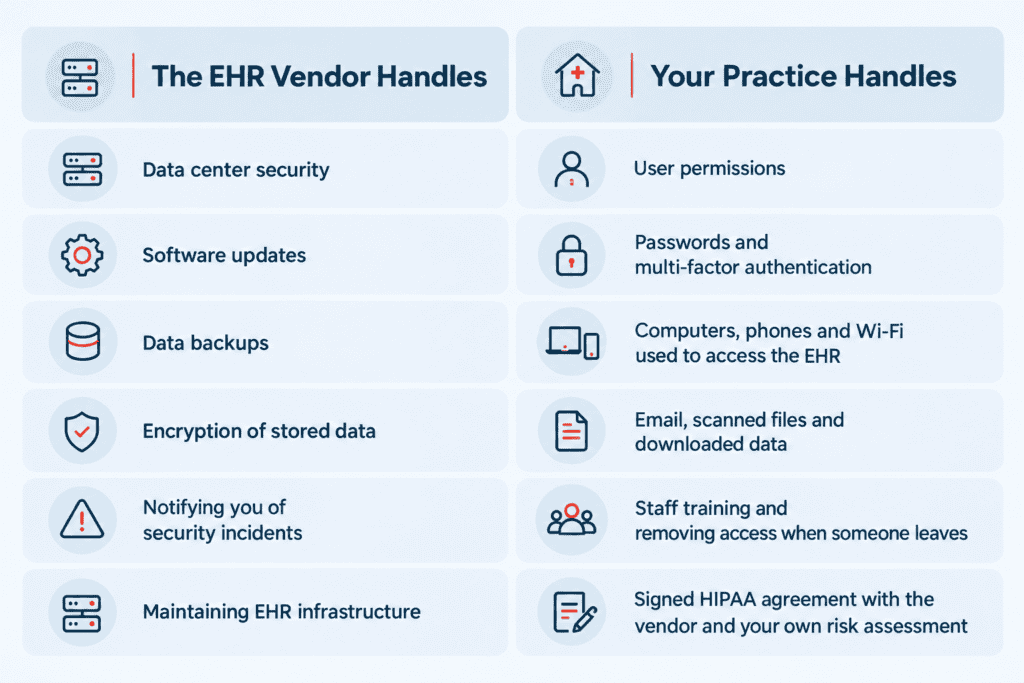
The exact split varies by vendor, so check your contract. Good cloud EHR security starts with knowing which column each job sits in. Federal guidance on cloud services describes the same division. It says login checks and individual user IDs may be the customer’s job, while other protections may be the vendor’s. The right-hand column is the heart of medical practice cybersecurity responsibilities for cloud EHR. The left-hand column is not a guarantee either. In March 2026, attackers spent six days inside the cloud systems of a company that provides EHR software to medical practices. At least 350,000 people had data taken, including Social Security numbers and medical information. A breach at the vendor still lands on your desk. HIPAA requires the vendor to report it to you. The practice is then responsible for telling its patients, no later than 60 days after it learns of the breach.
How Attackers Get In: The Numbers
Verizon’s 2026 breach report looked at 1,492 security incidents in healthcare. It lists the most common ways in:
- Software weaknesses that had not been fixed: 20%
- Phishing emails: 14%
- Stolen logins: 11%
- Employee mistakes: 11%
People were involved in 54% of the incidents, most often by sending information to the wrong person. Outside vendors were involved in about 32% of healthcare breaches. For healthcare cybersecurity, that puts staff habits at the center of the problem. Read that list with a cloud EHR in mind. Phishing, stolen logins, and staff mistakes all happen on the practice’s side of the table. Your vendor cannot stop a staff member from typing a password into a fake login page. That is why EHR cybersecurity for medical practices starts at the login screen. HIPAA Journal’s half-year report adds a related point. It counted 397 large healthcare breaches between January and June 2026. Network servers were the most common place the exposed data was stored, and email remained a common one.
Six Protections That Stay With Your Practice
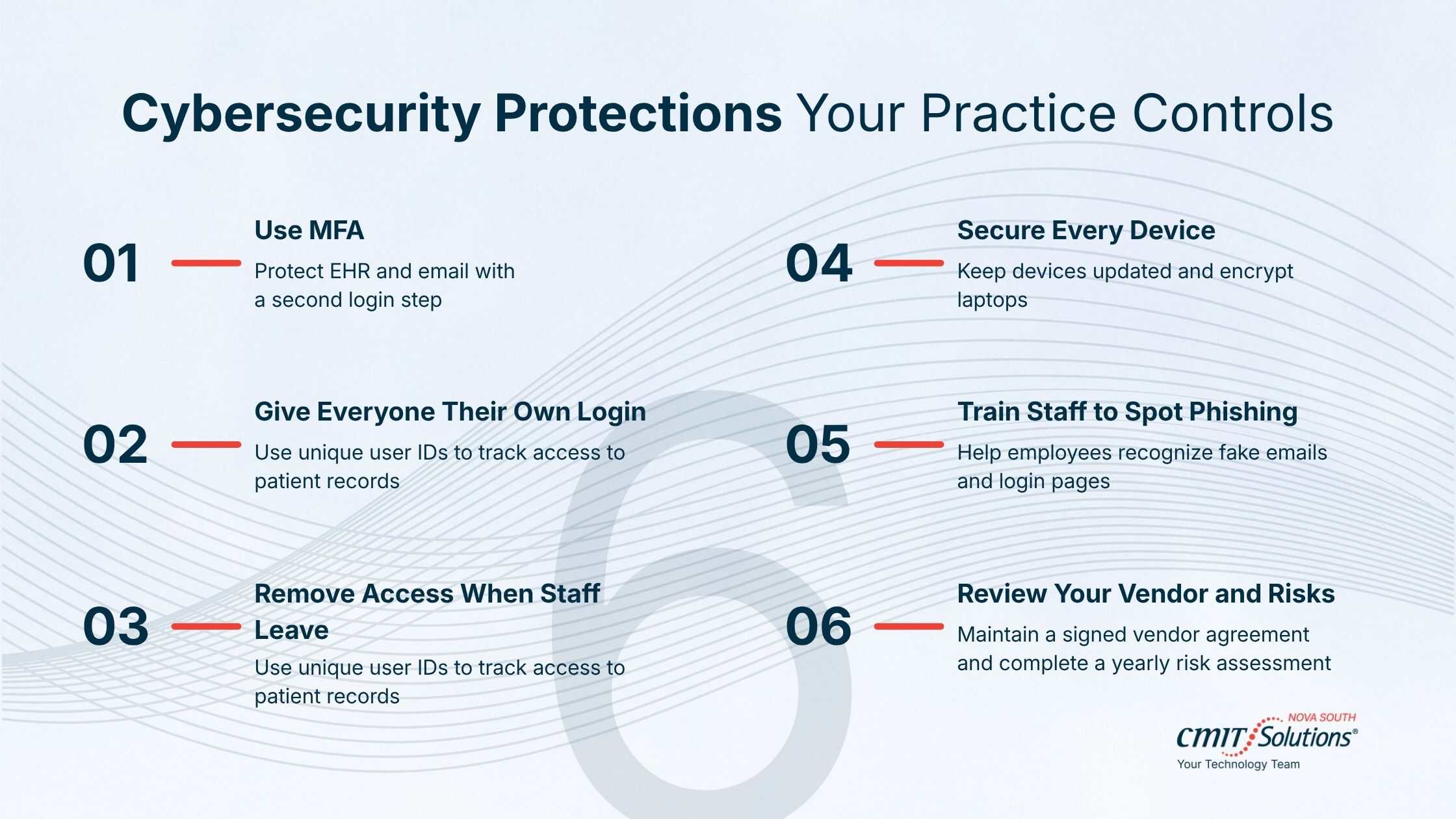
IT people call these controls. In plain terms, they are the locks and habits around your EHR. Here are the cybersecurity controls for cloud-based EHR systems that no vendor can put in place for you.
-
-
- A second login step. This is called multi-factor authentication (MFA). Turn it on for the EHR and for email. Staff enter a password and then a code from their phone. A stolen password alone is no longer enough to gain access.
- One login per person. HIPAA requires a unique user ID for everyone who touches patient records. A shared front-desk password makes it impossible to tell who opened which chart. That matters, because people inside the organization were behind 19% of healthcare breaches in Verizon’s report.
- Access removed the day someone leaves. A cloud-based EHR can be accessed from virtually any web browser. A former employee whose login still works can open it from home. Together, these first three are your EHR access controls: the rules for who can get in and what each person can see.
- Updated, encrypted devices. Verizon found that only 26% of the most serious software weaknesses were fully fixed in 2025. The typical fix took 43 days. Keep every computer updated. Encrypt laptops, which scrambles the data so a stolen one cannot be read.
- Staff who can spot a fake email. Phishing is the second most common way in on Verizon’s list. Yearly staff training was one of the fixes regulators required from the Illinois center.
- A signed vendor agreement and a yearly check. HIPAA calls your EHR vendor a business associate and requires a signed agreement with it. Your own risk assessment has to include the cloud system too.
-
These are the EHR security best practices for medical practices in Stafford, VA, and everywhere else. Between them, they address all four of the most common ways in on Verizon’s list, which makes them the core of healthcare data breach prevention for a small office. A practice with five staff can put every one of them in place. If you would rather not manage them in-house, the EHR security services Stafford, VA practices can hire cover the same list.
The Patient Data That Never Sits in the EHR
Every practice has patient information outside the EHR. It tends to collect in four places:
-
-
- Email inboxes, in referrals and messages to patients
- Download folders, in reports and spreadsheets exported from the EHR
- Shared drives, in scanned forms and insurance cards
- Phones, in texts and photos
-
Your EHR vendor protects none of these. This is the part of medical practice cybersecurity that is easiest to forget. A front-desk computer can hold years of exported reports that nobody remembers saving. Two dental practices here in Stafford saw the result in 2026. HIPAA Journal reported that a vendor’s email accounts were broken into after a phishing attack. More than 12,000 of their patients were affected between the two practices. The breach exposed patient information held in the vendor’s email accounts. Good cloud EHR security for healthcare providers in Stafford, VA, therefore covers more than the EHR. It follows patient data wherever it travels on the way in and out.
What HIPAA Says About the Cloud
HHS has published guidance on HIPAA security for cloud-based EHR and other cloud services. Four points matter most to a small practice.
-
-
- You need a signed agreement. A practice that stores patient information with a cloud company without a business associate agreement is in violation of HIPAA.
- You still do your own risk assessment. The guidance says both the practice and the vendor must assess the risks to patient information.
- Some protections are yours. Checking who is logging in may be the customer’s responsibility.
- The vendor must tell you about incidents. The agreement has to require it.
-
The HIPAA cybersecurity requirements for medical practices in Stafford, VA are the same federal rules that apply everywhere. Moving to the cloud changes who does some of the work. The practice still answers for the result. This is where EHR security and HIPAA compliance for medical practices meet. The six protections above are the same things a HIPAA risk assessment checks. Any HIPAA compliance services in Stafford, VA practices sign up for should cover the vendor agreement and the yearly assessment at a minimum. Broader healthcare compliance services should check your email and devices too, since that is where much of the patient data outside the EHR sits.
How CMIT Solutions of NOVA South Helps Stafford Practices
CMIT Solutions of NOVA South provides healthcare cybersecurity services for cloud-based EHR systems in Stafford, VA and across Northern Virginia. We help secure the systems, users, and workflows that fall outside your EHR vendor’s responsibility. Our EHR cybersecurity services for Stafford, VA practices cover the six protections above. We set up the second login step, keep devices updated and encrypted, and close accounts when staff leave. Somu Valliappan, our Managing Partner, spent more than ten years working on EHR and data systems for CMS and NIH. On the compliance side, our HIPAA cybersecurity services Stafford VA practices rely on include risk assessment and a review of your vendor agreements.
All of it can run as managed cybersecurity services for medical practices in Stafford offices pay for monthly. Your team can stay focused on patient care while we handle the cybersecurity and compliance requirements. It runs alongside our managed IT services for healthcare, so day-to-day IT help comes from the same team. Your EHR vendor is responsible for the EHR. Your practice is responsible for who logs in, and for every copy of patient data that sits outside it. If you are not sure each item in the right-hand column has an owner, ask us for a review.
Frequently Asked Questions
Is a cloud-based EHR automatically secure?
No. The vendor secures its own systems, and even that can fail. A cloud EHR company had data on at least 350,000 people taken in March 2026. Your logins and devices are outside the vendor’s control, so they need their own protection.
What cybersecurity responsibilities remain with a medical practice when its EHR is in the cloud?
Deciding who has a login, requiring a second login step, protecting the devices used to reach the EHR, and training staff. Patient data in email and files is also yours to protect. You keep the HIPAA duties too: a signed vendor agreement and your own risk assessment.
Who is responsible for EHR security, the medical practice or the cloud provider?
Both, for different parts. The provider is responsible for the system it runs. The practice is responsible for how its people use that system. Under HIPAA, the practice remains accountable to its patients and to regulators, so the contract should spell out the split.
What security controls should medical practices have around a cloud-based EHR?
A second login step, one account per person, quick removal of staff who leave, updated and encrypted devices, and phishing training. Add a regular look at the EHR’s access log, which shows who opened which chart. Ask your vendor how to run that report.
Does a cloud EHR eliminate a medical practice’s HIPAA cybersecurity responsibilities?
No. HHS guidance says a practice using a cloud service must still assess the risks to its patient information and manage them. A practice that uses a cloud company without a signed business associate agreement is in violation of HIPAA.
How can medical practices in Stafford protect patient data outside the EHR?
List where it sits first: inboxes, download folders, shared drives and phones. Then shrink it. Delete exported reports once they have been used. Send records through the EHR’s patient portal where you can. It is the least glamorous part of medical practice cybersecurity Stafford VA offices take on, and one of the most useful.
What should a Stafford medical practice review when assessing its cloud EHR security?
Five things. The signed vendor agreement. The list of active logins, checked against your current staff list. Whether the second login step is on for everyone. The devices used to reach the EHR. Where exported data ends up. Also ask the vendor how quickly it would tell you about an incident.


