

For a financial firm, a ransomware attack is not simply an IT outage. When systems go down, accountants may lose access to tax and accounting platforms, financial advisors may be unable to retrieve client records, employees may lose email and shared files, and teams may have to stop normal client-facing work while determining whether sensitive information was accessed or stolen.
That is why ransomware recovery for financial firms in Prince William County needs to be measured in more than the ransom demand. The real cost can include downtime, forensic investigation, system restoration, outside technical support, legal and regulatory work, client communications, lost productivity, and potentially lost business.
And ransomware remains a significant threat to smaller organizations. Verizon’s 2025 Data Breach Investigations Report found ransomware present in 44% of the breaches it reviewed. Among SMB breaches in its dataset, ransomware was involved in 88%. The report also found a median ransom payment of $115,000, while 64% of victim organizations did not pay.
For financial services businesses that cannot afford to lose access to critical systems for days, the more important question is not simply, “Can we stop ransomware?”
It is: If ransomware gets through, how quickly can we operate safely again?
The Real Ransomware Recovery Cost Is Bigger Than the Ransom
There is no reliable flat-dollar answer to how much ransomware recovery costs a small business. A 15-person accounting practice and a large financial institution have different systems, data volumes, regulatory obligations, insurance policies, and business interruption exposure.
The FBI also warns against treating reported ransomware losses as the complete cost of an incident. Its Internet Crime Complaint Center notes that reported ransomware losses do not include estimates for lost business, time, wages, files, equipment, or third-party remediation services.
For a financial firm, the ransomware recovery cost may include:
- Emergency incident response and digital forensics
- Lost billable and productive employee hours
- Hardware replacement or system rebuilding
- Backup validation and data restoration
- Security remediation
- Legal and compliance support
- Cyber insurance deductibles and uncovered expenses
- Client notification and communication
- Regulatory reporting, where applicable
- Lost revenue during the outage
- Reputation and client-retention impact
The ransom itself, therefore, can be only one line item in a much larger recovery bill.
What Does a Day of Ransomware Downtime Actually Cost?
There is no credible universal “average downtime cost per day” for a small accounting or financial firm. Any provider that gives every business the same number is ignoring how differently these firms operate.
A better way to calculate the business downtime cost of ransomware is:
Daily downtime cost = lost or delayed revenue + idle payroll + emergency recovery expenses + operational workarounds + downstream client impact
Consider what happens if a Prince William County accounting firm cannot access its primary accounting software, document management system, email, client files, or cloud applications for a full business day.
Employees are still being paid. Deadlines do not disappear. Client requests continue. Recovery specialists may be billing. Leadership is diverted from normal work. Some work may have to be recreated or manually processed.
Now extend that interruption from one day to five.
The financial impact can grow quickly even if the company never pays a dollar to the attacker.
This is particularly relevant in a large local business market. The U.S. Census Bureau reports that Prince William County had 9,286 employer establishments and more than 120,000 employees across employer establishments in 2023. For local professional and financial businesses operating within that economy, cyber resilience is increasingly an operational issue, not simply an IT issue.
Why Financial Firms Have More at Stake
A ransomware attack on financial services can combine two problems at once: loss of system availability and potential exposure of sensitive data.
Financial advisors, accounting practices, lenders, insurance-related businesses, and other financial organizations may hold information such as:
- Tax documents
- Social Security numbers
- Bank and payment information
- Investment and account records
- Payroll information
- Personally identifiable information
- Business financial records
- Login credentials and correspondence
Modern ransomware attacks may also involve data theft before systems are encrypted. Restoring a server therefore does not automatically answer the questions that matter after an attack.
Was information accessed?
Was anything exfiltrated?
Are compromised credentials still active?
Can restored systems be trusted?
Does the incident trigger notification requirements?
These questions are why ransomware incident response must go beyond simply restoring yesterday’s backup.
What a Ransomware Attack Recovery Timeline Can Look Like
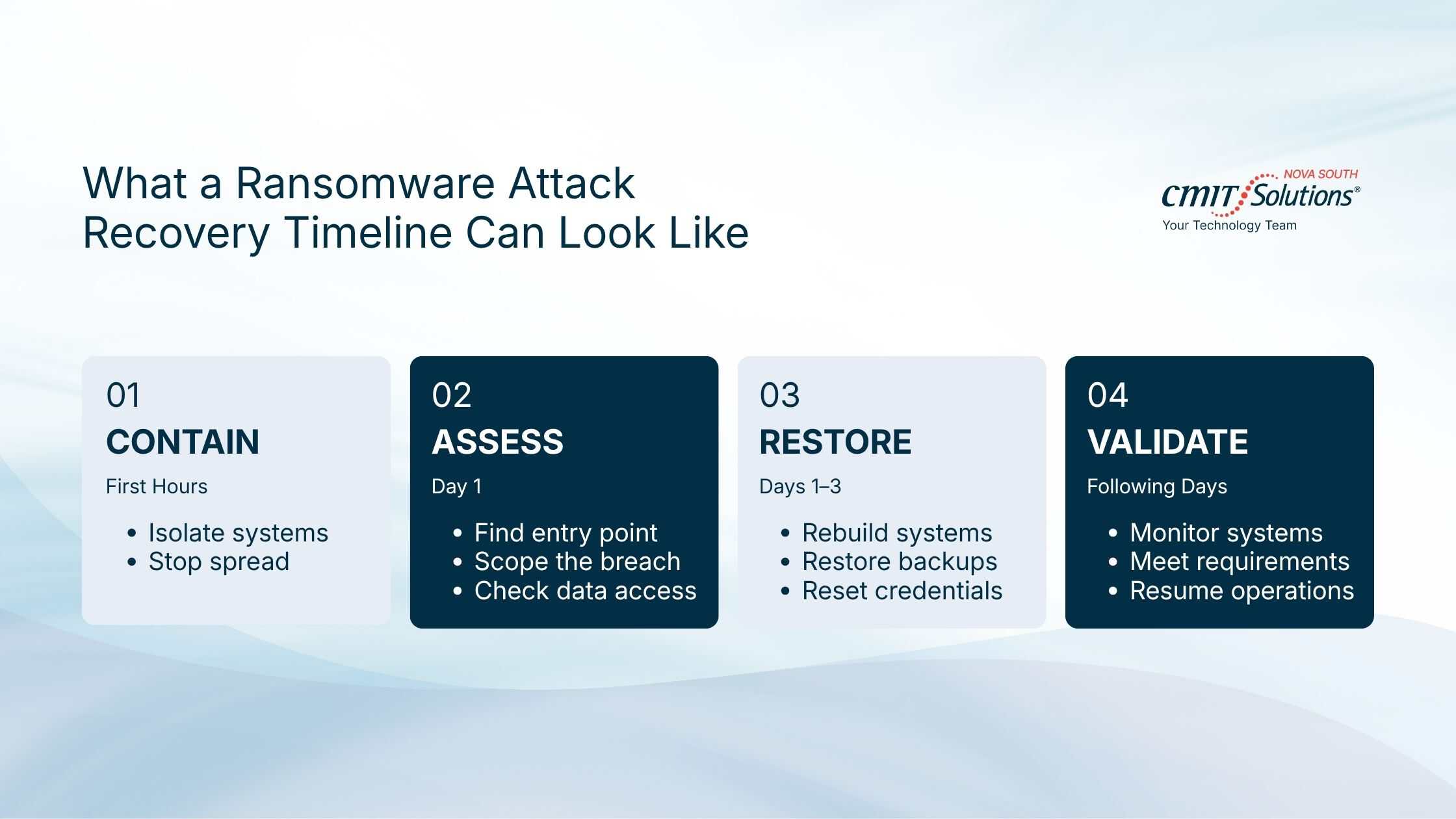
The ransomware recovery time for financial firms depends heavily on what was prepared before the incident.
There is no guaranteed recovery timeline, but the process generally includes several stages.
First Hours: Contain the Attack
Affected devices and systems need to be identified and isolated to limit additional damage.
CISA’s ransomware response guidance recommends immediately determining which systems were affected and isolating them. If multiple systems or subnets are involved, broader network isolation may be necessary.
At this stage, the priority is containment, not getting every employee back online as quickly as possible.
Day 1: Determine the Scope
The response team needs to investigate how the attacker entered, which accounts and systems were compromised, whether data was accessed or exfiltrated, and whether persistence mechanisms remain in the environment.
Simply wiping one infected laptop may not solve the underlying compromise.
Days 1–3: Rebuild and Restore Critical Operations
Clean systems can begin to be rebuilt, credentials reset, vulnerabilities remediated, and verified data restored.
Recovery should prioritize the applications that the business needs most. For a financial firm, that may include identity systems, core financial applications, document repositories, communications, and client-facing systems.
Following Days: Validate and Return to Normal Operations
Systems need to be monitored as they return online. The business may also need to work through insurance, legal, regulatory, client communication, and post-incident security requirements.
The difference between hours and days of disruption often comes down to decisions made long before the attack.
Why Backups Alone Are Not a Ransomware Strategy
“We have backups” is a good start. It is not a complete ransomware recovery plan.
CISA recommends maintaining offline, encrypted backups of critical data and regularly testing their availability and integrity. The agency specifically notes that many ransomware variants attempt to find and encrypt or delete accessible backups.
A financial firm therefore needs to know:
- Are backups isolated from production systems?
- Can attackers using compromised administrator credentials delete them?
- Are critical cloud applications also backed up?
- How frequently is critical data backed up?
- When was a complete restoration last tested?
- How long would restoration actually take?
- Which systems need to come back first?
An untested backup tells you that a copy of the data may exist.
A tested recovery process tells you whether the business can use it when operations are under pressure.
Ransomware and GLBA Compliance: Recovery Can Become a Regulatory Issue
For financial firms, ransomware can also trigger compliance and notification obligations depending on the organization, data involved, regulators, and facts of the incident.
FTC Safeguards Rule Ransomware Requirements
Certain financial institutions subject to the FTC Safeguards Rule must maintain safeguards designed to protect customer information.
Under the Rule’s breach notification requirements, covered financial institutions must notify the FTC as soon as possible and no later than 30 days after discovering a notification event involving the unauthorized acquisition of unencrypted information of at least 500 consumers. The FTC explains that encrypted customer information can also fall within the requirement if the encryption key was accessed by an unauthorized person.
This is one reason ransomware and GLBA compliance cannot be treated separately from incident response.
SEC Requirements for Covered Financial Firms
SEC requirements depend on the type of firm.
Amended Regulation S-P requires covered institutions, including broker-dealers, registered investment advisers, investment companies, funding portals, and certain transfer agents, to maintain written incident-response policies and procedures addressing unauthorized access to or use of customer information.
Covered institutions generally must provide affected individuals with notice as soon as practicable and no later than 30 days after becoming aware of certain incidents involving unauthorized access to or use of customer information, subject to the rule’s requirements and exceptions.
Other SEC cybersecurity disclosure rules may apply to public companies, so businesses should determine their obligations based on their specific regulatory status rather than assuming one rule applies to every financial services organization.
For ransomware reporting requirements in financial services, legal and compliance counsel should be involved early in the response.
Should a Financial Firm Pay the Ransom?
Paying does not guarantee recovery.
CISA and federal law enforcement generally discourage ransom payments because payment does not guarantee that data will be restored and may encourage further criminal activity.
There are also practical questions.
Will the decryptor work?
Was data already stolen?
Will the attacker delete stolen copies?
Can the organization legally make the payment?
Will the cyber insurer cover it?
Will payment actually make recovery faster than restoring clean systems?
Verizon’s 2025 data shows that 64% of ransomware victims in its dataset did not pay.
The goal of a ransomware preparedness program should therefore be to give the organization viable recovery options that do not depend on an attacker’s cooperation.
What Prince William County Financial Firms Should Have in Place Before an Attack
Effective cybersecurity for financial firms in Prince William should combine prevention with recoverability.
For accounting practices, advisory firms, and other financial organizations, that means building several layers of protection:
Multi-factor authentication: Require MFA for email, remote access, administrative accounts, and critical cloud systems.
Endpoint detection and response: Monitor laptops, desktops, and servers for suspicious activity rather than relying only on traditional antivirus.
Patch and vulnerability management: Reduce opportunities for attackers to exploit known weaknesses.
Email security and employee training: Phishing remains an important entry point for credential theft and malware.
Least-privilege access: Employees and vendors should have only the system access necessary for their roles.
Network segmentation: Limit how easily an attacker can move from one compromised device into other critical systems.
Offline or appropriately isolated backups: Keep recovery copies outside the attacker’s normal reach.
Backup restoration testing: Verify that data can actually be restored within an acceptable timeframe.
24/7 monitoring and alerting: Detect suspicious activity before an attacker has days to move through the environment.
Documented ransomware incident response: Define who isolates systems, contacts insurance, coordinates technical response, handles client communications, and makes regulatory decisions.
For firms without a dedicated internal security operation, managed cybersecurity services in Prince William can provide ongoing monitoring, endpoint protection, vulnerability management, backup oversight, and incident-response planning.
The goal is not to promise that ransomware can never happen. The goal is to make a successful attack harder and make recovery faster and more predictable if one does.
The Question to Ask Is Not “Do We Have Backups?”
For accounting and financial services firms, the better question is:
If ransomware hit at 10:00 tomorrow morning, when could we safely serve clients again?
If the answer is unclear, the organization does not yet know its true ransomware exposure.
Effective ransomware protection for accounting firms in Northern Virginia should include both cybersecurity controls and a tested recovery strategy. Firms need to know which systems are critical, how quickly those systems can be restored, who is responsible during an incident, and how regulatory and client communication requirements will be handled.
CMIT Solutions of NOVA South helps local businesses assess cybersecurity risks, strengthen their defenses, protect critical systems, and prepare for business continuity and recovery.
If your firm cannot afford a week of downtime, your ransomware plan should be designed before the clock starts.
Protect your business from evolving cyber threats with a cybersecurity strategy built around your most critical systems. Schedule a Free Cybersecurity Consultation with CMIT Solutions of NOVA South to identify vulnerabilities, strengthen your defenses, and prepare a practical ransomware recovery plan.
Frequently Asked Questions
How much does ransomware recovery cost a small financial firm?
There is no single average that applies to every firm. Ransomware recovery costs can include downtime, lost productivity, forensic investigation, restoration, legal and regulatory support, hardware or software remediation, client notification, insurance deductibles, and potentially lost revenue. The FBI notes that reported ransomware losses do not capture many costs such as lost business, time, wages, equipment, files, and third-party remediation.
How long does it take to recover from a ransomware attack?
A ransomware attack recovery timeline for a small business can range significantly depending on the extent of the compromise, availability of clean backups, number of affected systems, incident-response readiness, and whether data was stolen. Businesses should establish and test recovery time objectives for critical systems rather than relying on a generic industry average.
Should a financial firm pay the ransom?
Payment does not guarantee that systems or data will be restored. Federal guidance discourages paying ransomware demands, and organizations should involve incident-response specialists, legal counsel, law enforcement, and their cyber insurer before making decisions during an incident.
Does cyber insurance cover ransomware attacks on financial firms?
Some policies cover certain ransomware-related expenses, but coverage varies significantly. Policies may include conditions related to security controls, incident notification, approved response providers, deductibles, exclusions, and ransom payments. Firms should review ransomware insurance requirements for financial services with their insurer or broker before an incident occurs.
What regulatory reporting is required after a ransomware attack on a financial services firm?
Requirements depend on the type of institution, information affected, and applicable federal and state rules. Certain firms covered by the FTC Safeguards Rule must report qualifying notification events to the FTC within 30 days of discovery. Certain SEC-regulated institutions also have incident-response and customer-notification obligations under Regulation S-P. Legal counsel should determine which requirements apply to a specific incident.
How does ransomware typically get into a financial services firm?
Common entry points include compromised credentials, phishing and social engineering, exploitation of unpatched vulnerabilities, exposed remote-access systems, malware, and third-party compromise. Verizon’s 2025 DBIR found credential abuse, vulnerability exploitation, and phishing among the leading known initial access vectors across the breaches it studied.
Can backups alone protect a financial firm from ransomware?
No. Backups support recovery but do not prevent credential theft, data exfiltration, lateral movement, or system compromise. CISA recommends offline, encrypted backups alongside regular restoration testing, incident-response planning, access controls, endpoint protection, and other preventive measures.
What is the average downtime cost per day for a small financial firm?
There is no reliable universal daily figure. The cost of downtime for an accounting firm after ransomware depends on revenue, payroll, number of affected employees, transaction volume, recovery costs, client commitments, and the systems unavailable. Firms should calculate their own cost per hour or day for critical operations.
How can Prince William County financial firms prevent ransomware attacks?
Strong financial services cybersecurity in Prince William County should include MFA, endpoint protection, email security, patch management, vulnerability management, employee training, access controls, isolated backups, monitoring, and a tested incident-response and recovery plan.
What does a ransomware incident response plan include?
A ransomware incident response plan should identify how the organization will detect and contain an attack, isolate affected systems, preserve evidence, determine the scope of compromise, communicate internally, contact insurers and external responders, evaluate notification requirements, restore clean systems, reset compromised credentials, monitor the recovered environment, and document lessons learned.


