
In July 2025, Clorox filed a $380 million lawsuit against Cognizant, the IT vendor that ran its help desk. According to the filing in California Superior Court, attackers from the Scattered Spider group called the Cognizant service desk, said they had forgotten their password, and received new credentials without any identity verification.
That single unverified reset opened the door to a breach that forced Clorox to suspend manufacturing, run manual order processing for weeks, and absorb hundreds of millions of dollars in business interruption losses.
There was no zero-day or malware payload. There was just a phone call.
The Clorox story matters to Prince William County business owners for a reason most local firms overlook. If a Fortune 500 with an enterprise security budget can be undone by one credential reset call, the same tactics run through inboxes and phone lines across Manassas, Woodbridge, and Dale City every day. What has changed in 2025 is not the technique. It is the volume, the polish, and the cost of scaling it.
The stat that changed everything
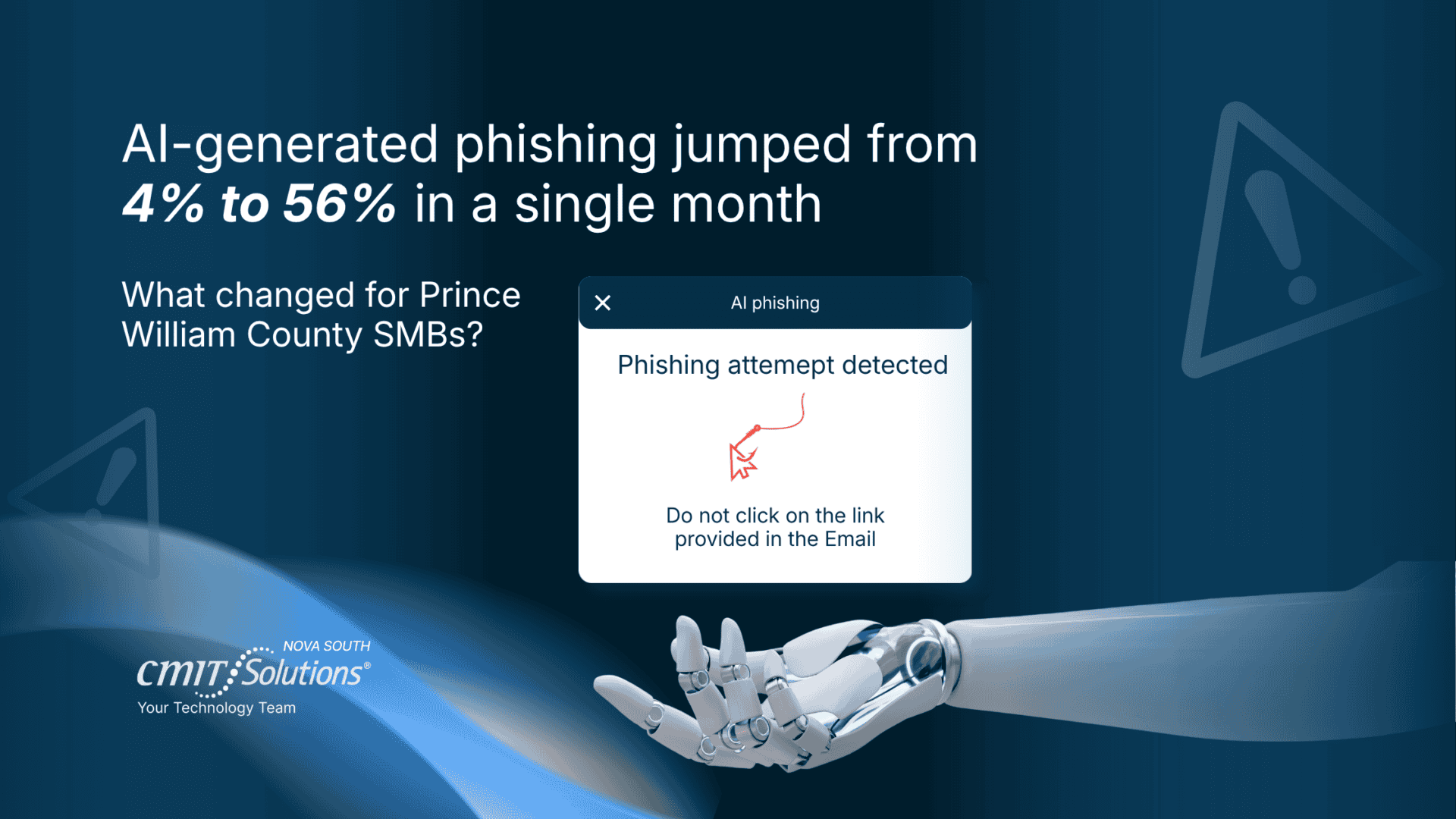
Hoxhunt’s 2026 Phishing Trends Report analyzed data from over 4 million users worldwide and found that for the first 11 months of 2025, AI-generated phishing represented under 5 percent of attacks reaching inboxes. In December 2025, that number surged to 56 percent. A 14-fold increase in a single month. The trend did not fully reverse in January 2026, when 40 percent of reported phishing attempts still showed signs of AI generation.
The KnowBe4 2025 Phishing Threat Report, which analyzed phishing emails between September 2024 and February 2025, found that 82.6 percent already contained AI-generated elements even before the December spike. The FBI’s 2025 Internet Crime Report logged over 22,000 AI-related fraud complaints with reported losses exceeding $893 million. Business email compromise alone accounted for $3.046 billion across 24,768 complaints in 2025, averaging roughly $123,000 per incident.
For a Prince William County firm running 15 to 100 employees, $123,000 is not just a bad quarter, but a business event.
What actually changed in the attacks
Generative AI removed the tells that phishing training was built around. Broken grammar used to be a warning sign. So did generic greetings and awkward pressure tactics. Attackers now write clean, on-brand messages that reference real internal projects, real vendor names, and real recent activity scraped from LinkedIn, press releases, and podcast archives.
Three shifts define the 2025 wave.
The first is personalization at scale. A single attacker can generate thousands of targeted emails in minutes, each one referencing the recipient’s actual role, their manager’s name, or a real project mentioned publicly.
The second is multichannel coordination. Email is the opening move. AI-cloned voice calls, SMS follow-ups, and deepfake video calls chain together in coordinated attempts on the same target.. Malicious SVG file attachments increased fiftyfold in the same period, according to Hoxhunt.
The third is adaptive tempo. Where a human attacker took days to change tactics after being blocked, AI-driven campaigns shift in hours. A wave stopped in the morning can return by afternoon with different sender addresses and different linguistic patterns.
The 2025 Verizon Data Breach Investigations Report analyzed over 22,000 incidents and found that 60 percent of confirmed breaches still involved a human action. Phishing was the initial access vector in 16 percent of breaches. Stolen credentials, most of them harvested through phishing, were used in 22 percent.
Why Prince William County SMBs are in the target zone
Prince William County businesses tend to sit in a specific attacker sweet spot. Small enough that a dedicated internal security team does not exist. Large enough that a wire transfer, payroll approval, or vendor invoice moves real money.
Government subcontractors in Woodbridge handling controlled unclassified information. Healthcare practices in Manassas and Dale City moving PHI through EHR and billing platforms. Accounting firms in the Innovation Park corridor sitting on client tax records during filing season. Construction companies routing project payments and change orders through Procore or email. All of them handle the kind of data AI-driven campaigns now build around.
The typical Prince William County SMB owner still describes phishing training the same way they did five years ago. Look for typos. Check the sender. Do not click links you did not expect. That advice is no longer sufficient, because the emails passing through inboxes now clear all three of those checks.
The financial exposure is not abstract. The 2026 AFP Payments Fraud and Control Survey found that 76 percent of US organizations experienced attempted or actual payments fraud in 2025, and business email compromise affected 74 percent of them. IBM’s 2025 Cost of a Data Breach Report put the average phishing-driven breach at $4.88 million. For a 30-person firm in Woodbridge or Manassas, even a fraction of that number is an existential event.
What effective defense looks like now
Defending against AI-generated phishing requires more than an annual training module and a spam filter. The controls that hold up under 2025 conditions are layered and continuous. For businesses that need ongoing protection rather than isolated security tools, cybersecurity services in Prince William County can provide the monitoring, identity controls, employee training, and response capabilities needed to address increasingly sophisticated phishing campaigns.
CMIT Solutions of NOVA South builds managed IT programs for small and mid-sized Prince William County businesses that pair modern email security with the operational discipline attackers try to bypass. That work usually covers five areas.
Advanced email security with AI-driven detection flags impersonation attempts, lookalike domains, and behavioral anomalies before messages reach the inbox. DMARC enforcement stops a spoofed sender using your own domain at the door.
Phishing-resistant multi-factor authentication using hardware keys or app-based prompts is deployed across every employee account. SMS-based codes are no longer safe. AI-driven vishing campaigns have learned to intercept them.
Ongoing security awareness training is built around phishing simulations that reflect what attackers are actually sending in 2025. Training vendors still shipping 2022-era content are teaching staff to spot a threat that has already evolved past them.
Endpoint detection and response monitoring catches lateral movement in the minutes after a credential is compromised. The initial phishing click is no longer the last defensive opportunity when EDR is watching what happens next.
Wire transfer and vendor payment protocols require out-of-band verification for any payment change. This is the control that closes the Clorox-style loophole, where a phone call produced a password reset with no verification step.
Somu Valliappan, Managing Partner at CMIT NOVA South, brings a decade of federal and financial services experience to how these controls get scoped. His work with CMS and NIH on systems handling sensitive federal data means the identity, access, and audit thinking behind these deployments is built on FISMA and NIST discipline. His years in banking translate the same rigor into what a Prince William County accounting firm or medical practice can operate on a small business budget.
The window for staying ahead of this is narrow
The 4 percent to 56 percent jump is not a statistic that will hold still. AI-generated phishing volumes through the second half of 2027 will almost certainly climb further as commodity AI tooling gets cheaper. Prince William County businesses that come through this cycle intact will be the ones that stopped treating phishing as an inbox problem and started treating it as an operational one. Every payment approval workflow, every help desk password reset, and every vendor onboarding step now has to assume the person on the other end may not be who they claim to be.
Wondering whether your Prince William County business could spot an AI-powered phishing attack today?
CMIT Solutions of NOVA South can perform a phishing readiness assessment to identify vulnerabilities in your email security, authentication controls, and employee awareness before attackers find them.
Schedule your cybersecurity risk assessment with our team and find out where your Prince William County business may be vulnerable to today’s evolving phishing threats.
Frequently asked questions
What is AI-generated phishing?
AI-generated phishing uses generative AI tools to write convincing, personalized phishing messages at scale. Attackers scrape public sources like LinkedIn, company websites, and podcast archives to build messages that reference real projects, real coworkers, and real internal terminology. The Hoxhunt 2026 Phishing Trends Report found the share of AI-generated phishing rose from under 5 percent to 56 percent between November and December 2025.
How can a small business in Prince William County detect AI-generated phishing?
Detection now depends on technical controls more than staff judgment alone. Advanced email security with impersonation detection, DMARC enforcement, and endpoint monitoring catches what an employee no longer can. Phishing simulations using current 2025 attacker patterns help staff recognize the behavioral cues that remain, like unusual payment change requests or urgency added to routine tasks.
Does multi-factor authentication stop AI-generated phishing?
Multi-factor authentication reduces damage when a phishing attempt succeeds, but not every form of MFA offers equal protection. SMS-based codes can be intercepted by vishing campaigns that impersonate IT support. Phishing-resistant MFA using hardware security keys or app-based prompts is significantly harder for attackers to bypass.
What managed IT services protect against AI-generated phishing attacks?
A layered program that includes email security with AI-driven detection, phishing-resistant MFA, ongoing security awareness training with current simulations, endpoint detection and response, and enforced out-of-band verification for financial transactions. CMIT Solutions of NOVA South configures and manages all of these for small and mid-sized businesses across Prince William County, Manassas, and Fairfax.


