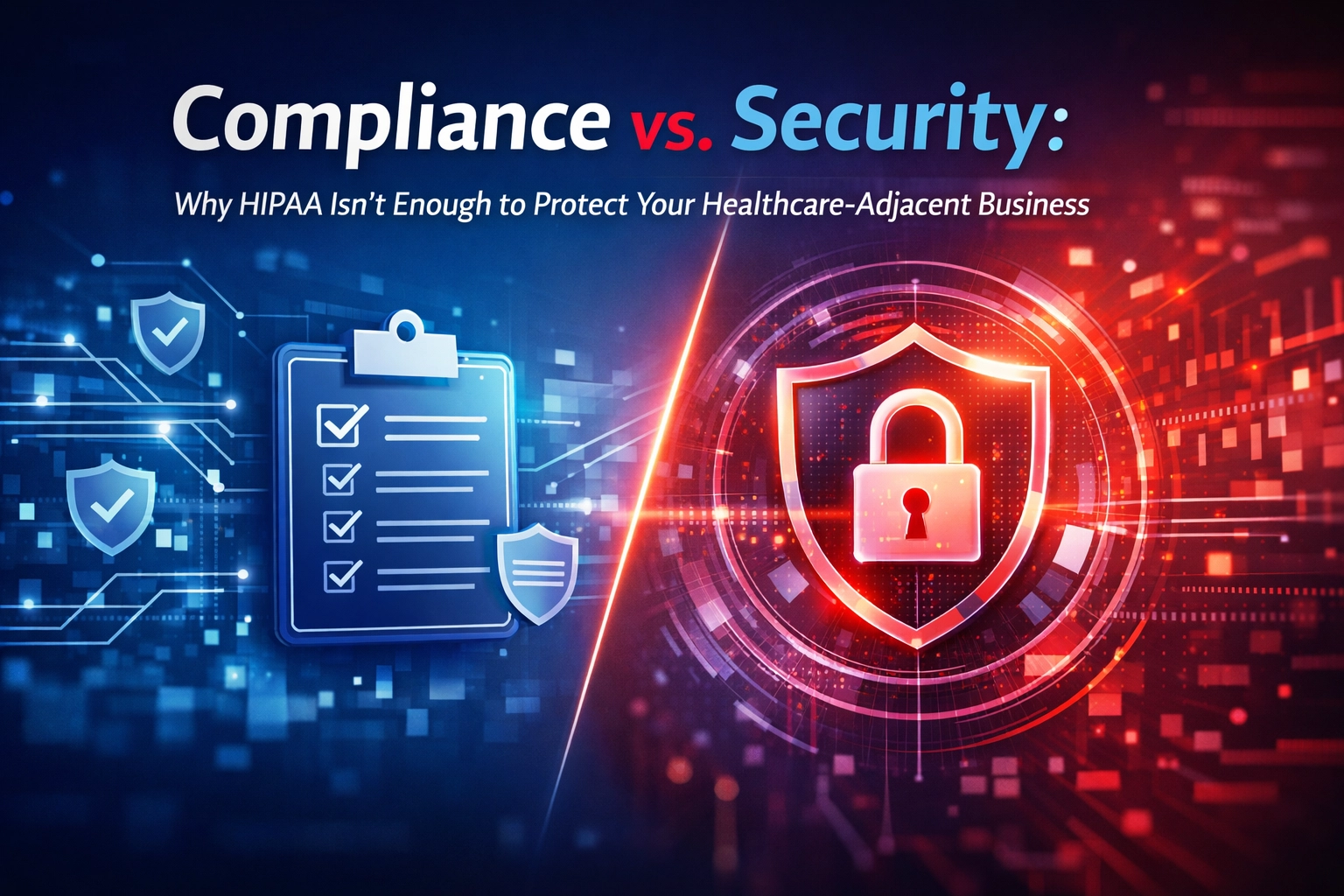
Most healthcare-adjacent businesses believe that passing a HIPAA audit means they are secure. They are not. Compliance documentation proves you have policies. It does not prove those policies stop actual attacks.
The Dangerous Gap Between Checking Boxes and Stopping Breaches
HIPAA establishes minimum standards for handling protected health information. These standards require you to document policies, train staff, and conduct annual risk assessments. What they do not do is guarantee that your systems can detect credential theft, block ransomware, or prevent unauthorized access in real time.
Compliance is about meeting regulatory requirements. Security is about reducing the likelihood and impact of an actual breach. These are related but not the same thing.
When a patient record is exposed, your audit documentation will not protect your reputation. The headline will not read "Clinic Had Compliant Policies." It will read "Patient Data Exposed." The business impact is the same whether your checklist was complete or not.

Why Healthcare-Adjacent Businesses Are Targeted
Clinics, laboratories, diagnostic centers, and specialty care providers hold high-value data. Patient records include names, dates of birth, Social Security numbers, insurance details, and medical histories. This information is worth more on criminal marketplaces than credit card numbers.
Attackers know that many healthcare-adjacent businesses operate with limited IT resources. They also know that these organizations must maintain access to patient data around the clock. Downtime is not an option. This creates leverage for ransomware actors who can demand payment in exchange for restoring access to critical systems.
Your business is attractive to attackers because patient data is valuable and your operational pressure is high. HIPAA compliance does not change that equation.
What HIPAA Compliance Actually Requires
HIPAA mandates specific administrative, physical, and technical safeguards. Organizations must:
- Conduct regular risk assessments to identify vulnerabilities
- Implement access controls to limit who can view patient data
- Encrypt data in transit and at rest
- Maintain audit logs of system activity
- Train employees on privacy and security policies
- Establish business associate agreements with vendors who handle patient information
These are necessary steps. But they are baseline requirements, not comprehensive security measures.
Passing an audit means your documentation is in order. It does not mean your systems are actively monitored for threats. It does not mean unauthorized access attempts are blocked in real time. It does not mean your backup systems are tested and functional.
Where Compliance Falls Short
Compliance frameworks are built on policy and procedure. Security is built on detection, response, and resilience.
Consider a common scenario. Your organization completes its annual risk assessment. Policies are reviewed. Staff complete training modules. Business associate agreements are signed. Your compliance documentation is current.
Then an employee's credentials are stolen through a phishing email. The attacker logs in using legitimate credentials. They move laterally through your network, accessing patient records over several weeks. Your audit logs record the activity, but no one is monitoring them. By the time the breach is discovered, thousands of patient records have been exposed.
Your HIPAA documentation was compliant. Your security was not sufficient.

Modern Threats That Compliance Does Not Address
Healthcare cybersecurity threats have evolved beyond what traditional compliance frameworks were designed to handle.
Credential-based attacks are now the most common entry point. Attackers do not need to break through firewalls. They log in using stolen usernames and passwords. These attacks appear as normal user activity, making them difficult to detect without monitoring tools that analyze behavior patterns.
Ransomware actors specifically target healthcare organizations because operational disruption creates immediate pressure to pay. They encrypt patient data and backup systems simultaneously, knowing that healthcare providers cannot afford extended downtime.
Business associate vulnerabilities create exposure through your vendor network. Your billing software provider, electronic health record vendor, or cloud storage service may have weaker security than your organization. If they are breached, your patient data is compromised even if your internal systems were never touched.
AI-enabled attacks are accelerating the pace and sophistication of phishing campaigns. Attackers use generative AI to create convincing emails that mimic legitimate communications from colleagues, vendors, or patients. These messages are difficult to distinguish from real correspondence.
Your compliance checklist was not built to address these threats. It was built to establish baseline safeguards in an earlier threat environment.
What Healthcare-Adjacent Business Leaders Should Be Asking
Compliance is a floor, not a ceiling. Business leaders responsible for patient data protection should be asking questions that go beyond audit requirements.
About Monitoring and Detection:
- Who is actively monitoring our systems for unusual access patterns?
- How quickly would we detect if credentials were compromised?
- Do we have visibility into after-hours system access?
- Are we alerted when someone attempts to access data they do not normally use?
About Response and Recovery:
- If ransomware encrypted our patient data today, how long would restoration take?
- Are our backups isolated from the network and tested regularly?
- Do we have a documented incident response plan that goes beyond compliance requirements?
- Have we tested that plan under realistic conditions?
About Vendor Risk:
- Do we know the security posture of every vendor who touches patient data?
- Are we relying on signed agreements or actual security validation?
- What happens if a business associate is breached and our patient data is exposed through their systems?
About Access Control:
- Is multi-factor authentication required for all systems that contain patient data?
- Do we enforce principle of least privilege, or can users access more data than their role requires?
- Are administrative credentials managed separately from standard user accounts?
These questions address operational security, not compliance documentation. They focus on reducing the likelihood of breach and minimizing damage if one occurs.
The Business Impact of Inadequate Security
The consequences of a breach extend beyond regulatory penalties.
Reputation damage is immediate and lasting. Patients trust you with their most sensitive information. A breach erodes that trust. Competitors may gain advantage. Referral relationships may weaken. New patient acquisition becomes harder.
Operational disruption can be severe. If ransomware locks your systems, patient care is affected. Appointments must be rescheduled. Procedures may be delayed. Staff productivity drops. Revenue stops.
Legal and financial exposure multiplies. HIPAA violations carry penalties. State breach notification laws impose requirements. Affected patients may file lawsuits. Cyber insurance may not cover all costs, particularly if security measures were insufficient.
Regulatory scrutiny increases after a breach. Expect audits, investigations, and oversight that continue long after the incident. Your organization will operate under heightened regulatory attention for years.
These are business risks, not IT risks. They affect revenue, operations, and leadership accountability. Compliance documentation does not reduce them.
Why Healthcare IT Support Must Go Beyond Compliance
Healthcare-adjacent businesses need partners who understand the difference between meeting regulatory requirements and maintaining actual security.
This is where healthcare IT support focused on cybersecurity and business IT services becomes critical. The right partner does not simply help you pass audits. They help you reduce risk.
That means continuous monitoring for threats, not annual reviews. It means testing backup systems under realistic conditions, not assuming they will work when needed. It means vetting vendor security through validation, not documentation. It means implementing layered defenses that assume credentials will be compromised and limit what attackers can do once inside.
This is why businesses work with partners like CMIT Solutions. The focus is on operational security that protects patient data and business continuity. Compliance follows from security. Security does not follow from compliance.

Moving Forward
HIPAA compliance is mandatory. It is also insufficient.
If your organization treats compliance as the goal rather than the starting point, you are operating with more risk than necessary. Patient data deserves better protection. Your reputation deserves better protection. Your business deserves better protection.
The gap between compliance and security is where breaches occur. Closing that gap requires ongoing effort, monitoring, and partnership with experts who understand both healthcare requirements and modern cybersecurity threats.
This is worth addressing before it becomes urgent. If this is something you want to understand better, start with a conversation about what adequate security actually looks like for your organization.