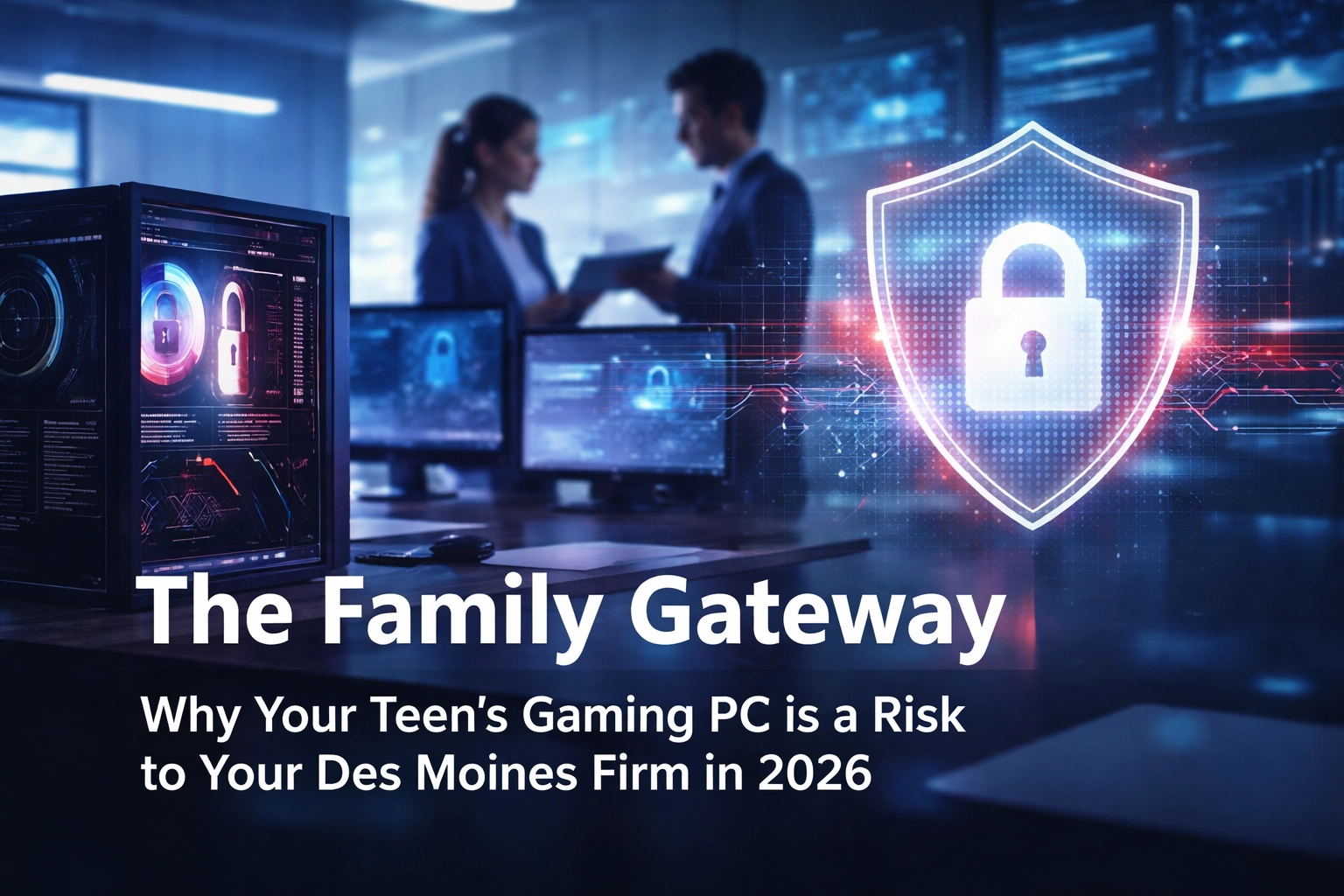
You drive home to Glen Oaks after a long day. You walk through the door. Your teenager is upstairs, headset on, deep in an online game.
Normal evening. Normal family.
What you do not see is the attack surface.
That gaming PC is connected to the same network you use for work emails. The same network where you access client files. The same network where your business lives after hours.
Most Des Moines executives assume the risk stops at the office door. It does not.
The Blind Spot No One Talks About
Business owners in Waukee, Ankeny, and across the metro spend significant money protecting their offices. Firewalls. Endpoint detection. Managed IT.
Then they go home and connect to a network shared with:
- A teenager downloading game mods from unverified sources
- A spouse streaming on an outdated tablet
- Smart home devices with firmware that has not been updated in years
This is the family gateway. And in 2026, it is the most overlooked vulnerability in executive cybersecurity.
Attackers know this. They are not trying to break through your office firewall. They are looking for the easier path. Your home network is that path.

Why Gaming PCs Are a Prime Target
A gaming PC is not just a toy. It is a high-performance machine with elevated permissions, constant internet connectivity, and a user who prioritizes speed over security.
Here is what makes it dangerous:
Unvetted software. Game mods, cheat tools, and cracked software often carry hidden malware. Your teenager downloads what looks like a texture pack. It contains a keylogger.
Always online. Gaming PCs are designed to stay connected. That persistence gives attackers more time to probe, exploit, and establish footholds.
No corporate oversight. Your office devices have monitoring. Your home devices do not. There is no logging. No alerts. No visibility.
Shared network access. The gaming PC and your work laptop share the same router. Once an attacker compromises one device, lateral movement becomes possible.
In 2026, AI-powered phishing attacks are nearly indistinguishable from legitimate messages. Your teenager might receive a Discord message that looks like it came from a friend. It did not. One click, and the compromise begins.
The Business Impact You Cannot Ignore
This is not about your teenager getting a virus. This is about your business.
When an attacker gains access through a home device, they can:
- Harvest credentials stored in browsers or password managers
- Monitor keystrokes when you log into business systems
- Pivot to your work laptop through the shared network
- Access cloud applications using stolen session tokens
- Deploy ransomware that spreads to connected devices and network shares
The cost is not theoretical. Operational disruption from ransomware costs thousands of dollars per minute. A single breach can expose client data, trigger compliance violations, and damage the reputation you have spent years building.
You are accountable for that outcome. Even if the entry point was a game mod your kid downloaded last Tuesday.
Shadow IT Has Moved Into Your Living Room
There is a term in cybersecurity called shadow IT. It refers to technology used without official oversight or approval.
In 2026, shadow IT is no longer just about employees using unapproved apps at the office. It is about the entire ecosystem of devices in your home that touch your work life.
Personal tablets where you check email. Gaming PCs on the same network. Smart speakers always listening. IoT devices with weak firmware and default passwords.
None of these are managed. None of these are monitored. All of them are potential entry points.
AI tools have made this worse. Your family members may use generative AI applications on personal devices, unknowingly processing sensitive information without any corporate logging or governance. The data you assumed was private is now training someone else’s model.
What Executives Should Be Thinking About
You do not need to become a cybersecurity expert. You need to ask the right questions.
Network segmentation. Is your home network configured to keep work devices separate from personal and IoT devices? Most consumer routers do not do this by default.
Device hygiene. Are all devices in your home running current operating systems with up-to-date patches? That includes the gaming PC, the tablets, and the smart TV.
Credential isolation. Are you using the same passwords across personal and business accounts? Are your family members?
Visibility. Do you have any way to know if a device on your home network has been compromised? Most executives do not.
AI governance. Are family members using AI tools on shared devices or networks? What data might be exposed through those interactions?
These are not technical questions. They are risk questions. And they deserve answers.
The Whole Picture Matters
Traditional business IT support services focus on the office. They secure your endpoints at work. They monitor your servers. They manage your cloud applications.
But they stop at the parking lot.
Your risk does not stop there.
An executive cyber concierge approach looks at the whole picture. It considers where you actually work, which in 2026 includes your home office, your phone, and every network you connect to.
This is not about installing antivirus on your teenager’s gaming PC. It is about understanding the full attack surface and making informed decisions about how to protect it.
Des Moines business owners are pragmatic. You understand that risk management is not about eliminating every threat. It is about knowing where the threats are and addressing the ones that matter most.
Your home network matters. Your family’s devices matter. The commute from Ankeny where you check email on your phone matters.
A Different Kind of Partnership
This is why businesses work with partners like CMIT Solutions.
Not just for office IT. For the complete picture.
An executive cyber concierge service extends protection beyond the office walls. It provides visibility into home network risks. It offers guidance on securing the devices your family uses. It helps you understand where AI and modern threats intersect with your daily life.
This is not about fear. It is about clarity.
When you know where the risks are, you can make better decisions. When you have a partner who understands the whole picture, you are not guessing.
Start With a Conversation
If this is something you have been thinking about, you are not alone. Business owners across Des Moines are realizing that cybersecurity in 2026 extends far beyond the office.
The gaming PC upstairs is not the enemy. Lack of visibility is.
This is worth addressing before it becomes urgent. Start with a conversation about what executive cyber concierge services look like for your situation. No pressure. Just clarity.
Your family is your priority. So is your business. Protecting both starts with understanding where they intersect.