

For decades, the standard approach to IT support followed a simple pattern. Something breaks, a business calls for help, and a technician arrives to fix it. This break fix model worked reasonably well when technology played a smaller role in daily operations, but it has become increasingly costly and disruptive in a business environment that depends on systems running continuously.
Predictive IT monitoring has emerged as the replacement, shifting the entire relationship between businesses and their technology from reactive to proactive. Instead of waiting for something to fail, predictive monitoring identifies warning signs early, often resolving issues before anyone in the business even notices a problem. This article explains why this shift is happening, how predictive monitoring actually works, and why so many businesses are moving away from break fix support entirely. Businesses evaluating this shift often start with a comprehensive IT assessment to understand where reactive support has been costing them the most.
What the Break Fix Model Actually Looks Like
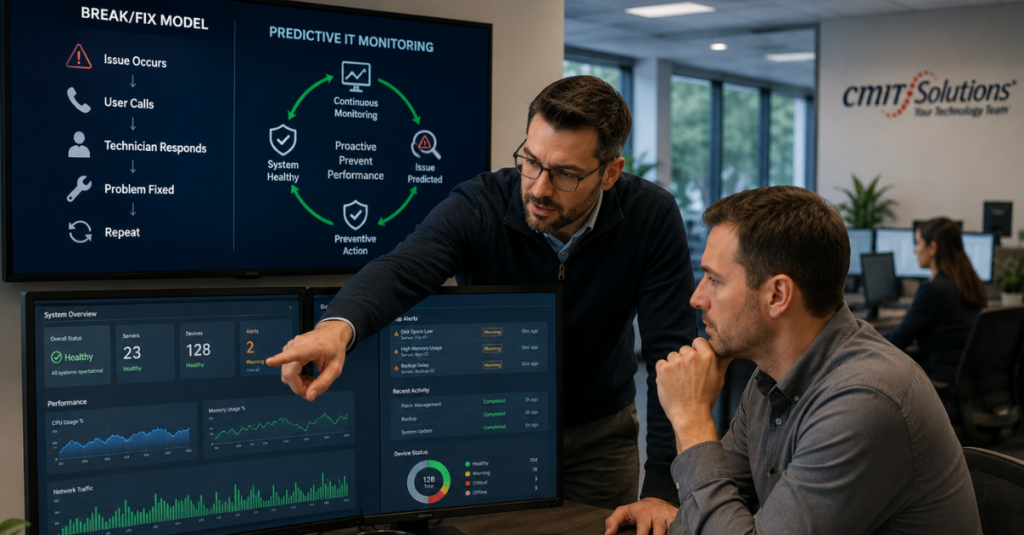
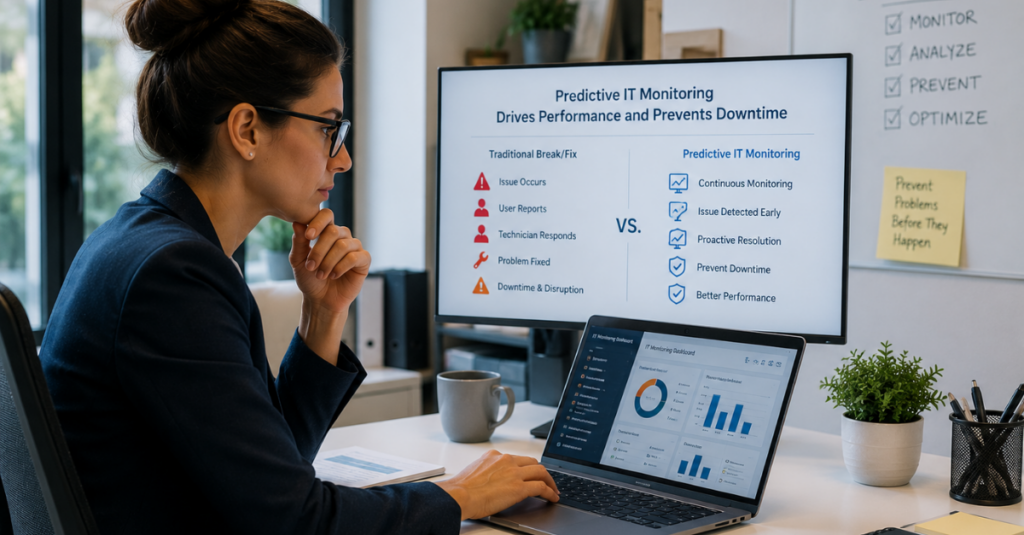
Break fix support operates exactly as the name suggests. A business pays for help only when something goes wrong, with no ongoing monitoring or maintenance in between incidents.
Typical characteristics of this model include:
- No visibility into system health until a failure actually occurs
- Support requested only after a problem has already disrupted operations
- Billing based on time and materials for each individual incident
- No incentive for the support provider to prevent future issues, since revenue depends on problems occurring
This structure creates a fundamental misalignment. The business wants systems to run smoothly, while the support provider is paid specifically when systems do not. This misalignment is one of the core reasons businesses are reconsidering whether break fix support truly serves their long term interests.
Why Break Fix Support Struggles in Modern Business Environments
Technology has become deeply embedded in daily operations, from communication and scheduling to financial systems and customer data. This dependency has made the limitations of break fix support far more costly than they once were.
Key challenges include:
- Unpredictable downtime. Businesses cannot plan around failures that happen without warning.
- Reactive costs add up. Emergency support calls typically cost more than routine maintenance would have cost to prevent the issue entirely.
- No early warning system. Small issues that could have been caught early are allowed to grow into major failures before anyone notices.
- Inconsistent support quality. Since providers are paid per incident, there is little incentive to invest in long term relationship building or strategic planning.
Businesses reconsidering their support model often compare this reactive approach against proactive support benefits, which highlights how much productivity is lost simply waiting for problems to be identified under a break fix arrangement.
What Predictive IT Monitoring Actually Does
Predictive IT monitoring uses continuous data collection and analysis to identify potential problems before they cause disruption. Rather than waiting for a failure, monitoring tools track performance patterns and flag anomalies that typically precede a breakdown.
Core capabilities include:
- Continuous system monitoring across servers, workstations, networks, and cloud environments
- Pattern recognition that identifies early warning signs, such as a hard drive showing signs of failure or a server running consistently near capacity
- Automated alerts that notify support teams before an issue affects daily operations
- Historical trend analysis that helps predict when hardware or systems are likely to need attention
This approach fundamentally changes the relationship between a business and its IT support, shifting from emergency response to ongoing partnership. The broader shift is explored in smarter IT automation, which explains how automated monitoring has become a central part of modern IT strategy rather than an optional add on.
How Predictive Monitoring Catches Problems Before They Happen
The real value of predictive monitoring lies in its ability to identify issues while they are still minor, well before they escalate into something that disrupts business operations.
Examples of what predictive monitoring can catch early include:
- A server’s performance gradually degrading over several weeks, indicating an approaching hardware failure
- Storage capacity steadily climbing toward its limit, allowing time to plan an upgrade before running out of space
- Network traffic patterns suggesting a device is malfunctioning or improperly configured
- Security related anomalies that may indicate a developing threat rather than an active breach
This early detection capability overlaps significantly with modern security practices, since many of the same monitoring principles used in AI driven protection also apply to general system health monitoring, creating efficiencies when both are managed through the same platform.
The Financial Case for Predictive Monitoring Over Break Fix
Cost comparisons between the two models often surprise business owners who assume break fix support is the more affordable option simply because there is no ongoing subscription fee.
Break fix support typically involves:
- Higher individual repair costs due to emergency response requirements
- Unplanned downtime costs that are difficult to predict or budget for
- No investment in long term system health, meaning the same types of failures tend to repeat
- Higher long term hardware replacement costs due to issues being caught only after significant damage has occurred
Predictive monitoring typically involves:
- A predictable monthly cost that covers ongoing oversight
- Reduced emergency repair costs, since many issues are caught and resolved before they escalate
- Extended hardware lifespan through early identification of developing problems
- Fewer disruptions to daily operations, protecting productivity across the entire team
This comparison is explored further in managed IT costs, which breaks down why many business owners are surprised at how much more cost effective proactive support turns out to be over time.
How Predictive Monitoring Supports Business Continuity
Predictive monitoring plays a direct role in reducing the kind of unexpected disruptions that traditional continuity planning has always tried to prepare for. Catching a problem before it causes an outage is far more effective than simply having a recovery plan ready for after the outage occurs.
Key continuity benefits include:
- Reduced likelihood of unexpected system failures disrupting operations
- Early warning for hardware nearing end of life, allowing planned replacement rather than emergency response
- Better data supporting strategic IT guidance around when and how to upgrade systems
- Stronger overall reliability across network management solutions that support daily operations
This proactive layer complements broader continuity efforts, ensuring businesses are not just prepared to recover from an incident, but are actively working to prevent many incidents from occurring in the first place.
Predictive Monitoring and Cybersecurity Overlap
While predictive monitoring is often associated with hardware and performance, it plays an increasingly important role in cybersecurity as well. Many of the same tools that track system health also identify behavioral patterns associated with developing security threats.
This overlap includes:
- Monitoring for unusual login patterns that may indicate compromised credentials
- Identifying abnormal data transfer volumes that could suggest unauthorized access
- Flagging unexpected software installations or configuration changes across devices
- Supporting broader cybersecurity protection services by providing early visibility into anomalies before they escalate into confirmed incidents
Because predictive monitoring and modern security monitoring rely on similar underlying technology, many businesses find it efficient to manage both through a single, integrated platform rather than separate systems that do not communicate with each other.
Cloud Environments and Predictive Monitoring
As more businesses shift operations to the cloud, predictive monitoring has expanded to cover cloud infrastructure alongside traditional on premise systems. This ensures visibility does not stop at the edge of the physical office.
Cloud specific monitoring benefits include:
- Tracking performance and usage patterns across secure cloud services to identify inefficiencies or emerging issues
- Monitoring for unusual access patterns across cloud based applications and storage
- Identifying capacity trends that inform decisions about scaling resources up or down
- Supporting smoother transitions during ongoing cloud migration trends by catching configuration issues early in the process
This extended visibility ensures businesses maintain the same level of oversight across hybrid environments that combine on premise and cloud based systems, rather than losing visibility the moment workloads move off site.
What a Modern Managed IT Relationship Looks Like
Predictive monitoring is typically delivered as part of a broader managed IT relationship, replacing the transactional nature of break fix support with an ongoing partnership focused on prevention and long term planning.
A modern managed relationship typically includes:
- Continuous monitoring across all connected systems and devices
- Regular reporting that gives business owners visibility into system health trends
- Scheduled maintenance planned around actual data rather than guesswork
- Strategic planning conversations tied to business growth, not just immediate technical fixes
- Support for IT procurement services that ensures new equipment purchases align with long term monitoring and support needs
This shift transforms the IT relationship from something businesses only think about during a crisis into an ongoing part of overall business strategy.
Common Concerns About Moving Away From Break Fix Support
Some business owners hesitate to move away from break fix support, often due to misconceptions about cost or complexity. Addressing these concerns directly helps clarify why the transition is usually worthwhile.
- “It seems more expensive upfront.” While there is a predictable monthly cost, it typically ends up lower than the cumulative cost of emergency repairs and downtime over the same period.
- “We don’t have major IT problems right now.” Predictive monitoring is most valuable precisely because it prevents problems from developing in the first place, rather than waiting until they become obvious.
- “We already have someone we call when something breaks.” Reactive relationships rarely include the ongoing data analysis that predictive monitoring provides, meaning small issues are often missed entirely until they become larger ones.
Reviewing available service package options helps business owners see exactly what predictive monitoring includes compared to a traditional reactive arrangement, making the comparison much clearer.
Why This Shift Is Accelerating Now
Several factors are accelerating the shift away from break fix support and toward predictive monitoring across small and mid sized businesses.
- Growing dependency on technology across every part of daily operations
- Increasing awareness of how costly unplanned downtime actually is
- Wider availability of monitoring tools that were once only accessible to large enterprises
- Rising cyber threats that make early detection more valuable than ever before
This broader shift is part of a larger trend discussed in IT upgrade trends, which highlights how businesses across nearly every industry are rethinking their approach to technology support and planning.
How CMIT Solutions of Plano & Garland Supports This Transition
CMIT Solutions of Plano & Garland helps local businesses move away from reactive, break fix support toward a predictive monitoring model built around prevention rather than emergency response.
Support typically includes:
- A full comprehensive IT assessment to understand current system health and identify existing risk
- Ongoing monitoring through dedicated network management solutions covering both on premise and cloud environments
- An AI readiness evaluation for businesses interested in incorporating automation into their monitoring strategy
- Strategic planning support tied to strategic IT guidance rather than reactive, one off fixes
- Access to additional IT resources and helpful IT tools for businesses evaluating their current support model
- Insight from client success stories involving other local businesses that have made this transition
- Educational webinar sessions covering predictive monitoring in clear, practical terms
Conclusion
The traditional break fix model was built for a time when technology played a smaller, more isolated role in daily business operations. That time has passed. Businesses today depend on their systems running continuously, which makes waiting for something to fail before addressing it an increasingly costly and unnecessary risk. Predictive IT monitoring replaces this outdated approach with continuous visibility, early detection, and a genuine partnership focused on preventing disruption rather than simply responding to it after the fact.
Frequently Asked Questions